Haplogroup R1a1a1b1a1a1c1l

– 5 min read


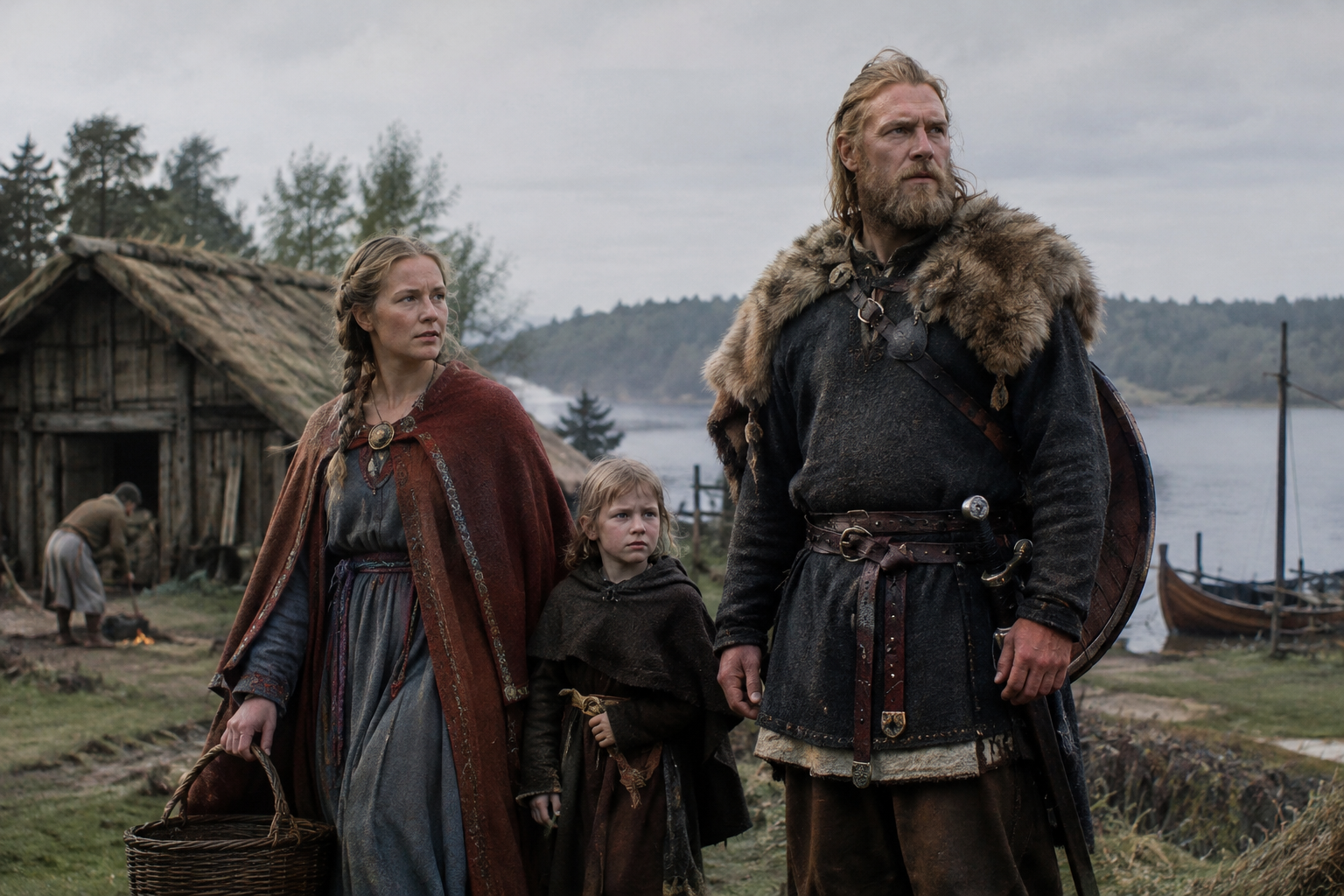
At Varnhem near Skara in western Sweden, archaeologists have been able to do something historians usually only dream about: put a genetic signature onto a man who lived in the Viking Age and the early Christian centuries that followed it. One of the ancient individuals from this setting, sample VK309, is dated to around AD 1050 and is associated here with the Y-DNA haplogroup R1a1a1b1a1a1c1l.
That is a very narrow paternal label, and it matters because Y-DNA traces only one line of descent: father to son, across many generations. It does not describe a whole person's ancestry, language, or identity. But in a place like Varnhem, where Viking Age and early medieval Scandinavia meet in the archaeology, even one well-placed paternal lineage can open a useful historical question: what kinds of male lines were present in Christianizing Sweden at the end of the Viking Age, and how do they fit into the wider story of Scandinavian movement around the Baltic and beyond?
Varnhem is not some obscure dot on a map. It sits in Vastergotland, one of the key regions of early medieval Sweden, close to Skara, one of the country's oldest ecclesiastical centres. By about AD 1050, this was a landscape in transition. Older Scandinavian traditions had not vanished, but Christianity, church institutions, and new burial customs were increasingly shaping daily life and the treatment of the dead.
That makes VK309 especially interesting. He belongs not to the heroic fog of saga, but to a real burial population from a real Swedish region at the moment when the Viking world was becoming medieval. In public imagination, Viking Age men are often flattened into a stereotype, as if they all belonged to one people and one paternal stock. Ancient DNA keeps spoiling that simplicity, which is one of its chief pleasures.
The haplogroup name here is extremely specific, much more specific than the broad label R1a that many readers will recognize. That distinction is crucial. Broad R1a lineages have a long and complicated history across Eurasia, appearing in many regions and periods. It would be careless to pour all of that vast story straight into the much narrower branch R1a1a1b1a1a1c1l without direct evidence.
What can be said more safely is that a paternal line within the wider R1a family was present in this Viking Age Swedish individual. In Scandinavian contexts, lineages from the wider R1a cluster often attract attention because they can appear in populations linked with eastern Baltic and eastern European contacts as well as within Scandinavia itself. That does not make VK309 a foreigner, a trader, a warrior, or a dynast. It simply places his direct male line inside one of the paternal branches that formed part of the human mixture of the Viking world.
An ancient DNA study examining Viking Age populations, available as research on the genomics of the Viking world, helped establish just how varied that world was. The broad lesson is not that every burial maps neatly onto a known migration route, but that Viking Age Scandinavia was genetically diverse and deeply connected to surrounding regions.
The date attached to VK309 matters almost as much as the haplogroup. Around AD 1050 is late for the classic Viking Age. This is a period when raiding still loomed large in later memory, but the archaeological reality in Sweden also includes churches, mission activity, reorganized cemeteries, and stronger royal and ecclesiastical frameworks. A lineage found here is therefore part of a society already changing its institutions and its ideas about community.
That is one reason Varnhem has drawn such interest. Sites in this zone can illuminate how older Scandinavian populations were carried into a Christian future rather than simply replaced by it. The men buried in these cemeteries were not standing outside history as "Vikings" in costume; they were participants in the making of medieval Sweden.
From the standpoint of paternal ancestry, VK309 suggests that the branch represented by R1a1a1b1a1a1c1l had reached, or persisted in, inland western Sweden by this time. Whether that line had been local there for many generations or arrived through more recent movement is a different question, and one a single grave cannot settle on its own.
Post-Viking Christian Scandinavia
It is tempting to think that one sample is too little to be meaningful. Archaeology, however, often advances by precisely this sort of stubbornly limited evidence. A single securely dated individual from an important region can anchor larger patterns, especially when compared with other Scandinavian burials and with broader genomic studies.
In this case, the importance of VK309 is not that he proves a sweeping theory all by himself. It is that he gives this particular paternal branch a documented place in Viking Age Sweden. That is already valuable. Haplogroup articles can easily drift into grand migration epics unsupported by the actual evidence; the more responsible approach is to start from the grave in front of us.
And the grave in front of us belongs to a man living in a region central to early Swedish political and religious development. Skara and its surrounding countryside were not peripheral. They were part of the heartland in which local power, church organization, and regional identity were taking durable medieval form.
Because this sample comes from Sweden in the Viking Age, it naturally sits beside the history of North Germanic speech communities and the movement of people around the North Sea and Baltic. But genetics and language do not line up like railway tracks. A Y-chromosome lineage is not a language family. Men carrying different paternal lines could speak the same language, and men from the same paternal line could, over time, end up in different linguistic worlds.
Still, ancient genomics has helped show that the spread and development of Germanic-speaking populations cannot be reduced to a single biological profile. That larger point is useful here. VK309's lineage contributes to a picture of Scandinavian society as layered and mixed, not biologically uniform.
For readers interested specifically in Swedish contexts, it is worth placing Varnhem beside other medieval and Viking-period Scandinavian cemeteries where DNA is reshaping old assumptions about kinship, mobility, and burial practice. The pattern across the region is not one of perfect isolation. It is one of continuity mixed with contact.
Medieval Swedish graves and kinship
If your paternal line falls under R1a1a1b1a1a1c1l, VK309 offers something modest but solid: a documented appearance of this branch in Viking Age Sweden, in the Skara-Varnhem region, around AD 1050. That does not make every modern carrier "a Viking" in any simple sense, nor does it create an instant bridge to a named family or dynasty. What it does provide is a historically grounded point on the map: this paternal line, or a line reported as belonging to this branch, was present in a major Scandinavian setting during a pivotal moment of social change.
That is often how the best ancient DNA evidence works. Not with a trumpet blast, but with a burial, a date, a place, and a lineage that lets the past become just a little less anonymous.






Comments