Haplogroup R1a1a1b1a1a1a2

– 6 min read


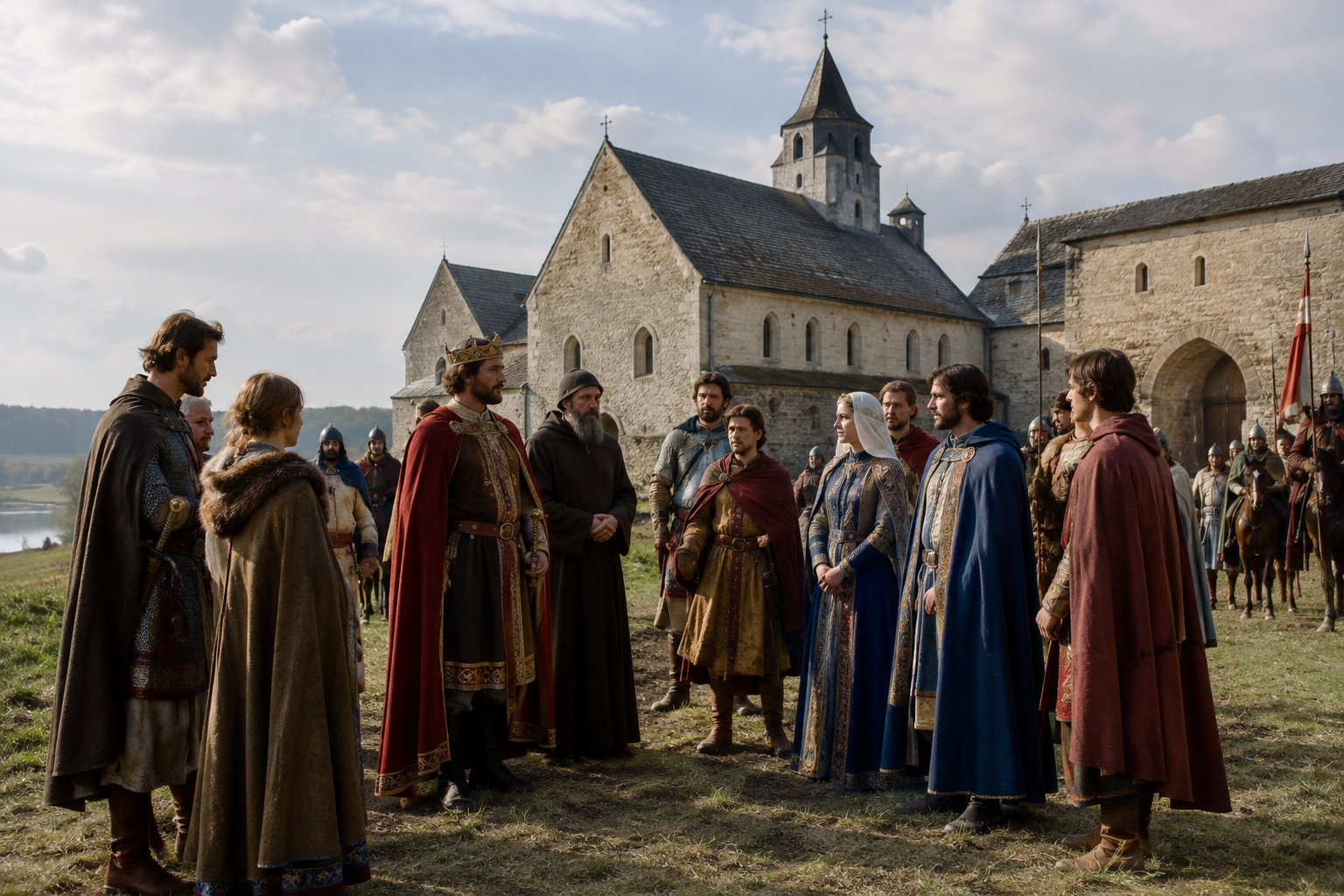
Some Y-DNA branches become interesting not because they are everywhere in the record, but because when they do appear, they turn up in places that make historians sit up. Haplogroup R1a1a1b1a1a1a2 is one of those lineages. It belongs to the wider R1a family, a major paternal branch with deep importance across Eurasia, but this very specific subclade is best approached carefully: not as a label for a people, kingdom, or dynasty, but as a narrow paternal signature that appears in a set of medieval and late antique contexts stretching across parts of Central and Eastern Europe.
That is where Y-DNA is so useful, and also where it is often misunderstood. A Y-DNA haplogroup traces one direct paternal line only: father to father to father. It does not describe a person's whole ancestry, culture, language, or identity. Yet even that single thread can be remarkably revealing. In the case of R1a1a1b1a1a1a2, the supplied ancient DNA points us toward a story of continuity and mobility from Croatia to Hungary and, most strikingly, into the medieval Polish world of Piast-era strongholds and noble memory.
This haplogroup sits within the broad R1a tree, a paternal lineage often associated in general terms with parts of Eastern Europe, Central Europe, and regions farther east across Eurasia. That broad picture is well established. What is much harder, and much more important, is not to lazily pour the whole history of R1a into one narrow downstream branch. A subclade like R1a1a1b1a1a1a2 has its own more limited historical visibility.
The evidence supplied here suggests a notable medieval and late antique footprint around the lands linking the Carpathian Basin, the Balkans, and Poland. That does not prove a single migration event or one neatly bounded ethnic community. Medieval Europe was not a museum display case with tidy labels. It was full of overlapping populations, dynastic movements, military retinues, frontier settlements, and local continuities. A paternal lineage could persist in one district for centuries, or travel with a family, war band, or elite network into another.
For that reason, it is safest to speak of historical settings rather than fixed ethnic ownership. In this case, those settings include post-Roman Croatia, early medieval Dalmatia, Piast Poland, and later medieval Hungary.
The archaeological samples are where this story becomes especially vivid. One of the earliest is I26748, from Visigoth/Ostrogoth Era Croatia Sisak Pogorelec Sisak, dated to 400 AD. Sisak, ancient Siscia, stood in a region shaped by the breakup of Roman authority and the movement of Gothic and other post-Roman groups. It would be rash to claim that one Y-line proves a Gothic identity. But the sample matters because it shows this paternal branch, or a closely relevant assignment in this context, present in a major late antique crossroads of the Balkans.
Another Croatian sample, VEM054, from Early Medieval Croatia Velim-Velistak, dated to 750 AD, brings the story forward into the early medieval Adriatic hinterland. Again, one should resist turning haplogroups into tribal badges. But the appearance of this lineage in both late antique and early medieval Croatian settings is a useful reminder that paternal lines can persist through periods of enormous political change, even while identities, rulers, and burial customs shift around them.
Then the evidence moves north into medieval Poland, and here the concentration becomes hard to ignore. Several samples come from Santok in the Lubusz Province Gorzw Wielkopolski region: PCA0502, PCA0510, PCA0513, PCA0517, and PCA0380, all dated to 1100 AD. Santok was no sleepy backwater. In the Piast period it occupied a strategic frontier position, a place of defense, administration, and contact. If one wanted a location to study how paternal lineages operated within a growing medieval polity, Santok would do very nicely.
The same pattern appears elsewhere in Piast Poland. PCA0533 and PCA0557 come from Medieval Piast Era Poland Silesia Milicz, again dated to 1100 AD. PCA0309 is from Medieval Poland Konskie Sub Carpathia, also 1100 AD. And there are two especially evocative entries: PCA0661, a Piast Non-Masovian Dynasty Prince dated to 1265 AD, and PCA0251, another Piast Non-Masovian Dynasty Prince dated to 1299 AD.
That cluster does not prove that every Piast ruler, every Polish noble, or every later family in the region belonged to this exact paternal line. But it does place this branch squarely inside the political and aristocratic landscape of medieval Poland. That is exactly the sort of thing ancient DNA can do well: not write a fairy tale of direct descent, but show that a lineage was genuinely present in the right time and place.
If we stand back from the individual burials, a geographical picture starts to emerge. This haplogroup appears in regions tied together by river corridors, frontier politics, and the long, messy development of medieval states. Croatia in late antiquity and the early Middle Ages was a meeting ground of Roman inheritance, Balkan continuity, and incoming political formations. Poland under the Piasts was consolidating power through fortified centers, princely authority, and control of strategic zones such as Santok.
There is also a Hungarian thread. The sample HUAS194B, from the Hungarian Royal House of Aba Abasar Bolt-teto Benedictine Monastary 194, dated to 1405 AD, adds a later medieval elite context from the Carpathian Basin. One should be precise here: a shared haplogroup context between a Hungarian elite burial and Polish dynastic or noble settings is not proof of close genealogical kinship. But it does show that this paternal branch belonged to the kind of lineages that could be found in aristocratic and politically significant circles across the broader region.
That matters because medieval Europe was built from such networks. Monasteries, border strongholds, princely courts, and landed estates all participated in the movement of families and the persistence of male lines. Written genealogy can tell us who inherited what and who married whom, at least when records survive. Ancient DNA adds something different: it reveals that beneath the chronicles and charters there were durable paternal continuities crossing centuries of upheaval.
Read About Ancient Croatia DNA
This is where the House Skarzynski enters the story, not as a proven genetic endpoint, but as a historical echo of the same Polish world in which several of these medieval samples appear. Manor Skarzynski belongs to the long tradition of the szlachta, the Polish nobility whose estates were as much repositories of memory as they were residences. Such manors were local centers of farming authority, family identity, and social standing.
The supplied history is telling. The Skarzynski seat reflects the wider fate of many country estates in the old Polish-Lithuanian Commonwealth and its successor lands: prosperity, adaptation, pressure under foreign rule after the partitions of Poland, the shocks of the nineteenth century, the devastation of the First World War, and the profound social and political transformations after the Second World War. In other words, the manor stands in a landscape where family continuity mattered deeply, even when states rose and fell around it.
There is an important distinction to keep in view. A noble family associated with this haplogroup in community tradition or reporting is not thereby genetically proven in every branch, nor does a manor house itself prove paternal descent. But historically the link is still worth dwelling on. The same lands that produced Piast-era samples such as PCA0502 or PCA0661 later produced the manor culture of noble Poland. Genetics and architecture are doing different jobs here, yet together they illuminate a shared regional history.
The manor, then, is not merely a house. It is a surviving sign of how paternal lines, kin memory, property, and regional identity were bound together in Polish history. Ancient DNA gives us glimpses of the men buried in princely and frontier settings. The manor reminds us what those long continuities looked like when they became social institutions.
Explore the House of Skarzynski
R1a1a1b1a1a1a2 is historically interesting because it appears, in the evidence supplied here, not in abstraction but in real places: Sisak in the late antique Balkans, Velim-Velistak in early medieval Croatia, Santok and Milicz in Piast Poland, a princely Piast context in the thirteenth century, and an elite monastic burial connected with the House of Aba in medieval Hungary.
That distribution suggests a paternal lineage with meaningful roots in the historical zone between the Balkans, the Carpathian Basin, and Poland. It may reflect a mixture of regional continuity and elite or military mobility over time. What it does not do is prove that all bearers were one family, one ethnicity, or one dynasty. Nor does it make every modern man with this haplogroup a descendant of a Piast prince or a Polish noble house. History is more interesting, and more complicated, than that.
Still, this is the pleasure of ancient DNA. It lets us watch a narrow paternal thread surface in monastery burials, frontier settlements, and dynastic contexts, then set those discoveries against the later world of noble estates such as Manor Skarzynski. The result is not a simple family tree. It is something better: a grounded historical picture of how one paternal lineage moved through the centuries.
If you want to explore the deeper background of the Polish and regional setting around these lineages, the broader discussion in Foreign Founders: Genetic Genealogy of the Medieval Piast Dynasty and Its Links to Other European Royal Houses is well worth your time.
MyTrueAncestry lets you compare your DNA with ancient individuals, archaeological cultures, and historical populations from the very regions discussed here. A match to ancient DNA will not by itself prove direct descent from a prince, a Gothic-era burial, or a noble house. But it can offer a fascinating new angle on where parts of your ancestry fit into the long human story.






Comments