Haplogroup R1a1a1a

– 8 min read


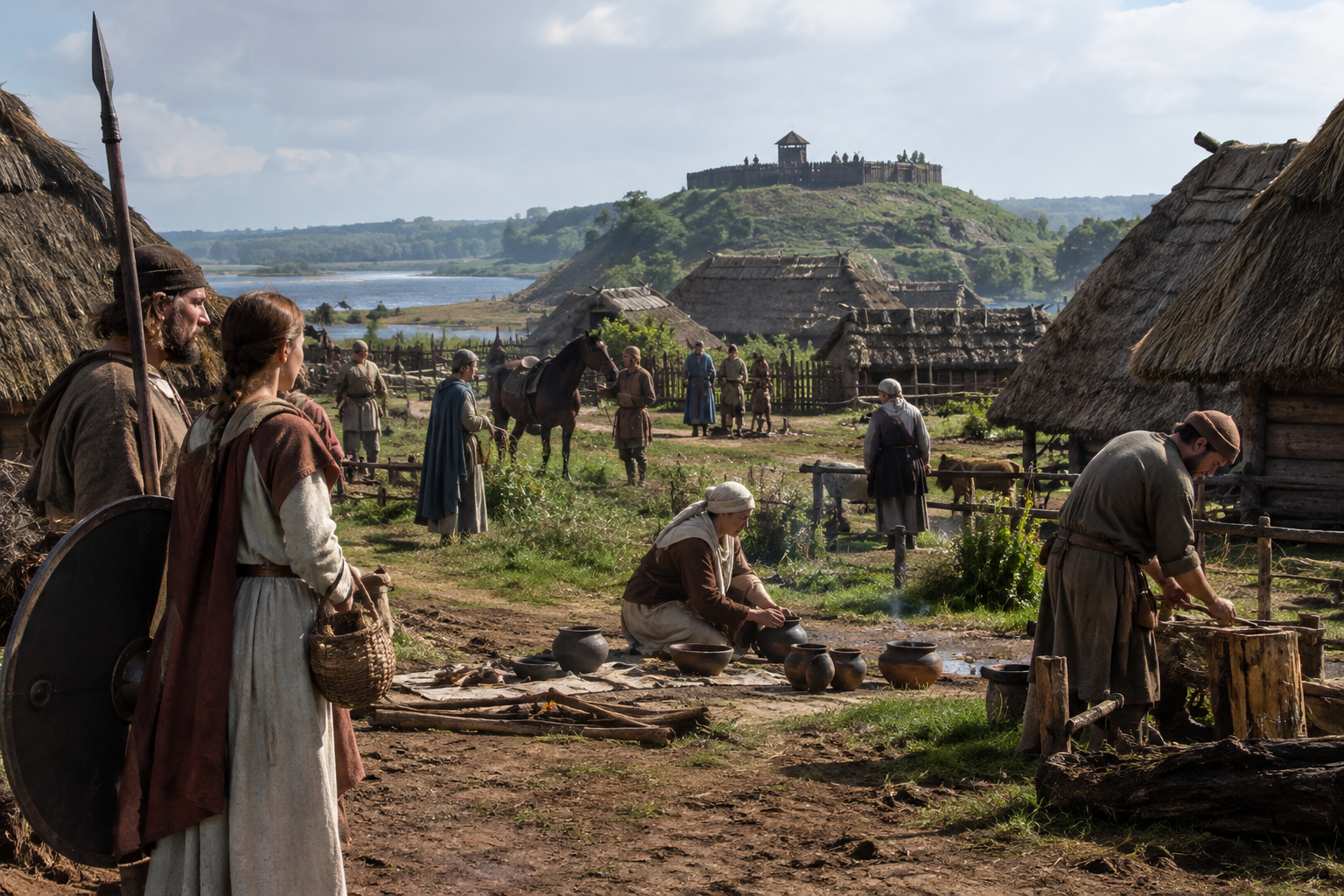
Haplogroup R1a1a1a is one of those Y-chromosome lineages that turns up in exactly the places historians and archaeologists like to argue about: the Eurasian steppe, Bronze Age central Europe, Iron Age war bands, medieval frontier societies, and later noble landscapes of castles and lordship. That does not mean it belonged to one people, one language, or one dynasty. Quite the opposite. Its importance lies in showing how a paternal line can travel through very different worlds while written history changes its labels again and again.
As a Y-DNA lineage, R1a1a1a traces only one narrow line of descent: father to son to son. It is not a summary of a person's whole ancestry, and it is certainly not a shortcut to claiming membership in any ancient tribe or noble house. But in ancient DNA, it is a useful marker. It helps us follow male-line continuity and movement across regions stretching from the North Pontic world to central Europe, the Baltic, Scandinavia, and beyond.
In broad phylogenetic terms, R1a1a1a sits within haplogroup R1a, a major branch often discussed in connection with prehistoric Eurasian movements. For this particular article, caution matters. We should not lazily pour the whole history of all R1a branches into this narrower label. Still, the supplied ancient samples strongly suggest that lineages within or close to this branch were present across an enormous zone from the steppe and forest-steppe into central and northern Europe over a very long period.
Some of the earliest useful anchors come from Copper and Bronze Age contexts associated with Corded Ware and related worlds. Sample I0104, from Corded Ware Esperstedt Germany dated to 2370 BC, and RISE446 from Neolithic Germany Corded Ware Culture Bergrheinfeld dated to 2572 BC, place this paternal signal in the middle of the great reorganization of European populations after steppe-derived ancestry arrived in much of the continent. Add to them I7279 and I7280 from Corded Ware Culture Brandysek Czech dated to 2500 BC, plus PNL002, RDV001, STD001, and the Radovesice axe burials I7207, I7208, and I7209, and one begins to see not a single migrating family but a repeated paternal presence across central Europe.
That matters because it helps explain why later Bronze Age and Iron Age societies in places like Bohemia, Poland, and Germany could carry related male-line signals without requiring a fresh invasion every century. The archaeological cultures changed. The paternal landscape, at least in part, could remain recognizably connected.
Explore North Pontic migrations
The real drama of R1a1a1a appears when we follow it through very different archaeological settings. In Ukraine, sample UKR150 from the Pre-Cimmerian Hillfort Dykyi Sad Mykolaiv Ukraine dated to 1100 BC and UKR170 from Early Iron Age Ukraine Germanic Petrykiv Ternopil dated to 800 BC remind us how unstable ethnic labels can be. What survives in the ground are burials, hillforts, and genetic traces; names like "Germanic" or "Pre-Cimmerian" belong to later scholarly frameworks and should not be mistaken for the individual's own identity.
Then come the steppe elites. UKR083 from the Scythian Hillfort Bilsk Poltava dated to 400 BC, SHI008 from Elite Scythian Saka Iron Age Shilikty East Kazakhstan dated to 750 BC, ESZ004 from Scythian Grave Eleke Sazy East Kazakhstan dated to 550 BC, and DA130 from the Eurasian Steppes Saka Scythian dated to 775 BC show this paternal line in aristocratic and martial settings stretching far into Inner Asia. That is not proof of a single Scythian dynasty carrying one neat haplogroup. But it does support the wider picture that R1a-linked male lines were at home in steppe and steppe-adjacent societies over a vast area.
Central Europe tells a parallel story. LEU008 and LEU033 from Bronze Age Unetice Thuringia Leubingen Sommerda Germany dated to 1950 BC place the lineage in an early Bronze Age society famous for hierarchy and rich burials. WEZ56 from the Bronze Age Germany Tollense Valley Battlefield Mecklenburg-Vorpommern dated to 1250 BC shows it in a context of organized violence. This is one of the virtues of ancient DNA: the same paternal branch appears not in abstract maps, but in actual men buried with the marks of their particular world.
By the Iron Age and early medieval period, R1a1a1a or closely related paternal lines appear in a strikingly mixed political landscape. There is I15049 from the Iron Age Boii Tribe Bohemia Radovesice Litom LaTene dated to 325 BC, and later PCA0002 from Gothic Wielbark Poland Kowalewko Oborniki dated to 200 AD. In Denmark, CGG106525 from Proto-Jute Iron Age Denmark Jutland Sosing dated to 218 BC and CGG019208 and CGG019214 from the Jute Early Roman Era Denmark Jutland Bog War Alken Enge dated to 47 BC and 116 AD carry the story northward.
Later still, samples from Pannonia and post-Roman Hungary - GYS005 from Invader Late Antique Pannonia Arrabona Szechenyi Square Hungary dated to 425 AD, SZL018 from Longobard Period Pannonia Savaria Szeleste Barbaricum Hungary dated to 525 AD, SZL035 from Germanic Post Roman Pannonia Savaria Szeleste Barbaricum Hungary dated to 525 AD, SZL080 from Post Roman Period Szeleste Savaria Pannonia Prima Hungary dated to 525 AD, and RKO004 and RKF265 from Migration Period Hungary Rakoczifalva dated to 650 AD - show how useful this haplogroup can be for tracking mobility in the centuries after Rome.
And then the medieval world proper: the Piast-era burials of Poland, including PCA0187 from Medieval Poland Piast Dynasty Lad dated to 950 AD, PCA0218 from Piast Dynasty Greater Poland Oblaczkowo Lad dated to 1100 AD, PCA0254 from Piast Dynasty Greater Poland Poznan Srodka Lad dated to 1100 AD, and PCA0560 from Medieval Piast Era Poland Silesia Milicz dated to 1100 AD. These are especially interesting because they place a steppe-connected paternal branch firmly inside a Christian medieval kingdom with charters, dynastic memory, and state formation. Ancient DNA does not replace written medieval history here; it complicates it in the best way.
Beyond the ancient and early medieval record, paternal lineages also enter the more documented world of seigneurial families, inherited estates, and named residences. That later evidence belongs to a different historical scale from prehistoric burials and Iron Age hillforts, but it is still part of the long story of how male lines become anchored in particular regions.
One later historical association linked to this haplogroup is the House de Livet, a Norman noble family whose name is rooted in the landscape of Normandy. Families of this kind matter because they show how paternal lineages, whatever their deeper prehistoric background, eventually became woven into the feudal geography of western Europe: local lordship, inherited property, and regional identity expressed through place-names and residences rather than through tribal labels.
In the case of the House de Livet, the interest lies less in grand conquest than in continuity within a specific Norman setting. Normandy was, of course, a region shaped by layers of population movement and political change, from Frankish and Scandinavian influences to the growth of powerful local aristocracies after the medieval consolidation of ducal rule. A family such as de Livet belongs to that later world of landed nobility, where status was preserved in charters, marriages, and estates rather than in the burial archaeology that dominates the earlier history of R1a1a1a.
As always, the genetic point should be handled carefully. An association between a noble house and a Y-DNA haplogroup does not mean that every historical member of the family necessarily carried the same paternal signature, nor does it create a documented bridge from Bronze Age or Iron Age samples to a specific medieval lineage. What it does provide is a useful historical frame. It reminds us that the story of a haplogroup does not end in prehistory. It continues into the era when families acquired surnames, built residences that still stand, and left behind records that make them historically visible in a very different way.
The strongest architectural link here is the Chateau de Saint Germain de Livet in Normandy, associated with the historical world of the House de Livet. Its origins go back to an 11th-century manor, placing the site firmly within the feudal development of medieval Normandy. The present building, however, was constructed mainly between the late 15th and 16th centuries by the Estouteville and Tournebu families, giving it the layered character so common in aristocratic residences that evolved over centuries rather than appearing all at once.
What makes Saint Germain de Livet particularly memorable is its striking combination of brick, stone, and glazed tile. It is the sort of building that immediately tells you that a noble residence was not merely a defensive place to retreat to, but also a statement of lineage, wealth, and regional taste. In that sense, it offers a tangible setting for understanding how later families associated with a haplogroup inhabited the social world of lordship. Castles and manor houses do not prove genetic descent, of course, but they do preserve the environments in which named paternal lines operated.
The chateau later passed through several noble owners before being given to the town of Lisieux in 1958. Today it is preserved as a museum, which makes it especially valuable for readers interested in connecting documentary family history with real places. For anyone exploring the later historical associations of R1a1a1a, Saint Germain de Livet is a useful reminder that the long history of a paternal lineage can eventually be traced not only in graves and ancient DNA reports, but also in surviving buildings that still embody the social history of a region like Normandy.
What, then, has all this to do with a Norman noble residence? Quite a lot, if we are sensible about scale. The House de Livet belongs to the later historical landscape in which old paternal lines, whether local or introduced through centuries of migration, became embedded in lordship, landholding, and architecture. That does not mean the family can be directly derived from any ancient sample listed above, nor that every male in the house carried the same Y-DNA line through all generations. Medieval genealogy was never so tidy.
But the setting is illuminating. The Chateau de Saint Germain de Livet in Normandy began as a medieval manor in the 14th and 15th centuries. It later developed into the remarkable structure known today, with brick, stone, glazed tiles, a moat, and that striking checkerboard decoration which makes it look both defensive and self-consciously theatrical. The d'Estouteville family and later owners reshaped it over time, and the Renaissance added greater comfort to what had begun as a seigneurial house. In the 19th and early 20th centuries, Jules See and his wife Fernande carefully restored and preserved it before leaving it to the town of Lisieux. Today it survives as a museum.
This is exactly the sort of place where genetics and history meet without pretending to be the same thing. A castle preserves memory: names, inheritance, regional power, architectural taste. Y-DNA preserves a different kind of memory: one paternal thread among many. When readers encounter an association between R1a1a1a and a later noble house, the responsible way to understand it is as historical context, not automatic proof of direct descent.
The supplied sample set for R1a1a1a is impressive because it is so geographically unruly. It appears in Corded Ware contexts in Germany and the Czech lands, in Bronze Age Poland and Unetice burials, in Scythian and Saka settings across the steppe, in Jutland, in Gothic and Piast-period Poland, in post-Roman Pannonia, in Viking Age Scandinavia, and even in later early modern and colonial-era burials. That does not flatten these people into one population. It does the opposite. It shows that one paternal lineage could be absorbed into many societies, languages, and political orders.
In other words, R1a1a1a is historically interesting not because it belongs to a single grand narrative, but because it resists one. It turns up in fortified sites, battlefields, dynastic burials, frontier cemeteries, and medieval Christian communities. Ancient DNA lets us place real sample IDs such as I0104, LEU008, UKR083, GYS005, and PCA0218 on that long timeline. Written history then gives us the later worlds of manors, dynasties, and castles such as Saint Germain de Livet.
If your own Y-DNA falls within R1a-related branches, MyTrueAncestry can help you explore whether your paternal line shows affinities with ancient individuals from these regions and periods. That will not prove that you descend from a Scythian chief, a Piast prince, or the lords of a Norman chateau. But it may place your ancestry within the same broad human story - one written not only in chronicles and stone, but in the bones of men buried across three thousand years.
Upload your DNA to MyTrueAncestry and see which ancient worlds your results may connect with.


Comments