Haplogroup Oa1c1a1b1

– 5 min read


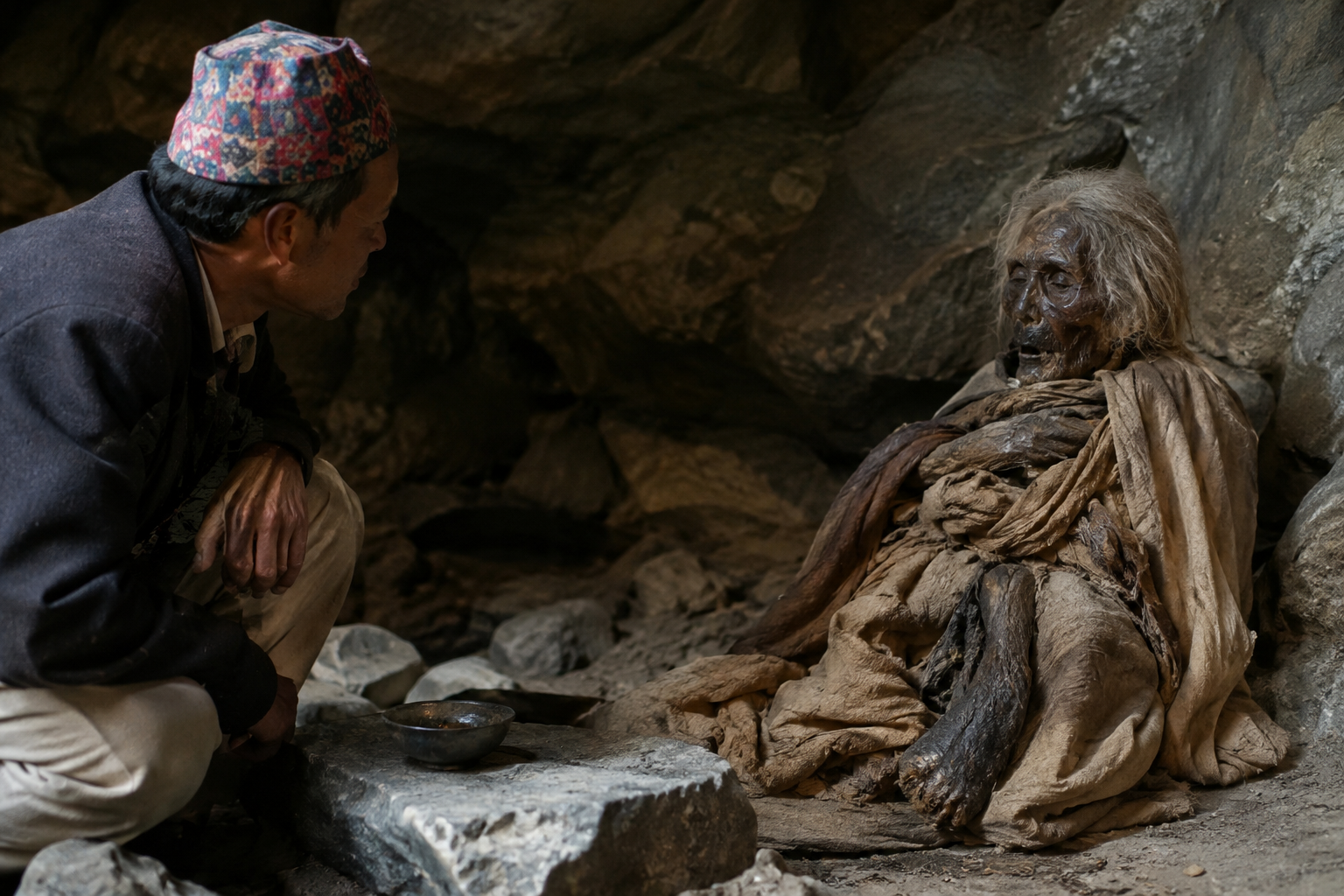
At Mebrak Cave in Nepal, archaeologists recovered one of the Himalayas' most arresting ancient individuals: a naturally preserved mummy dated to around 250 BC, identified as M354. The setting matters. Mebrak sits in the high Mustang region, a stark landscape of caves, caravan routes, and mountain communities that linked the Tibetan Plateau with South Asia. When a Y-chromosome lineage such as Oa1c1a1b1 appears in that context, it immediately raises a useful historical question: what can one paternal line tell us about men living on this upland crossroads more than two millennia ago?
The first thing to say, plainly, is that Y-DNA follows one direct male line only. It is not a person's whole ancestry, language, or identity. Even so, ancient Y-DNA can be very revealing when it turns up in a place like Mustang, where geography channels movement, exchange, and settlement. In the case of M354, the interest lies not in grand claims about conquest or ethnicity, but in the fact that this paternal branch was present in an early Himalayan community already participating in a wider world of movement across Inner Asia.
Mebrak Cave has become famous because it preserves human remains in a region where cold, dry conditions can keep bodies and organic materials intact with unusual clarity. That does not mean every detail of an individual's life can be reconstructed, and it would be foolish to invent more than the evidence allows. But the site itself is enough to make M354 historically important: this was not an isolated snowy ledge beyond history, but part of a chain of communities positioned between the Tibetan cultural sphere and the plains to the south.
The mummy dated to around 250 BC belongs to a period when trans-Himalayan connections were already old, practical, and local. People in such environments moved animals, salt, craft goods, and ideas through narrow valleys and seasonal routes. A paternal lineage like Oa1c1a1b1 appearing here is therefore most useful as evidence of population presence in a connected mountain zone, not as a badge of a single people frozen in time.
A genetic study of ancient Himalayan populations, including material from this broader region, helped place such individuals into a larger picture of long-term movement and mixture across the Tibetan Plateau and adjoining areas. That broader research is discussed in this ancient DNA study, which is especially relevant because it treats the Himalayas not as a remote fringe but as a region with its own deep demographic history.
Ancient DNA from Himalayan crossroads
The branch name Oa1c1a1b1 is very specific, but ancient classification is only as strong as the underlying data and reporting. With a sample like M354, caution matters. We can say that the article's lineage is associated with this ancient individual from Nepal; we should not use one sample to sketch a neat map of origins, language spread, or tribal identity.
More broadly, haplogroup O and its many descendant branches are central to the paternal history of East and Southeast Asia, as well as parts of the Himalayan world. But that wider truth must not be lazily pasted onto one narrow subclade. For this article, the real value of Oa1c1a1b1 is that it places one direct paternal line inside an archaeologically rich Himalayan setting in the last centuries BC. That is concrete, and it is enough to be interesting.
In public discussions of DNA, there is always a temptation to ask whether a lineage "belongs" to a kingdom, a language family, or a modern nation. Ancient archaeology is usually much messier than that. A man buried or preserved in Mustang may have lived in a community shaped by local traditions, plateau ties, and southern contacts all at once. A Y-chromosome result does not tidy that complexity away; if anything, it underlines it.
One of the most useful ways to think about ancient Mustang is not as a wall, but as a filter. Mountains make movement difficult, yes, but they also concentrate it. Travel narrows into corridors, and those corridors can become historically important for astonishingly long periods. That is why a single ancient paternal lineage from Nepal can matter well beyond one burial or one cave.
Communities in the Himalayan belt often show this double character. They can appear remote in modern imagination while being, in practice, deeply tied into regional exchange. Archaeology and ancient DNA increasingly support that picture from several directions: not endless mass migrations every century, but repeated contact, local continuity, and periodic influx from neighboring zones. The ancient individual M354 fits neatly into that broader pattern of mountain populations shaped by both endurance and connection.
This is where comparison with nearby regions becomes helpful. Studies from Ladakh, western Tibet, and other upland zones show that high-altitude societies were rarely simple isolates. They were often mixed in ancestry and historically linked to multiple spheres at once. That makes M354 less of an outlier and more of a valuable point on a much larger Himalayan map.
Ladakh's mixed ancient ancestry
It is easy to underrate a dataset when it contains only one clearly supplied ancient sample for a lineage. In fact, single individuals can be tremendously useful when they come from the right site. M354 is one of those cases. A well-dated mummy from a major Himalayan cave context offers something that many broader population summaries cannot: a direct human presence, fixed in place and time, against which larger models of regional history can be tested.
That is one reason ancient DNA from mountain Asia has drawn so much interest in recent years. It helps move the story away from sweeping assumptions based only on later texts or present-day populations. Instead of guessing from the end of the story backwards, researchers can start with actual people from actual sites. M354 is precisely the sort of individual who forces historians to pay attention to the Himalayas as a lived landscape.
There is also a methodological point worth making. Ancient Y-chromosome work in Asia has begun to refine older, vaguer pictures of paternal history into something more local and more archaeological. Rather than talking vaguely about "eastern" or "northern" ancestry, scholars can trace where particular paternal branches appear in specific times and places. A recent MyTrueAncestry discussion of this wider issue can be found here:
Ancient East Asian Y-chromosomes
Ancient Nepal is often squeezed awkwardly between South Asian history on one side and Tibetan history on the other, as though it must belong wholly to one narrative or the other. Archaeology resists that sort of tidiness. Mustang and its cave sites point instead to a frontier zone with its own local traditions, while also participating in much wider networks of exchange.
That is exactly why a lineage such as Oa1c1a1b1 is worth noticing in M354. It contributes to a picture of paternal diversity in the Himalayan arc that cannot be reduced to a single civilizational label. The man from Mebrak Cave was part of a mountain society, but mountain societies are never just perched in splendid isolation. They are built from routes, obligations, animals, weather, and neighborly contact over generations.
If you are exploring this haplogroup in your own results, that may be the most historically sensible takeaway. Its ancient appearance in Nepal does not hand you a ready-made ethnic identity. What it does offer is a credible link to the human history of upland Asia: communities living at altitude, tied into regional movement, and already part of a complicated world by the mid-1st millennium BC.
The most distinctive thing about Oa1c1a1b1 here is not sheer quantity of samples, but quality of context. Through M354 at Mebrak Cave, this paternal line is anchored in an ancient Himalayan community around 250 BC, in a region that connected plateau and plain without ever being reducible to either. For anyone researching this haplogroup today, that is the responsible historical insight: one direct male line can sometimes illuminate an entire landscape of movement, settlement, and survival.






Comments