Haplogroup O1b2a1a1c

– 6 min read


Some Y-chromosome lineages are famous because they turn up in headline-grabbing royal tombs or in sweeping migration stories across continents. Haplogroup O1b2a1a1c is interesting for a different reason. It belongs to a paternal branch that matters especially in the history of East Asia, and more narrowly in the Japanese archipelago, where ancient DNA is beginning to connect written history, island populations, and elite lineages in ways that were simply impossible a generation ago.
As always with Y-DNA, a caution first. A Y-haplogroup traces only one line of ancestry: the direct paternal line, father to son to son. It does not describe a person's whole ancestry, culture, language, or identity. Nor does sharing a haplogroup automatically prove close kinship. But when a specific branch appears in a historical individual from a known time and place, it gives us a precious fixed point. In this case, O1b2a1a1c offers exactly that sort of anchor for thinking about paternal continuity and change in Japan and the Ryukyu world.
O1b2a1a1c is a downstream branch within the wider haplogroup O, one of the major Y-chromosome clades of East and Southeast Asia. That much is well established. What becomes harder, and where one must be careful, is moving from the broad parent lineage to the specific history of this narrow subclade. It would be wrong simply to assign the entire history of haplogroup O to O1b2a1a1c as if nothing changed along the way.
Still, the broad frame is useful. Paternal lineages within haplogroup O have long been important in reconstructing the peopling of East Asia, the movements of farming and later state societies, and the complicated demographic history of Korea, Japan, and neighboring regions. For a branch like O1b2a1a1c, the most responsible thing to say is that it belongs to that East Asian paternal world and is best understood through regional continuity, island-mainland connections, and later historical layering rather than through a single dramatic migration tale.
That matters especially in Japan, where archaeology, written chronicles, and genetics each tell part of the story. The archipelago was never genetically static. Yet neither was it simply overwritten by one incoming people after another. Haplogroups such as O1b2a1a1c help us ask a subtler question: how did particular paternal lines persist, spread, or narrow over time within changing political worlds?
Explore East Asian Paternal Migrations
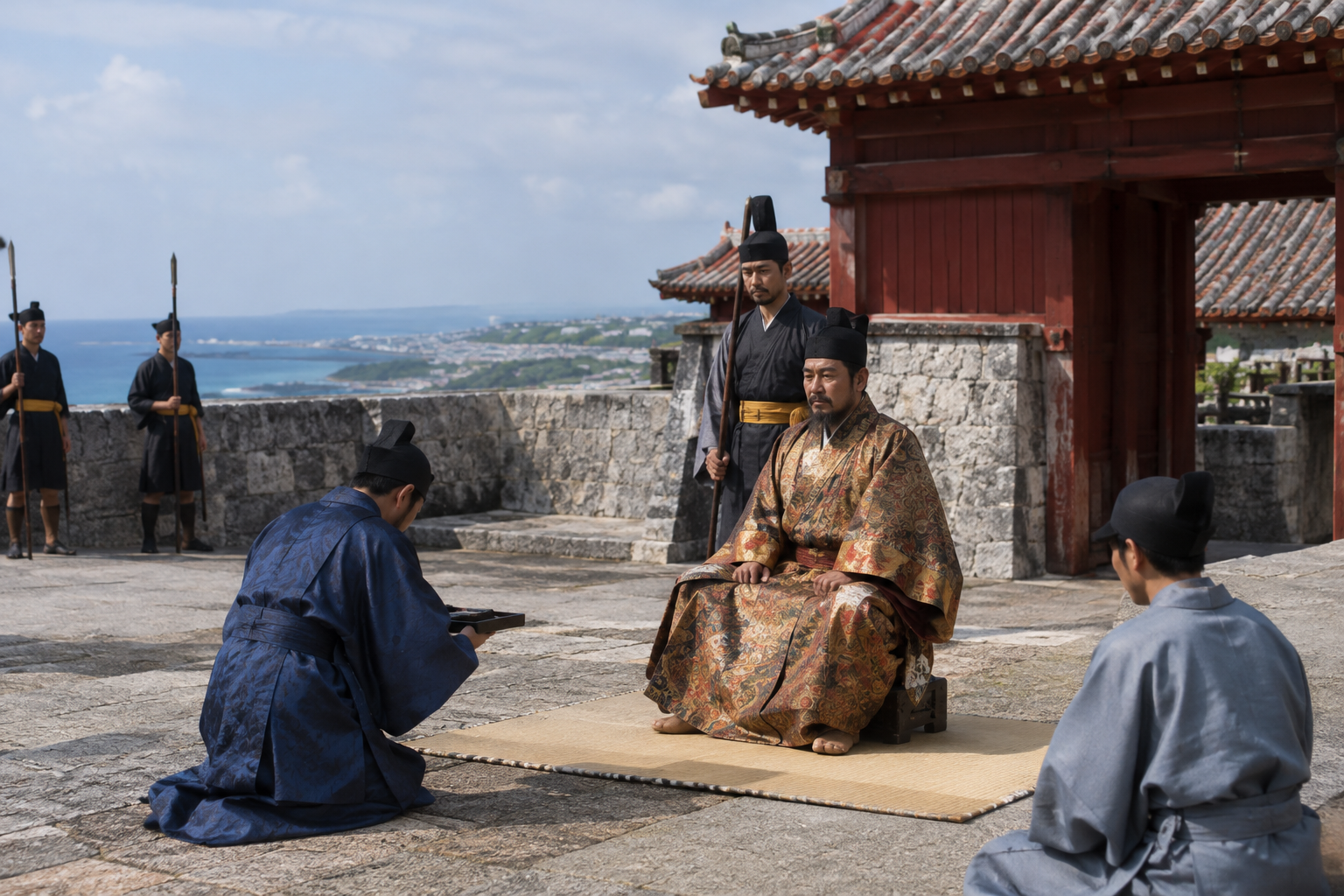
The most concrete evidence supplied here is a historical individual rather than a prehistoric skeleton: NAG036, from Tokugawa Shogunate Okinawa Japan, dated 1700 AD. That date places him in a remarkable setting. Okinawa in the early modern period stood at the meeting point of several histories at once: the older Ryukyu kingdom tradition, the influence of Japanese political authority, and the deep maritime networks that had long linked the islands to East Asia.
There is something salutary about a sample like NAG036. Ancient DNA enthusiasts are often drawn to the very oldest burials, as if age alone guaranteed significance. But an early modern man from Okinawa can be just as revealing. He shows that Y-chromosome research is not only about the remote prehistoric past. It can also illuminate societies that were literate, stratified, and historically documented, yet still genetically underexplored.
If NAG036 is associated with O1b2a1a1c in your results, what he offers is not proof of direct descent from any famous house, but a historical waypoint for the lineage in the Ryukyu-Japan sphere. That is already quite valuable. It suggests that this paternal branch was present in Okinawa during the Tokugawa period, a time when political control, trade, and identity in the islands were all being renegotiated.
And Okinawa is not just any location. The Ryukyu Islands preserve evidence of long local histories while also recording repeated contact with larger neighbors. A paternal lineage found there may reflect deep island continuity, later movement from the main Japanese islands, or a combination of both. One sample cannot settle that question on its own. But it does let us place the lineage on the historical map with unusual precision.
For Japan, continuity is always the tempting word, but it must be handled with care. Genetics can show that some lineages persisted in a region over long spans of time. It cannot by itself tell us whether that persistence maps neatly onto later identities, clans, or institutions. The people of the Ryukyus were shaped by local island history, by links with Kyushu and the main islands, and by wider East Asian contacts. A Y-lineage present in 1700 AD Okinawa belongs in that complex setting.
This is where ancient DNA adds something written sources cannot. Documents preserve rulers, officials, tribute relations, and court ritual. DNA preserves ordinary biological relationships and the survival of lineages whether or not chroniclers noticed them. In that sense, O1b2a1a1c becomes part of a larger historical question: how much of the paternal landscape of early modern Japan and Okinawa reflects older local roots, and how much reflects later political consolidation?
That question has no single answer. Some paternal lines surely expanded with successful households, local elites, or regional founders. Others may have remained common without ever appearing in prestigious genealogies. This is why one should never confuse a haplogroup with a social rank. Genetics can reveal a lineage; history must explain the society in which it lived.
Readers interested in the archaeological side of Japan's island history may also want to look at research on human traces recovered at fortress sites such as Katsuren Castle, which reminds us that castles and island polities are not separate from the genetic story but part of the same inhabited landscape.
Explore DNA from Katsuren Castle
The noble association supplied here is the Nakatomi Clan. That name immediately places us in one of the most important aristocratic settings of early Japan. The Nakatomi are remembered above all for their role in ritual and court politics, and for their connection to the transformations of the Yamato state. In historical terms, they belong to the world in which lineage, ceremony, and political power were tightly entangled.
Now for the necessary caution: the appearance of the Nakatomi Clan alongside O1b2a1a1c does not prove that the clan as a whole, or every male line within it, carried this haplogroup. Aristocratic houses were complicated institutions. Adoption, branching, unofficial paternity, cadet lines, and later genealogical reconstruction all complicate any simple genetic claim. Without a securely tested male-line burial tied specifically to the clan, one must speak only of historical association, not proof.
Even so, the Nakatomi are a fruitful comparison. They show how Y-DNA questions intersect with a society deeply invested in descent and legitimacy. In such a world, paternal lines mattered socially long before anyone knew what a chromosome was. Genetics does not replace those old genealogies; it gives us another way of asking how much biological continuity sits behind them.
The input does not provide a clear castle name or location for the clan, and indeed that absence is itself revealing. Early Japanese aristocratic power was not always expressed through the same kind of castle-centered memory that later medieval and early modern Europe preferred. When castles do become important in the broader Japanese and Ryukyuan setting, they belong to changing military and regional landscapes rather than serving as straightforward proof of a single ancient paternal line.
So what does this haplogroup reveal? First, it places one direct paternal line firmly within the East Asian genetic world and, more specifically here, within the historical geography of Japan and Okinawa. Second, through NAG036, it gives us a concrete human reference point in 1700 AD Okinawa under the Tokugawa Shogunate. Third, when set beside the historical memory of lineages such as the Nakatomi, it reminds us that genetics and written history ask overlapping but not identical questions.
What it cannot do is prove that a present-day tester descends from NAG036, or from the Nakatomi Clan, or from any named noble family simply because the Y-branch is shared. Haplogroups are about lineage structure, not ready-made genealogy. Their real fascination lies elsewhere: they let us see that the political worlds of courts, islands, and clans were inhabited by men whose paternal lines can sometimes still be traced in the genetic record.
That is the proper thrill of archaeogenetics. Not fantasy pedigree-making, but the gradual sharpening of the historical picture. A sample ID, a date, a place, a branch on the Y-tree: from these small and stubborn facts, whole landscapes of ancestry begin to come into focus.
If you want to place this lineage in the broader setting of Japanese dynastic history, the larger question of elite paternal continuity in Japan opens out toward imperial and aristocratic traditions more generally.
Explore the Imperial House of Japan
Haplogroup O1b2a1a1c is a reminder that even a narrow paternal branch can lead into big historical questions about Japan, Okinawa, island continuity, and noble memory. With MyTrueAncestry, you can explore whether your DNA shows similarities to ancient individuals and historical populations, including discoveries that shed light on paternal ancestry. Those matches can offer valuable historical perspective, even when they do not prove direct descent from a specific ancient person or noble clan.






Comments