Haplogroup O1b2a1a1b

– 4 min read


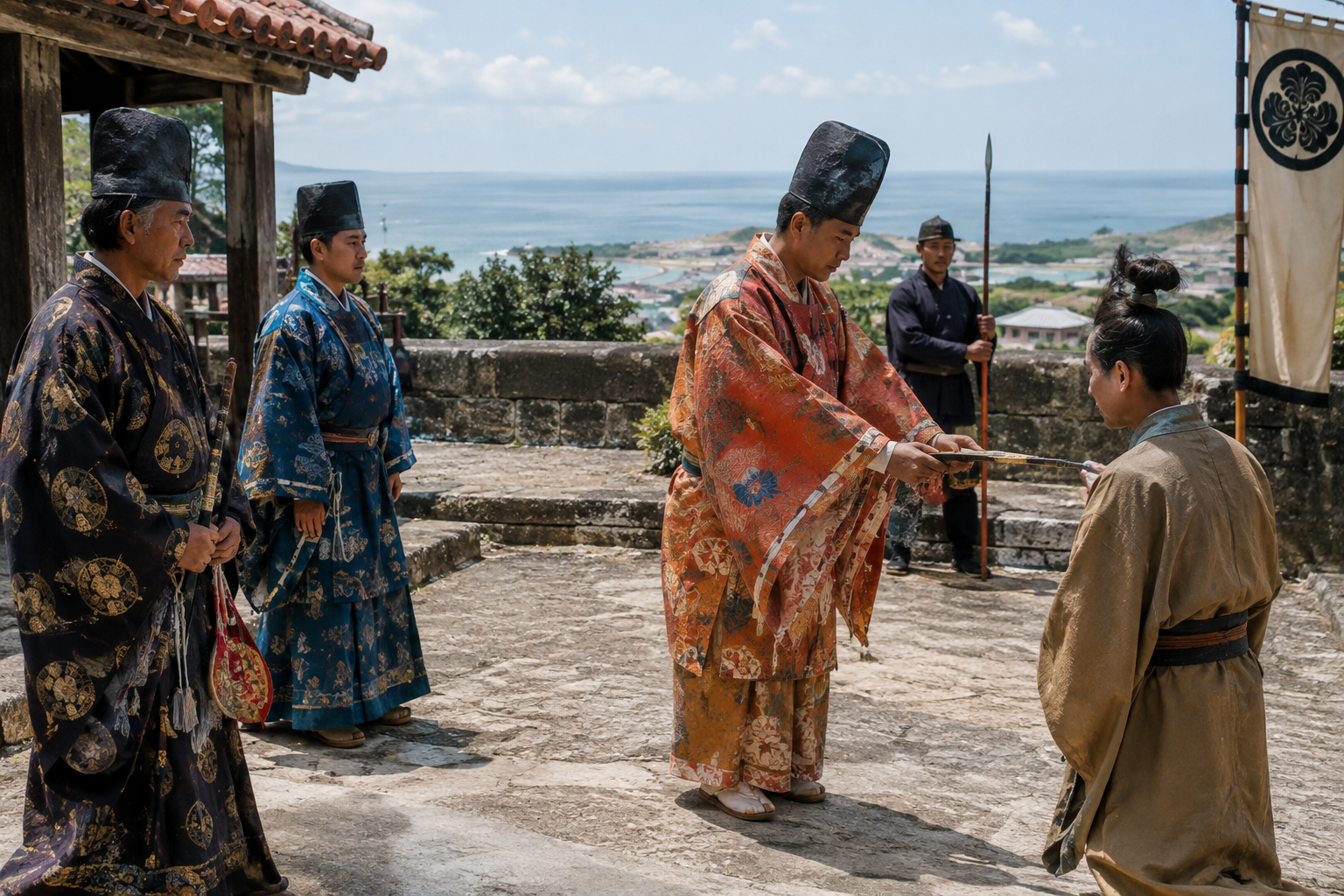
One of the more intriguing clues for Y-DNA haplogroup O1b2a1a1b comes from a relatively recent burial rather than a prehistoric skeleton: sample NAG039, dated to around AD 1700 in Okinawa, Japan, in the era of the Tokugawa shogunate. That immediately makes this lineage historically interesting. Instead of appearing first in some remote Stone Age context, here it surfaces in the Ryukyu Islands at a moment when Okinawa stood between local island traditions, Japanese political pressure, and long-distance maritime exchange.
This is worth pausing over, because Y-DNA follows one direct paternal line only. It does not describe the whole ancestry of a person from Okinawa in 1700, nor does it automatically identify language, status, or ethnicity. But a lineage like O1b2a1a1b can still be historically revealing when we place it in the setting of the Ryukyus, southern Japan, and the broader East Asian paternal landscape.
By about AD 1700, Okinawa was living through a peculiar political arrangement. The Ryukyu Kingdom continued to exist, but after the Satsuma invasion of 1609 it operated under heavy Japanese control while also maintaining tributary links with Qing China. In other words, this was not an isolated island society at all. It was a place of courts, ports, taxation, diplomacy, and layered identities.
That is the setting in which NAG039 matters. A paternal lineage assigned to O1b2a1a1b in Okinawa during this period fits a larger picture in which the Ryukyus were connected to populations of the Japanese archipelago and the East China Sea world, while still preserving distinctive local population history. The value of the sample is not that it proves a dynasty or a migration event on its own, but that it gives us a firm historical anchor for this branch in the islands.
O1b2 is a well-known East Asian Y-chromosome family, especially discussed in relation to Korea, Japan, and parts of eastern Asia more broadly. But that broader parent branch should not be confused with the narrower label O1b2a1a1b. The deeper history of O1b2 as a whole is not automatically the history of this exact subclade, and careful writing matters here.
What we can say responsibly is that a branch like O1b2a1a1b belongs to a paternal landscape shaped by long regional histories: movements between mainland East Asia and the islands, demographic expansions during later prehistory, and the reworking of populations over many centuries. Ancient Y-chromosome research on East Asia increasingly shows that coastal and inland histories do not collapse into one simple story. Different paternal branches rose, spread, and persisted in different ways, even within populations that later came to share language or political structures.
A useful wider context is provided by MyTrueAncestry's discussion of ancient Y chromosomes and East Asian paternal migrations, which helps show why a lineage found in Okinawa should be read as part of a complex regional pattern rather than a single ethnic label stamped across time.
There has been a long temptation, in both older history and older genetics, to treat island populations as delayed or diluted versions of mainland peoples. The Ryukyus refuse that simplification. Archaeology and genomics increasingly point to a population history in which island communities retained local continuity while also receiving later inputs from surrounding regions, including the Japanese main islands.
That makes a Tokugawa-period Okinawan sample especially useful. It sits late enough to reflect centuries of historical change, but still early enough to belong to a premodern society with its own courtly institutions and distinctive island networks. If a paternal line like O1b2a1a1b appears here, it tells us that this branch was part of the male-line landscape of the Ryukyus before the modern demographic upheavals of the nineteenth and twentieth centuries.
That matters for descendants today. A match to this haplogroup is not just a point on a phylogenetic tree; it may connect a present-day paternal line to the maritime borderlands of early modern East Asia, where Okinawa was neither peripheral nor static, but deeply entangled in regional history.
Ancient DNA from Katsuren Castle
Although the single named sample here is historical rather than prehistoric, it belongs beside a growing body of work on the deep population history of Japan and the Ryukyus. Research on ancient Ryukyu Jomon genomes has highlighted long-term genetic contributions from earlier island populations, while later periods brought additional mainland-associated ancestry into the archipelago. The result is continuity mixed with change, which is exactly what historians would expect from island societies that were both rooted and outward-looking.
That broader framework is helpful when thinking about O1b2a1a1b. A Y-line can persist through many cultural transformations: changes in kingdoms, tribute systems, agriculture, language use, or imperial control. So the presence of this branch in Okinawa around AD 1700 does not mean the lineage first arrived then. Rather, it marks one documented point in a much longer chain of fathers and sons whose earlier steps are still only partly visible.
The archaeology of Okinawa reinforces that caution. Sites in the Ryukyus often reveal continuity of settlement and local practice alongside evidence of exchange with Kyushu, the Japanese main islands, China, Korea, and Southeast Asia. A paternal lineage found in such a world should be understood as historically situated, not romantically isolated.
For someone exploring O1b2a1a1b today, the strongest historically grounded insight is not a glamorous royal claim, but something more solid: this lineage is documented in Okinawa in the early modern period, in a society shaped by island continuity and regional entanglement. That is already quite a story. It places a direct paternal line within the lived history of the Ryukyu Islands under Tokugawa-era pressure and East Asian exchange.
It also encourages a sensible research approach. Look not only at modern surname traditions or national identities, but at the older geography of southern Japan, the Ryukyus, and neighboring coastal East Asia. Haplogroups do not replace archives or archaeology, but in cases like O1b2a1a1b, they can give family history a real historical setting: an island crossroads where paternal lines endured through centuries of political change.






Comments