Haplogroup O1b2a1a

– 4 min read


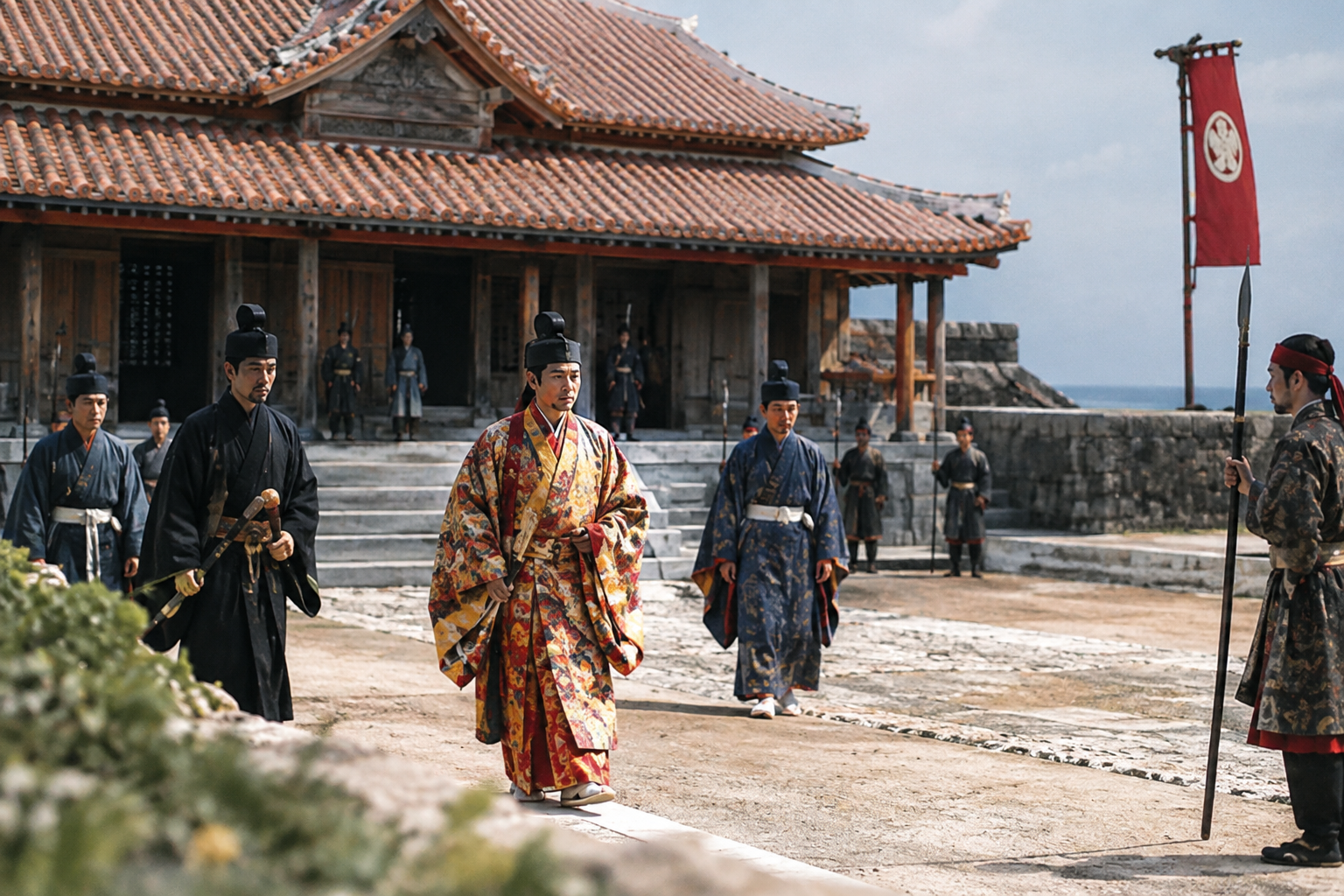
One of the clearest ancient signposts for O1b2a1a in this set comes from Okinawa: sample NAG036, dated to around AD 1700 and described as belonging to the Tokugawa Shogunate period in Japan. That is already enough to make the story interesting. We are not looking at a shadowy prehistory reconstructed from broad regional averages, but at a paternal line turning up in a documented early modern island world shaped by tribute, trade, and the complicated political relationship between the Ryukyu Kingdom, Satsuma, and Tokugawa Japan.
For anyone tracing this haplogroup today, that matters because Y-DNA follows one direct paternal line only. It does not tell the whole ancestry of a person, still less an ethnicity. But a sample like NAG036 does something very useful: it places O1b2a1a in a real historical landscape, in the Ryukyus at a time when Okinawa stood at the intersection of local continuity and wider East Asian power.
O1b2a1a is a branch within the wider O haplogroup family, one of the major Y-chromosome lineages of East and Southeast Asia. In modern populations, branches of O1b2 are especially important in parts of Korea and Japan, and they feature prominently in discussions of how paternal lineages spread across the Japanese archipelago over time. That does not mean every ancient or modern carrier shares the same recent history, but it does mean that this branch belongs to one of the central paternal strands in Northeast Asian population history.
In Japan, these questions are especially lively because the archipelago was never peopled in a single event. Archaeologists and geneticists have long had to think in layers: the deep background of Jomon populations, later agricultural expansions associated with Yayoi-era change, and then the many historical movements that knitted together regional societies from Kyushu to the Ryukyus. A useful companion piece here is MyTrueAncestry's look at Ancient Y Chromosomes Reveal Coastal and Inland Migrations that Shaped East Asian Paternal History, which places lineages like this into a broader East Asian setting.
East Asian paternal migrations
Sample NAG036 comes from an era when Okinawa was neither isolated nor simply absorbed. After the Satsuma invasion of 1609, the Ryukyu Kingdom continued to exist, but under heavy Japanese domination while still maintaining tributary links with China. In other words, Okinawa in about AD 1700 was a place of layered sovereignties and carefully managed identities. A paternal lineage found there belongs to that historical reality, not to a timeless and closed island world.
This is why the date is so useful. An early modern Okinawan man carrying O1b2a1a shows that the branch was part of the male population of the Ryukyus during a period of major political restructuring. It does not prove whether his paternal ancestors had been in the islands for many centuries or arrived more recently from elsewhere in the Japanese sphere. But it does anchor the haplogroup in a region where local island history and mainland connections overlapped.
That overlap is now becoming much clearer thanks to ancient DNA work on the Ryukyus. MyTrueAncestry readers may want to compare this case with Ancient Ryukyu Jomon Genomes and Their Lasting Genetic Impact on Japanese Populations, which explores the deeper population background of the islands. The crucial point is that paternal continuity and genome-wide ancestry are not the same thing. A man with O1b2a1a in Okinawa around AD 1700 may represent one paternal stream within a much more complex ancestry profile shaped by centuries of island history.
There is a bad habit in older history writing of treating islands as marginal. Okinawa was nothing of the kind. The Ryukyus sat on sea routes linking southern Japan, Taiwan, coastal China, and wider maritime Asia. Goods moved through these waters; so did people, and sometimes power itself. That makes any Y-chromosome result from the islands historically interesting, because paternal lines there may reflect long local persistence, mainland ties, or both at once.
Even with only one listed ancient individual here, the setting helps us see what is at stake. A haplogroup such as O1b2a1a in Okinawa belongs in debates about how the Japanese archipelago was assembled region by region. The Ryukyus were shaped neither by simple replacement nor by perfect isolation. Instead, they preserve a record of mixture, regional adaptation, and selective continuity.
That wider pattern also helps explain why East Asian archaeology has become so dependent on genetics without ever being reducible to it. A lineage can survive political upheaval; a kingdom can change masters while many local families remain in place. The Tokugawa frame tells us about state power. The Y chromosome tells us about one father-to-son line. Neither cancels the other out.
With NAG036, caution is part of the story, not an obstacle to it. We can say that a man from Okinawa in the Tokugawa period is associated here with O1b2a1a. We can also say that this fits a broader picture in which O1b2-related paternal lines are historically important in Japan and neighboring regions. What we should not do is pretend that one individual explains all Okinawan origins or that a modern tester with the same haplogroup descends from this exact island community.
Still, one sample can be powerful when the context is sharp. NAG036 gives this haplogroup a human scale: not just a branch label on a phylogenetic tree, but a man living in an island polity negotiating the weight of two great East Asian spheres. If your own paternal line belongs to O1b2a1a, that does not make you "Tokugawa" or "Ryukyuan" by itself. But it does place your direct male line within one of the enduring paternal histories of Northeast Asia.
Readers interested in how later historical societies can reveal dense family structures through ancient DNA may also enjoy Ancient DNA Uncovers Endogamy and Dense Kinship Networks in a Three-Kingdoms Silla Community. That article concerns Korea rather than Okinawa, but it is a helpful reminder that East Asian lineages often become most meaningful when read against real communities rather than abstract maps.
The most responsible way to read O1b2a1a is as a durable paternal thread in the history of East Asia, one that appears here in early modern Okinawa at a moment of intense regional entanglement. NAG036 does not offer a grand dynastic tale or a single migration legend. What it offers is better: a securely historical glimpse of this lineage in the Ryukyus, where island continuity and mainland connections met in everyday lives.
For family historians, that is often the real value of ancient DNA. It does not turn a haplogroup into a costume drama. It places a paternal line in the sort of world real ancestors inhabited: political, mobile, local, and deeply historical.






Comments