Haplogroup O1a1a1b1b

– 6 min read


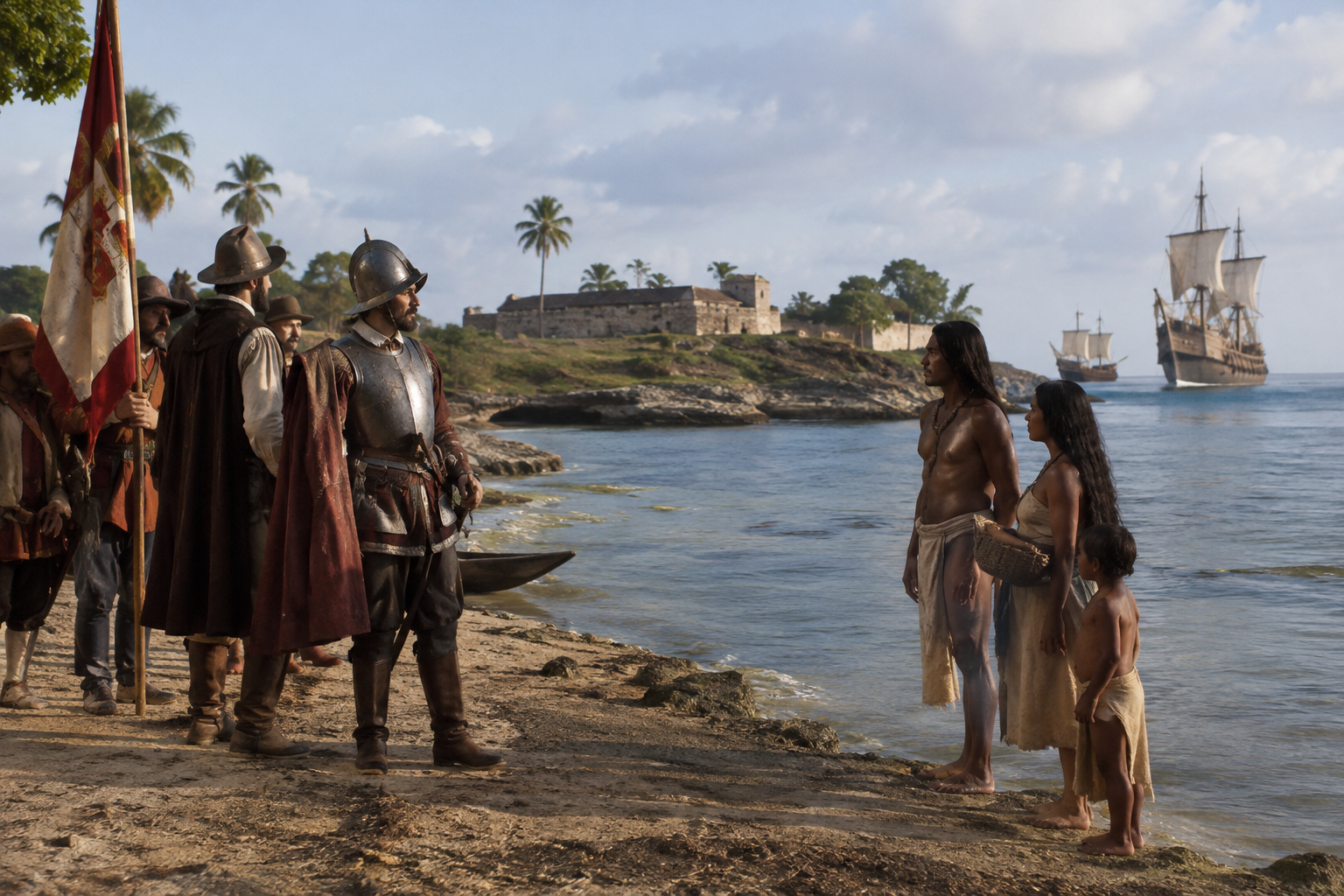
There is something wonderfully disorienting about finding a Y-chromosome lineage usually associated with East and Southeast Asia in an early colonial burial in the Caribbean. Haplogroup O1a1a1b1b is a fine example of why Y-DNA can make history feel less like a row of neat national boxes and more like a record of movement, encounter, and human unpredictability.
Y-DNA haplogroups trace one very particular line of descent: the direct paternal line, passed from father to son. That makes them powerful for reconstructing deep male-line ancestry, but also easy to overinterpret. A haplogroup is not a person's whole ancestry, not a passport to an ethnicity, and certainly not proof of descent from a noble house. What it can do is open a narrow but fascinating window onto how paternal lineages spread, persisted, and sometimes turned up in places where the written record alone would never have led us.
Haplogroup O belongs to a major branch of the Y-chromosome tree that is widely associated with East and Southeast Asian paternal ancestry. Within that larger family, O1 lineages have often been discussed in connection with populations of coastal East Asia, southern China, Taiwan, Island Southeast Asia, and adjoining regions. For a narrow branch such as O1a1a1b1b, however, caution is essential. We should not casually assign to this specific subclade the entire history of broad haplogroup O, still less attach it to one language family, kingdom, or people as if the matter were settled.
What can responsibly be said is that O1-related branches matter to archaeogenetics because they help track paternal histories linked to parts of maritime and coastal Asia. In recent years, ancient Y-chromosome work has begun to sharpen that picture, showing that East Asian paternal history was shaped not by one single expansion but by multiple movements, inland and coastal, across long stretches of prehistory and history.
Explore East Asian Paternal Migrations
That broader background matters here because O1a1a1b1b only becomes historically vivid when we place it against the long story of seafaring, trade, forced migration, imperial networks, and colonial dislocation. A paternal lineage with deep Asian roots appearing in the sixteenth-century Caribbean is not a curiosity to be brushed aside. It is precisely the sort of finding that reminds us how quickly the early modern world became globally entangled.
The key sample supplied here is I15676, from Early Colonial La Caleta Dominican Republic, dated 1530 AD. That is an extraordinary setting. La Caleta belongs to the first generations after European invasion and settlement in the Caribbean, when Hispaniola had become one of the earliest and most consequential staging grounds of the Atlantic colonial world.
By 1530, the Dominican Republic was not an isolated island society but a deeply disrupted colonial crossroads. Indigenous communities had already suffered catastrophic upheaval. Europeans, enslaved Africans, and people moving through imperial circuits were reshaping the demography of the Caribbean with shocking speed. In that context, a paternal lineage such as O1a1a1b1b is historically significant because it hints at connections that stretch well beyond the familiar triangle of Europe, Africa, and the Americas.
Now, one must be careful. A single Y-DNA result does not tell us the full biography of I15676. It does not by itself identify language, culture, legal status, or place of birth. Nor does it prove a direct line from some named Asian population to one individual in Hispaniola. But it does raise historically serious possibilities: that Asian-linked paternal lineages had already entered early colonial Caribbean populations through imperial movement, maritime labor systems, or other channels of mobility that the archive only partially records.
This is exactly why ancient DNA from the Caribbean is so valuable. Written records from the period are patchy, selective, and often brutally uninterested in the lives of ordinary people. Bones, by contrast, can preserve evidence that bureaucrats never thought to write down.
Discover Ancient DNA in the Caribbean
Readers interested in the wider genetic setting of early Caribbean peoples might also compare this with work on Genetic Continuity and Mainland Affinities of Pre-Ceramic Caribbean Populations. That broader precolonial background helps show just how dramatic the demographic break of the colonial centuries really was.
So how might a lineage like O1a1a1b1b fit into a Caribbean burial of 1530 AD? The honest answer is that the exact route remains uncertain. But uncertainty is not ignorance; it is simply where good history begins. By the sixteenth century, the world of Iberian expansion was already linked to wider maritime systems that touched Africa, the Indian Ocean, and Asia. Even where direct evidence for one individual is missing, the historical landscape was clearly one of rapid long-distance movement.
This is where archaeogenetics helps us resist tidy narratives. Colonial societies are too often imagined as if they sprang fully formed from a few named European founders. In reality they were unstable mixtures of survivors, migrants, captives, sailors, soldiers, servants, and intermediaries. A Y-lineage such as O1a1a1b1b appearing at La Caleta belongs in that messier, truer story.
For that reason, another relevant comparison is the MyTrueAncestry article on Ancient Genomes Reveal Three Waves of Settlement and Deep Genetic Diversity in Indigenous Americas. It offers a reminder that the Americas already had a deep and complex human history long before colonial rule added yet more layers of migration and admixture.
Explore Deep American Population History
At first glance, House of Dudley and O1a1a1b1b seem to inhabit utterly different historical worlds. Dudley Castle, after all, began as a Norman motte and bailey soon after the Conquest, later growing into a major Midlands stronghold under the Sutton family. It was held for the Royalists in the Civil War, suffered heavily in a Parliamentarian siege, and was left partly ruined. Yet it remained central to the identity of Dudley itself, accumulating later associations with industry, spectacle, landscaping, tourism, and even the nearby zoo.
That layered afterlife makes the castle historically appealing. It is not just a relic of conquest, but a place where Norman ambition, medieval lordship, Civil War violence, and Victorian fascination all sit on the same hill. Mary Beard would no doubt enjoy the point that ruins are not dead things at all; they are objects repeatedly reused by later societies, each age finding its own Dudley.
But what has this to do with a Y-haplogroup? Here the answer must be restrained. The supplied association allows us to place the haplogroup in conversation with a noble house and its regional memory, not to claim that the Dudleys or Suttons are genetically proven carriers of O1a1a1b1b. That would be absurdly overconfident. Castles are historical anchors, not genetic laboratories.
Still, the juxtaposition is useful. Dudley Castle represents the written, heraldic, and architectural side of ancestry: charters, sieges, lordship, inheritance, place. Sample I15676 represents the archaeological and biological side: a human body from the early colonial Caribbean carrying a paternal marker that opens up a very different map of the past. One sort of evidence preserves who held the hill. The other preserves who moved across oceans and ended up in graves the documents barely noticed.
Read About Norman Conquest DNA
The real lesson of O1a1a1b1b is not that one lineage can be made to explain everything. Quite the opposite. It shows how limited and how revealing Y-DNA can be at the same time. A paternal haplogroup follows one line only, but when ancient DNA places that line in a specific burial, at a specific site, in a specific historical moment, it can force us to rethink familiar maps.
In this case, the supplied evidence points us toward a broad East or Southeast Asian paternal background for the lineage, and toward a striking early colonial appearance in the Dominican Republic through sample I15676. It also invites a contrast with later documentary worlds such as Dudley Castle, where lineage was performed through architecture, titles, and local power rather than recovered from bone.
If you want a wider introduction to how this kind of evidence works, the MyTrueAncestry community article Ancient DNA and the Rise of Archaeogenetics is an excellent next step. It helps explain why a single well-placed sample can change the questions historians ask.
Learn How Archaeogenetics Rewrites History
For MyTrueAncestry users, that is the excitement. Your Y-DNA haplogroup does not make you a medieval lord, a Caribbean colonist, or a member of any one historical people. But it may place your direct paternal line within a much larger human story, one that reaches from ancient population history to named archaeological individuals like I15676, and from buried remains to the castles and family traditions later societies built around the idea of descent.
Upload your DNA to MyTrueAncestry to explore how your ancestry may connect with ancient individuals, historical populations, and the deep paternal histories behind haplogroups like O1a1a1b1b. These matches can offer remarkable historical perspective, even when they do not prove direct genealogical descent or membership in a noble family.






Comments