Haplogroup N1a2a

– 6 min read


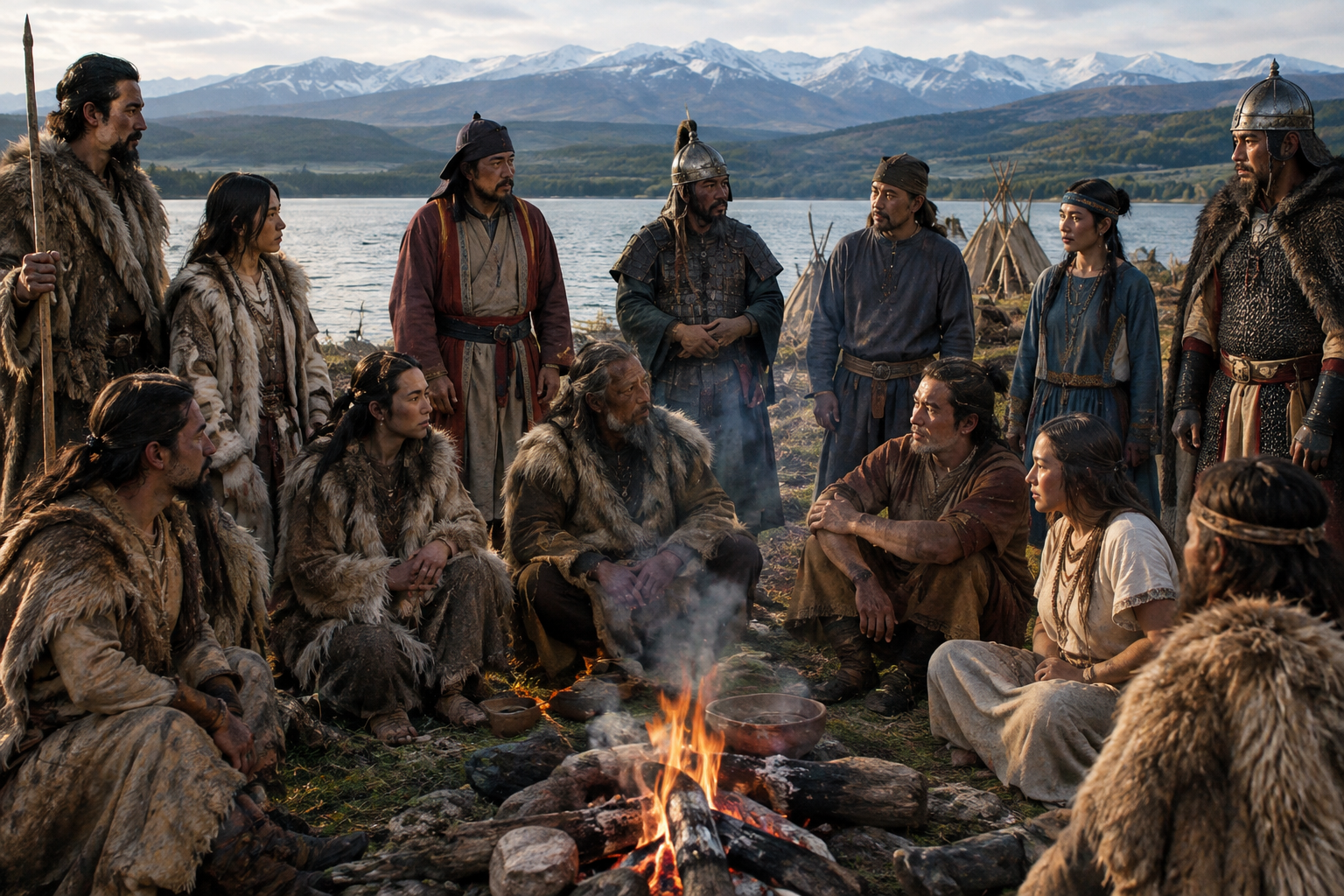
Some Y-chromosome lineages are easiest to tell as the history of a single region. Haplogroup N1a2a is not one of them. It appears instead as part of a much broader northern Eurasian story, surfacing in ancient remains from the forests of European Russia, around Lake Baikal, in the Trans-Urals, in medieval Scandinavia, in Finland, and in historical northern Asia. That alone makes it historically intriguing. It suggests not a neat march of one "people," but a long and complicated paternal history stretching across river corridors, forest zones, steppe edges, and later imperial worlds.
As ever with Y-DNA, a caution comes first. Haplogroups trace one direct paternal line only: father to father to father. They do not describe a person's whole ancestry, culture, language, or identity. Still, they are immensely useful. When a lineage like N1a2a turns up repeatedly in ancient burials across time and space, it gives us a valuable thread for following male-line continuity, dispersal, and contact between populations that written history either never recorded or recorded only much later.
N1a2a sits within haplogroup N, one of the major Y-chromosome branches associated today with parts of northern Eurasia. For a lineage at this level of specificity, it is important not to pour the entire history of haplogroup N into N1a2a itself. But the supplied ancient evidence does allow a careful conclusion: this branch, or closely related paternal lines, had a deep presence across northern Eurasian landscapes long before the rise of states, dynasties, or castles.
The earliest signposts in this dataset are strikingly old. At Minino in Vologda, in ancient Russia, sample NEO538 is dated to 7618 BC. That places this paternal line in the forested world of Mesolithic northeastern Europe, among communities living far from the literate civilizations that usually dominate history books. Further east, the Lake Baikal region and nearby Cis-Baikal provide several more early finds: DA245 and DA248 from Shamanka II, both dated to 7200 BC, and DA362 from Early Neolithic Cis Baikal Russia Shamanka II, dated to 5289 BC. Add to that I0999 from Neolithic Irkutsk Eastern Siberia Serovskaya Manzurka-2, dated to 5676 BC, and the picture becomes hard to ignore.
What this suggests is not a single migration event that can be pinned down with theatrical certainty, but a broad northern zone in which paternal lines related to N1a2a were already established very early. Forest hunter-gatherers, riverine communities, and early Neolithic groups across Siberia and northeastern Europe seem to form part of the context in which this lineage mattered.
Explore Uralic Roots in Ancient DNA
If one wanted an archaeological setting worthy of a Mary Beard aside, one might start around Lake Baikal, because these are not abstract dots on a map but real burial grounds in a landscape that was already peopled, traveled, and remembered thousands of years before Rome was dreamt of. The site of Shamanka II has become especially important for understanding deep population history in Siberia. Samples DA245 and DA248, both from 7200 BC, and later DA362 from 5289 BC, place this paternal thread among some of the earliest well-studied communities in the region.
Not far away in broader eastern Siberia and Transbaikalia, the Zjindo samples NEO115 dated to 5600 BC and NEO117 dated to 5706 BC show related evidence in Western Transbaikalia. These finds matter because they push N1a2a into another ecological corridor: the zone between the Baikal basin and the wider eastern steppe-forest world. In plain terms, this is the sort of evidence that helps explain why later northern Eurasian history so often looks interconnected. Long before empires, there were already human networks stretching across enormous distances.
And these were not frozen, isolated populations. Ancient DNA increasingly shows movement, mixture, and shifting local histories even in prehistory. A Y-line may persist while languages, economies, and identities change around it. That is one reason Y-DNA is so useful and so easy to misuse. It tells us something important, but never everything.
Read About Lake Baikal Prehistory
By the time we reach historical periods, the distribution of this lineage becomes even more interesting. Sample M22, from the Western Han Dynasty Qi State Zibo City Linzi and dated to 100 BC, places N1a2a in the world of early imperial China. That does not mean the lineage was "Han" in any simplistic sense, nor that it can be assigned to a single ethnicity. What it does show is that paternal lines of this kind had entered, or were present within, the demographic landscape of northern China in the age of imperial consolidation.
This is where the supplied noble-historical setting becomes especially evocative. Chengzhou, the early Zhou dynasty capital in the area of modern Luoyang, stood in the Luo River valley as one of the great political and ritual centers of early China. Over centuries, Luoyang became a layered capital landscape: Zhou, Eastern Zhou, Han, Wei, Jin, and later regimes all rebuilt, reused, and claimed it. Courts, walls, tombs, roads, and temples accumulated there. It is exactly the kind of place where genetics and history illuminate one another, though never in a crude one-to-one fashion.
N1a2a cannot be assigned to the Zhou royal house on the basis of this contextual information alone. That would be bad history and worse genetics. But the appearance of this lineage in historical northern China reminds us that the capitals of early China were never biologically static places. They were fed by movement from frontier zones, farming plains, military colonies, and older regional populations. Chengzhou matters here as a symbol of that long political landscape: ancient lineages did not vanish when states appeared; they were absorbed into larger historical worlds.
Explore Middle Yellow River Genomic History
The later samples push the story north and west again. Uyelgi16, from Uyelgi Trans-Ural Russia and dated to 900 AD, places N1a2a in a region famous for linking forest and steppe, Europe and Asia. The Trans-Urals were not some forgotten backwater but a hinge zone through which peoples, goods, and military traditions moved. In the early medieval period, such regions mattered enormously for the formation of later populations across both Eurasia and northeastern Europe.
Then there is PKN009, a Medieval Finland Outlier Tavastia Paelkaene sample dated to 1250 AD. Here N1a2a appears in a medieval Finnish context, suggesting that by this period branches of the lineage had become part of the paternal landscape of the far north of Europe. Likewise, lov002, from Early Vendel Age Sweden Stockholm Viken Lovo dated to 520 AD, shows the lineage in Scandinavia before the Viking Age proper. That is a lovely corrective to over-tidy national histories. Medieval and pre-medieval northern Europe was shaped by older northern Eurasian connections as well as by local continuity.
Finally, BRG004, the Late Medieval Mongol Warrior Burgaldain Khundii sample dated to 1300 AD, reminds us that the story of N1a2a also intersects with the mobile military societies of Inner Asia. Again, no melodrama is needed. One sample is not a nation. But placed alongside the earlier Siberian evidence, it fits a long pattern in which this paternal line remained part of populations spread across the northern half of Eurasia.
Unlike some haplogroup articles tied to a named medieval house, the noble connection supplied here is dynastic and urban rather than genealogically specific: Zhou Dynasty Chengzhou, the early capital near Luoyang. That may actually be the more interesting case. Chengzhou was not simply a residence. It was a political claim in stone, roadways, ritual space, and burial landscapes. Later dynasties repeatedly anchored themselves to Luoyang because capitals carry memory. They say, "We belong in the line of rulers."
Genetics asks a different question. Not who claimed legitimacy, but which lineages persisted in the population around such places over very long spans of time. The answer is rarely neat. A capital city draws in soldiers, laborers, administrators, migrants, brides, captives, merchants, and local elites. A paternal lineage found in historical northern China may be part of that wider story without identifying any specific noble house.
So Chengzhou and Luoyang belong here not as proof of aristocratic descent, but as the historical stage on which ancient paternal lineages became part of state societies. The walls and tombs of that capital landscape preserve political memory; ancient DNA preserves biological memory. They are not the same thing, but together they give us a fuller account of the past.
Discover DNA from the Eastern Zhou Heartland
What, then, does haplogroup N1a2a reveal? Above all, longevity and range. In the evidence supplied here, it appears from Mesolithic and Neolithic northern Eurasia to Han-period China, from the Trans-Urals to medieval Finland and Sweden, and on into the Mongol world. That is not the history of a single kingdom or tribe. It is the history of a durable paternal lineage moving through changing societies.
For family historians, that matters. A Y-DNA result like N1a2a does not hand you a ready-made ethnic label or a guaranteed noble pedigree. What it can do is place your direct paternal line within one of the most expansive and archaeologically interesting zones in Eurasian history. It may connect your lineage, in a broad genetic sense, to the men buried at Minino, Shamanka II, Zjindo, Uyelgi, Linzi, or medieval Tavastia. Not as named ancestors, but as members of the same deeper paternal branch across time.
If you want to see how your own DNA compares with ancient individuals and historical populations, MyTrueAncestry offers a remarkable way to explore those connections. You may find links to ancient Siberian foragers, medieval northerners, or historical populations from the great capital landscapes of Eurasia. Those matches do not prove direct descent from a king, a warrior, or a dynasty, but they can open a far richer view of where your ancestry fits in the human past.






Comments