Haplogroup N1a1a1a1a1a1a

– 6 min read


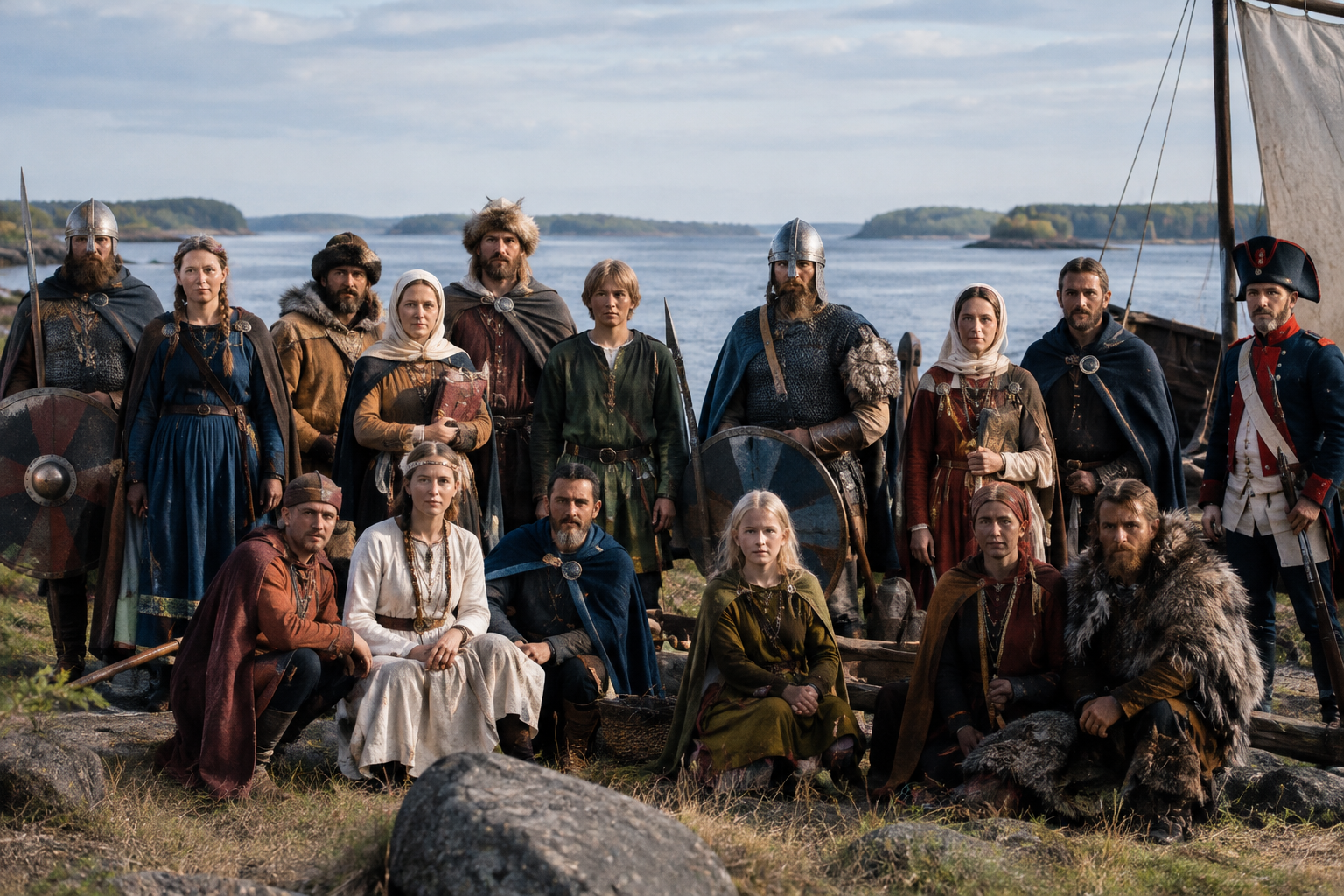
Some Y-chromosome lineages announce themselves with a thunderclap: a famous dynasty, a celebrated royal tomb, a dramatic migration. Haplogroup N1a1a1a1a1a1a is more interesting in a subtler way. It appears across a remarkable northern and eastern European arc, surfacing in Iron Age island communities, Baltic burials, Viking Age graves, medieval Finland, and even in the world of the Rus princes. It is the sort of lineage that reminds us that history was not built only by emperors and conquerors, but by long chains of fathers and sons moving through trading ports, farmsteads, war bands, and frontier settlements.
As ever with Y-DNA, a note of caution is essential. A Y-haplogroup traces one narrow line of ancestry: the direct paternal line. It does not describe a person's whole genetic background, still less their culture, language, or identity. But when ancient DNA repeatedly turns up a lineage like N1a1a1a1a1a1a in the Baltic, Scandinavian, Finnic, and Rus-connected world, it gives us a wonderfully concrete way to think about how paternal lines endured, shifted, and reappeared over many centuries.
This subclade belongs within the wider Y-DNA haplogroup N family, a major paternal lineage with deep importance across northern Eurasia. For very specific branches such as N1a1a1a1a1a1a, one must be careful not to dump onto them the entire story of haplogroup N as a whole. Still, the pattern in the supplied ancient samples is striking. Rather than a scattered presence anywhere in Europe, the evidence clusters strongly around the Baltic Sea, Scandinavia, Finland, the eastern Baltic, and the lands tied into the river routes of early Rus.
That geographic pattern matters. It suggests that by the Iron Age and early medieval period, men bearing this paternal branch were part of the human traffic of the north: island communities on Oland and Gotland, Baltic groups in Lithuania and Saaremaa, Viking Age networks in Sweden and Russia, and later populations in Finland and medieval Rus. Whether every movement reflects migration, local continuity, elite exchange, or some combination of all three must be judged case by case. Ancient DNA helps because it lets us test these historical possibilities against actual burials.
Explore Uralic Roots in Ancient DNA
One of the most revealing clusters comes from Sweden and the eastern Baltic. On Oland, the haplogroup appears in several individuals spanning centuries: CGG024147 from Pre-Vendel Sweden Oland Bengtstorp, dated to 175 AD; VK579 from Iron Age Oland Sweden, dated to 300 AD; and multiple victims from Pre-Vendel Age Oland Sandby Borg, including snb014, snb017, snb019, and snb019a, all dated to 475 AD. Sandby Borg, with its famous violent destruction, has become one of those sites where genetics and archaeology combine with chilling force. These were not abstractions. They were men living in a defended community on a Baltic island, caught in a catastrophic event, and yet still preserving a paternal signature that appears elsewhere around the Baltic world.
By the Viking Age, the same broad lineage is still there in maritime Scandinavia. We find it in VK533 from Viking Age Oland Sweden, dated to 950 AD; VK430 from Viking Age Gotland Frojel Sweden, dated to 975 AD; VK51 from Viking Age Gotland Kopparsvik Sweden, also dated to 975 AD; bro100 from Viking Age Sweden Stockholm Sasta, dated to 975 AD; and VK399 and VK406 from Viking Age Skara Varnhem Sweden, dated to 1050 AD. This is not proof of a single tribe, people, or dynasty. It is better read as evidence that this paternal line was well established in the Scandinavian-Baltic zone during the centuries when trade, raiding, colonization, and political consolidation bound those regions together.
The eastern Baltic tells a similar story. There is V12 from Iron Age Saaremaa Oesel, dated to 215 BC, and later a cluster from Vendel Age Saaremaa at Salme: VK481, VK550, VK504, VK505, and VK508, all dated to 725 AD. Saaremaa was hardly an outpost at the edge of nowhere. It sat in the midst of Baltic sea lanes, touched by conflict and exchange. Add VII4, a Late Bronze Age Estonia sample dated to 580 BC, and the long chronology begins to emerge: a paternal thread visible in the eastern Baltic long before the classic Viking Age.
The lineage also appears among Baltic and nearby mainland populations. In Lithuania there are R10838 and R10836 from Marvele, both dated to 460 AD, CGG017690 from Iron Age Baltic Tribes Lithuania Berciunai dated to 566 AD, CGG017691 from Iron Age Lithuania Flat Burials Kaireneliai dated to 554 AD, and CGG017694 from Iron Age Lithuania Barrows Maudziorai dated to 829 AD. These are especially useful because they suggest that the haplogroup was not confined to islands and coastal emporia. It was also present among inland Baltic communities over a considerable span of time.
Finland adds another important dimension. EU1002, from Viking Age Satakunta Finland Rich Grave Eura Vanha Kansakoulu, dated to 925 AD, places the lineage in a notably furnished burial. Later, JAN001 from Early Medieval Finland Janakkala Makasiininmaki Kanta Hame Burial, dated to 1190 AD, shows the branch persisting into medieval Finland. Together these finds suggest that N1a1a1a1a1a1a belongs to the historical formation of northern Baltic and Finnic populations, though no single sample can stand in for an entire people.
There are also intriguing appearances farther south and west in periods of mobility and upheaval: PCA0522 from Early Goth Pommerania Pruszcz Gdansk Pruszcz Wielbark, dated to 200 AD; MLE003 from a Longobard Grave at Moedling-Leinerinnen in the Vienna Basin, dated to 550 AD; SZL067 and SZL030 from Longobard Period Pannonia Savaria Szeleste Barbaricum Hungary, both dated to 525 AD; OSIJ002, a Roman-period Nordic Warrior from Mursa Croatia during the Third Century Crisis, dated to 260 AD; and VEM003 and VEM032 from Early Medieval Croatia Velim-Velistak, dated to 750 AD and 775 AD. These do not mean the haplogroup was "Germanic" or "Gothic" or "Longobard" in any simple sense. They show men with this paternal ancestry participating in wider continental movements and frontier worlds.
Read About Early Medieval Finland
The most eye-catching medieval sample in the list is Nev2, identified as Grand Prince Dmitry Alexandrovich Rurik Dynasty, dated to 1294 AD. This is the point where readers understandably lean forward. A named prince, a ruling house, a datable individual: surely this is where genetics meets chronicle history head-on. It does, but cautiously. What the sample offers is evidence for the paternal lineage of that particular tested individual within the broader Rurikid sphere. It does not prove that every branch of the dynasty shared the same exact subclade, nor does it license grand genealogical claims about all later descendants.
Even so, the historical setting is irresistible. The associated noble context points to the Grand Princes of Kiev and to Yaroslav's Court in Veliky Novgorod, one of medieval Rus's key political and commercial centers. Tradition linked it to Yaroslav the Wise in the early 11th century. On the Trade Side across the Volkhov from the Detinets, it developed into a market and assembly place where merchants from the Baltic and beyond exchanged goods, and where the veche was often said to gather. That matters enormously for this haplogroup's story. Novgorod was precisely the sort of place where Baltic, Scandinavian, Finnic, and Rus worlds overlapped.
So when a lineage like N1a1a1a1a1a1a appears in Viking Age Gnezdovo Russia as VK224, dated to 950 AD, and later in the Rurikid world with Nev2, the significance is not that we have solved a dynastic mystery once and for all. Rather, we can see how a paternal line present in the northern interaction zone also appears in the political formations that emerged from that zone. Yaroslav's Court survives in memory as a place of bargaining, debate, and long-distance connection. Genetics cannot read the speeches made there, but it can show that some of the paternal lines moving through that world had deep roots around the Baltic.
Explore DNA from the World of the Rus Princes
If there is a lesson in N1a1a1a1a1a1a, it is that continuity and movement are not opposites. The same paternal branch appears over long stretches of time in the Baltic and Scandinavian sphere, yet also turns up in contexts shaped by migration, warfare, trade, and state formation. We see it in Bronze and Iron Age Estonia and Saaremaa, in Swedish island communities, in Baltic tribal settings, in Viking Age Finland and Russia, in continental warrior graves, and in a medieval princely context.
That is exactly why ancient DNA is so useful. Written genealogy usually begins late and favors elites. Archaeology reveals objects, buildings, and graves but not always biological kinship. Y-DNA adds one more line of evidence: not a magic key, but a disciplined way of tracing direct paternal ancestry across time. It can illuminate regional continuity, show unexpected mobility, and place later medieval families and political centers into a much longer human story.
For readers with northern, Baltic, Finnic, Scandinavian, or eastern European connections, this haplogroup is a reminder that the past was peopled by communities linked by sea lanes and river routes as much as by frontiers. The men behind these samples were islanders, merchants, warriors, nobles, and townsmen. Some lived in violently destroyed forts, some in richly furnished graves, some in princely circles, and one - YYY089B - even turned up among the dead of Napoleon's Grande Armee in 1812, a final glimpse of how old paternal lines continue into the modern era.
If you want to place your own ancestry against this wider backdrop, MyTrueAncestry lets you compare your DNA with ancient individuals from sites like Oland, Saaremaa, Janakkala, Gnezdovo, and medieval Rus. Such matches do not by themselves prove direct descent from a prince, a Viking, or a noble family. But they can offer a fascinating window into the populations and historical landscapes connected to your deep paternal past.






Comments