Haplogroup N1a1

– 6 min read


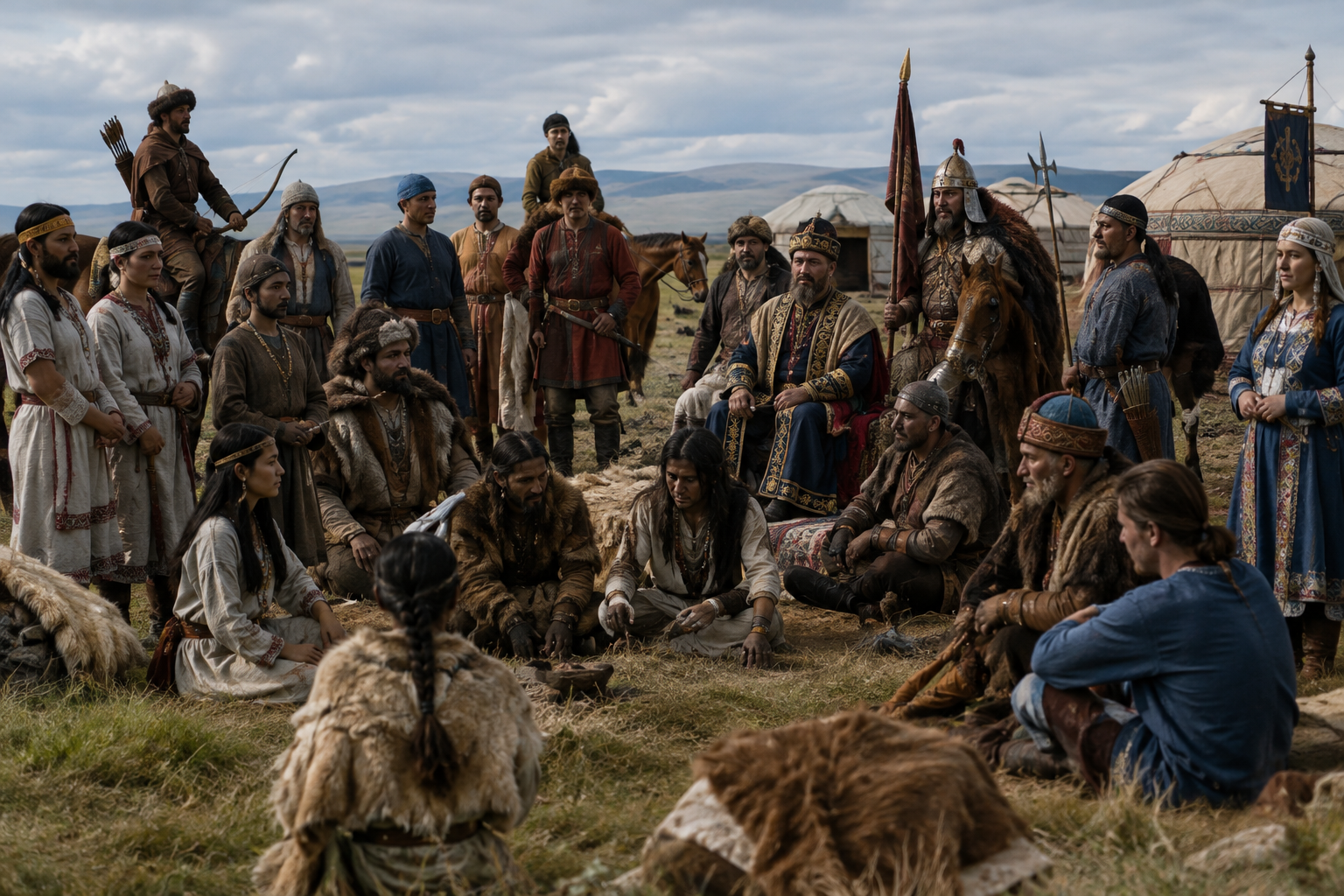
Some Y-chromosome haplogroups seem to sit quietly in the background of history. N1a1 does not. It turns up across an enormous northern zone of Eurasia: in early remains from Siberia and the Baikal region, in the forested lands of ancient Russia, in steppe contexts, and later in medieval northern and eastern Europe. That spread alone makes it historically interesting. It hints at a paternal lineage whose story is bound up not with one empire or one people, but with long movements across forests, river systems, steppe corridors, and frontier kingdoms.
As ever with Y-DNA, a caution comes first. Haplogroups trace one direct paternal line only: your father's father's father, and so on. They do not describe your whole ancestry, your culture, your language, or your identity. But they are wonderfully good at showing how one male lineage can persist, divide into branches, and reappear in very different historical settings. N1a1 is a fine example of that. In the broader Y-chromosome tree, it belongs within haplogroup N, a major northern Eurasian paternal lineage whose branches are especially important in discussions of Uralic-speaking regions, Siberia, and northeastern Europe. Exactly how the earliest branches of N1a1 spread remains a matter of reconstruction rather than complete certainty, but the ancient DNA record now gives us something much better than guesswork: actual men, from actual burials, across thousands of years.
The most striking thing about the evidence supplied for N1a1 is its depth. We are not looking only at medieval knights or early states. We are looking far earlier, into the world of hunter-gatherers and early post-glacial communities in northern Eurasia. One especially important sample is NEO538, from Ancient Russia Minino Vologda, dated to 7618 BC. That places a branch associated with this haplogroup deep in the forests of northwestern Russia at a very early date. It is exactly the sort of find that reminds us that the paternal history of northern Europe did not begin with Vikings, Slavs, or medieval kingdoms.
Then the trail runs east. At Zjindo in Western Transbaikalia, two ancient Siberian individuals, NEO115 from 5600 BC and NEO117 from 5706 BC, show related paternal presence in the Baikal-Transbaikalian world. Add to that DA251 from Early Neolithic Cis Baikal Russia Shamanka II, dated to 5347 BC, and later I8535 from Late Neolithic Russia Lake Baikal Fofonovo, dated to 2264 BC, and you begin to see a remarkable pattern. N1a1-related paternal lines were not fleeting visitors in the east. They formed part of the long human history of the Baikal and Siberian regions over millennia.
That does not mean every later carrier in Europe came directly from one Baikal ancestor, still less that one can draw a neat arrow across the map and call the matter solved. But it does support a broad picture in which important N-related paternal lineages had deep roots in northern Eurasia before appearing further west in later historical contexts.
Explore Uralic roots in ancient DNA
If the earliest evidence places N1a1 in the north and east, the later samples show that its story was not confined there. Bronze and Iron Age finds point to movement through the great contact zone between Siberia, the steppe, and Inner Asia. We see this in NEO900 from Bronze Age Kazakhstan Sjauke, dated to 1854 BC, and in NEO70 from the Bronze Age Central Asian Steppes Bazaiha, dated to 802 BC. There is also ARS003 from Late Bronze Age Arbulag Soum Mongolia, dated to 1060 BC, BER002 from Altai-Sayan Mongolia, dated to 1000 BC, and KOK002 from Iron Age Kokonovka, dated to 350 BC.
What do these scattered burials tell us? Not that N1a1 belonged to one single archaeological culture, because it plainly did not. Rather, they show that branches connected to this paternal line were present in populations inhabiting the immense belt from Kazakhstan to Mongolia. This was a world of exchange, mobility, and shifting confederations. Ancient DNA has made that old historical truth much sharper. The steppe was never occupied by a single, biologically uniform people. Paternal lines moved through it, mixed within it, and sometimes reached far beyond it.
That wider steppe setting becomes even more interesting when we move into the early medieval period. In the Carpathian Basin, N1a1 appears in Avar-period and elite contexts: KFJ001 from Avar Period Hungary Kunszallas Fulop Jakab, dated to 650 AD; MMper58_GE from Hungary Avar Mounted Archer Mako-Mikocsa, dated to 600 AD; and KBper300_GE from Hungary Elite Khagan Ruler, dated to 640 AD. Those are not trivial finds. They place N1a1 in the political and military world of the Avar Khaganate, a realm shaped by steppe traditions, migration, and power.
Read about steppe elites in Europe
By the early and high Middle Ages, N1a1 is visible in northern and eastern Europe in ways that make geographical sense. In the Trans-Ural zone, three samples from Uyelgi Trans-Ural Russia, all dated to 900 AD - Uyelgi16, Uyelgi20, and Uyelgi6 - show this paternal signature in a region often discussed in connection with movements between the Urals and Europe.
Further west, the picture becomes even more suggestive. lov002 from Early Vendel Age Sweden Stockholm Viken Lovo, dated to 520 AD, shows that this was not solely an eastern or steppe phenomenon. In Finland, PKN009 from Medieval Finland Outlier Tavastia Paelkaene, dated to 1250 AD, offers a particularly relevant northern European appearance. So too do the Russian medieval samples VOS002 from Medieval Russia Volosovo Leningrad Oblast, dated to 1200 AD, and SHK002 from Medieval Russia Shekshovo, also dated to 1200 AD.
Put those together and a sensible historical pattern emerges. N1a1 is one of the paternal lines that helps explain why the population history of northeastern Europe cannot be reduced to a simple west-to-east story. The medieval Baltic-Finnic and East European zone was shaped by deep local continuity, long contact with the forest and steppe worlds, and repeated episodes of migration and assimilation. A Y-lineage like N1a1 fits that landscape rather well.
Readers interested in that northern context may also enjoy a closer look at Finland's changing medieval population history.
Discover early medieval Finland
Now to the delicate business of linking ancient DNA with later noble history. The supplied noble association is the Grand Dukes of Lithuania and the Palace of the Grand Dukes of Lithuania in Vilnius. Here we must be precise. The palace does not prove a haplogroup. A dynastic association in this context does not mean every ruler, prince, or collateral branch carried N1a1, and it certainly does not mean that an ancient Siberian or Avar individual was a direct ancestor of a Lithuanian grand duke.
What the connection does offer is a historically rich setting in which to think about N1a1's medieval geography. The Palace of the Grand Dukes of Lithuania in Vilnius began as a medieval residence beside the cathedral and grew, especially in the 15th and 16th centuries, into the political and ceremonial center of the Grand Duchy. Jagiellonian rulers held court there, welcomed envoys, and projected the authority of one of Europe's largest states. This matters because the Grand Duchy occupied exactly the kind of frontier-rich space where lineages from the Baltic, Finnic, East Slavic, and steppe-connected worlds could meet.
The palace's later history is equally telling. Damaged in wars with Muscovy and Sweden, diminished under the Polish-Lithuanian Commonwealth, and then demolished after the Russian Empire took Vilnius, it became part ruin, part memory, part political argument. Its reconstruction in the 2000s, after archaeology and historical research brought buried remains back into view, is a reminder that nations rebuild the past from fragments: walls, chronicles, graves, and now genomes.
That is where a haplogroup article and a palace article genuinely meet. Ancient DNA gives us one sort of continuity, written dynastic history another, and archaeology a third. None is complete on its own.
For readers interested in the ruling houses that shaped Lithuania's political world, one natural companion piece is the story of the Gediminid dynasty.
Explore the House of Gediminid
N1a1 is historically compelling because it shows unusual time depth and geographic range. In the evidence here, it appears in Mesolithic or early post-glacial Russia, Neolithic Baikal contexts, Bronze Age Kazakhstan and Mongolia, Avar Hungary, the Trans-Urals, medieval Russia, Sweden, and Finland. Few paternal lineages illustrate so clearly the value of ancient DNA for reconstructing northern Eurasia.
But the lesson is not that one haplogroup equals one people. Quite the reverse. N1a1 appears in many settings because human history is full of movement, mixture, local survival, and political reinvention. A shared Y-line may connect men across vast distances in deep time, while telling us nothing simple about their language, status, or identity. That is precisely why the evidence is so interesting.
If you want to see how ancient DNA keeps changing our understanding of this whole region, another excellent read is the broader survey of northern Eurasian archaeogenetics.
Explore northern Eurasian ancient DNA
If your Y-DNA belongs to N1a1, you may be looking at one paternal line with deep roots in the forests, steppes, and frontier societies of northern Eurasia. MyTrueAncestry can help place that line in a wider ancient context by comparing your DNA with archaeological samples and historical populations. Those matches do not prove direct descent from a particular ancient individual or noble dynasty, but they can offer a fascinating new way to think about where parts of your ancestry fit into the human past.






Comments