Haplogroup L1a1

– 5 min read


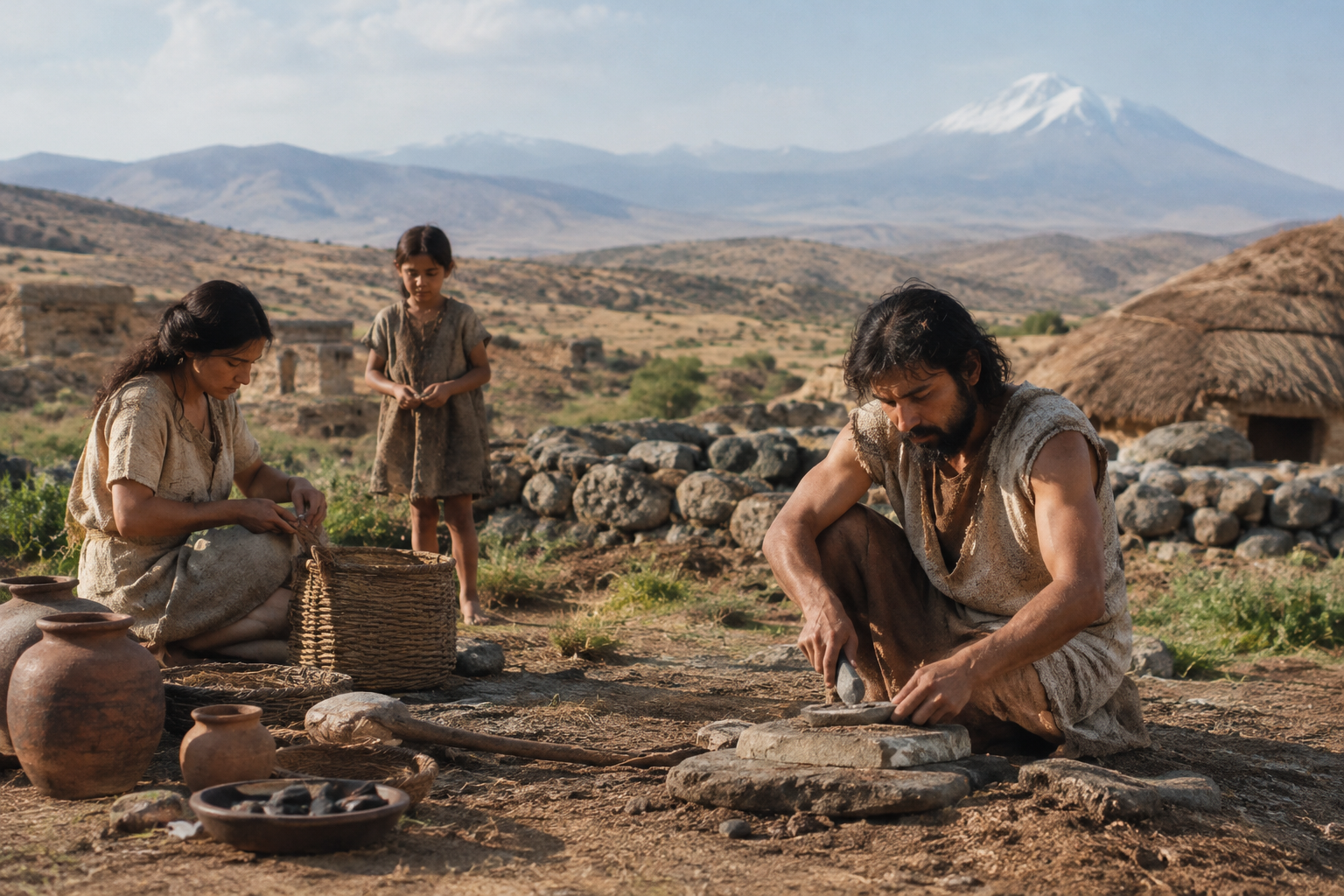
At present, the clearest ancient anchor for Y-DNA haplogroup L1a1 in this set of evidence is a single man from Copper Age Armenia, sample I1632, dated to around 4100 BC. That may sound modest, but in archaeology a lone well-placed sample can be extremely revealing. Here, it places this paternal line in the South Caucasus at a strikingly early moment, when farming villages, metalworking, and long-distance exchange were reshaping the highlands between Anatolia, Mesopotamia, and the Iranian plateau.
The important point is not that one burial can tell us everything. It cannot. But it can tell us that a direct paternal line associated with L1a1 was already present in a region that sat at one of the great crossroads of prehistoric western Asia. Y-DNA follows one narrow line of descent, father to son, rather than a person's whole ancestry, yet that narrow line can still illuminate where particular male lineages appear in the archaeological record and when.
Sample I1632 comes from a period when the South Caucasus was no backwater. By the fifth millennium BC, communities in Armenia and neighboring regions were participating in wider networks linking upland settlements with lowland zones to the south and east. Copper use was spreading, settlement systems were changing, and local societies were experimenting with new forms of production and exchange.
That makes the presence of L1a1 especially interesting. Haplogroup L as a broader paternal family is often discussed in relation to South and Southwest Asia, but that wider story should not simply be pasted onto a narrower branch like L1a1. What the sample actually shows, and what we can say with confidence, is that a man assigned to this branch is attested in Copper Age Armenia around 4100 BC. That places L1a1 within the human landscape of the South Caucasus early enough to matter for debates about prehistoric mobility across the region.
Armenia in this era was part of a belt of interaction rather than a sealed ethnic homeland. Obsidian, metals, animals, crops, and ideas moved across these landscapes. So when a paternal lineage turns up here, the most sensible historical reading is not to assign it to a neat modern identity, but to see it as one thread in a busy prehistoric world of contact zones and local continuity.
If you are trying to understand why one Armenian Copper Age sample deserves attention, the geography is half the answer. The South Caucasus sits between the Black Sea, the Caspian, eastern Anatolia, northern Mesopotamia, and the Iranian plateau. For archaeologists, it is one of those maddeningly important places where local traditions are strong, but outside connections are impossible to ignore.
That is precisely the sort of setting where a lineage like L1a1 becomes historically suggestive. Not because it proves a single migration route, but because it appears in a region where people and goods could move in several directions at once. A paternal line present in Copper Age Armenia may have deeper roots nearby, or it may reflect earlier links with populations farther south or east. With only one ancient sample here, the responsible answer is that the region is plausible for either local persistence, wider interaction, or both.
This is where ancient DNA usefully disciplines the imagination. Older histories often relied too heavily on later ethnic names or on very broad assumptions about where lineages "must" have belonged. A securely dated ancient individual like I1632 reminds us that prehistoric Armenia was populated by real communities whose biological histories do not always map neatly onto later political or linguistic categories.
It is tempting to treat haplogroups as if they were tribes in disguise. They are not. L1a1 is not a language, a culture, or a kingdom. What it marks is one paternal line carried by one man buried in a Copper Age society that was itself made up of many ancestors and many kinds of relationships.
Yet that one line still matters because the fifth millennium BC was a formative period in the highlands. Metallurgy was becoming more significant; village communities were embedded in broader exchange systems; and the South Caucasus was helping shape developments that would matter far beyond its valleys and plateaus. A lineage present there at this date belongs to that story of early complexity.
Readers interested in the wider regional background may want to compare this Armenian evidence with broader work on neighboring populations, including discussions of ancient Iran and adjacent zones. That wider frame helps show how the Caucasus was never isolated from the worlds to its south and east.
There is an odd pleasure in sparse evidence. It forces caution, but it also sharpens the question. With I1632, we are not looking at a large cemetery full of related men, nor at a dynasty that can be traced across centuries. We are looking at one early datapoint that shows L1a1 in prehistoric Armenia and therefore places this branch in the archaeological map of the South Caucasus much earlier than many casual discussions of paternal ancestry might assume.
That matters for anyone whose own paternal results fall somewhere within this branch. It suggests that one part of the L1a1 story may run through ancient western Asian highland societies, not only through later historical populations. But it does not let us leap from one Copper Age burial to a tidy statement about where every modern L1a1 family comes from. Ancient DNA is best when it gives us a firmer starting point, not when it flatters us with false certainty.
It also matters that the date is around 4100 BC, well before the better documented imperial and classical eras that so often dominate public history. This was a time before Armenia in any later political sense, before written royal genealogies, and before the named peoples of historical texts. In other words, L1a1 here belongs to deep prehistory first and foremost.
For MyTrueAncestry users, the real value of a case like this is that it grounds a paternal branch in a specific ancient landscape. Not in a slogan, not in a national myth, but in a real excavated human being: I1632, Copper Age Armenia, around 4100 BC. That is the sort of evidence that turns an abstract haplogroup code into a historical problem worth thinking about.
As more ancient genomes are published from the Caucasus, eastern Anatolia, Iran, and South Asia, the picture of L1a1 will almost certainly become more detailed. For now, though, this early Armenian sample stands as a small but important signpost. It suggests that the history of L1a1 belongs in the old connected worlds of the highlands and borderlands of western Asia, where local communities and long-distance contacts were already shaping human history six thousand years ago.
The most distinctive thing we can responsibly say about L1a1 from this evidence is simple: it is documented in the South Caucasus by the Copper Age, through sample I1632 from Armenia around 4100 BC. For someone researching this paternal line today, that is a meaningful clue. It points toward a deep history in the interconnected uplands between Anatolia, Mesopotamia, and Iran, while reminding us that a haplogroup is one ancestral strand among many in the lives of ancient people.






Comments