Haplogroup J2b2a1a1a1a1a1a1

– 6 min read


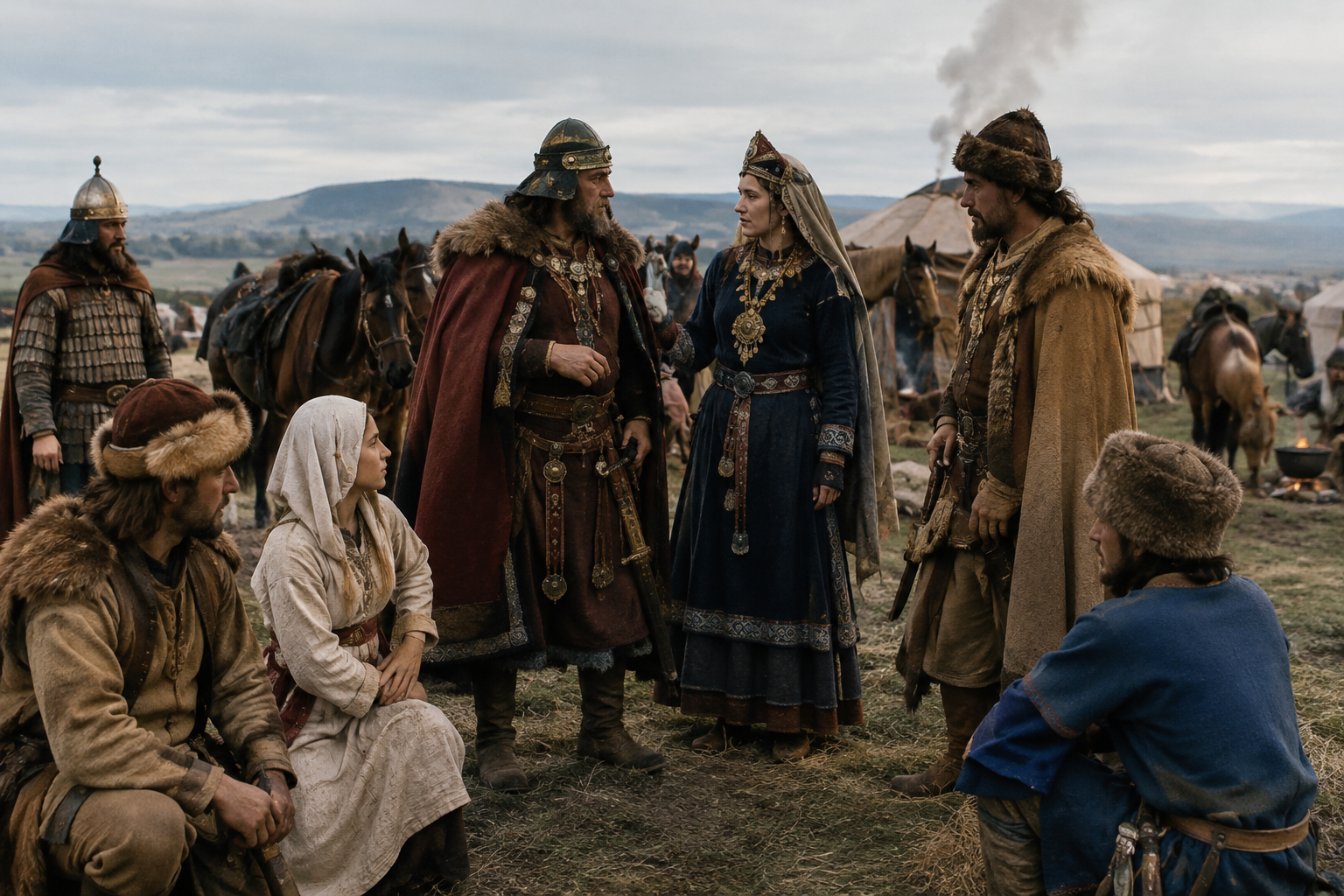
Some Y-DNA haplogroups announce themselves with a broad, familiar historical footprint. J2b2a1a1a1a1a1a1 does something more intriguing. It appears in a scatter of ancient contexts across the Mediterranean, the Balkans, Central Europe, and even farther north, which makes it less the badge of a single people than a clue to movement, mixing, and persistence over many centuries.
That is worth pausing over. A Y-DNA haplogroup traces one direct paternal line only: father to father to father. It does not describe a person's whole ancestry, culture, language, or identity. But when the same paternal branch turns up in burials from Roman Croatia, post-Roman Italy, Avar-period Hungary, medieval Germany, Viking Age Sweden, and late medieval Albania, it gives us a remarkable way of following one thread through a very untidy historical world.
In the wider Y-chromosome tree, this lineage sits within haplogroup J2, a major branch long associated in broad terms with parts of the eastern Mediterranean and western Eurasia. For a very narrow subclade such as J2b2a1a1a1a1a1a1, however, caution is essential. We should not simply pour the full history of all J2 into this one twig. What ancient DNA can show is not a neat origin myth, but a pattern: this paternal line was present in multiple connected zones of the ancient and medieval world, especially where empires, frontier societies, and trade routes brought people together.
The earliest sample in the material provided is especially striking: I24671 from Phoenician Era Mozia Sicily, dated 805 BC. Mozia was no sleepy village. It belonged to the Punic and wider Mediterranean trading world, one of those places where ships, merchants, colonists, and local communities met in ways that written sources only partly capture. A paternal lineage found there reminds us that by the first millennium BC, male lines related to this branch were already present in a maritime world that linked Sicily to North Africa, the Levant, and Italy.
Then the trail shifts into the Roman and post-Roman Balkans. We find R116, a Celtoiberian Outlier Roman Empire VP sample dated 100 AD; PC1001 from the Late Roman Period Poland Carpathian Foothills Boczne dated 300 AD; and Balkan samples such as R3481 from Iron Age Montenegro Doclea Bjelovine dated 320 AD, I15548 from Late Imperial Roman Serbia Timacum Kuline Ravna Village dated 395 AD, I34294 from Late Imperial Roman Croatia Hvar Radosevic Palace dated 400 AD, and R3544 from Late Imperial Roman Period Croatia Gardun dated 431 AD. This is not a tidy ethnic map. It is a Roman map: forts, islands, roads, provinces, and military landscapes.
That is perhaps the best way to think about J2b2a1a1a1a1a1a1 in the evidence here. Not as the signature of one tribe marching under one banner, but as part of the paternal variety present in zones where soldiers, settlers, locals, and newcomers were constantly being thrown together.
By the sixth and seventh centuries, the same pattern continues. In Italy there are P9892g and P9892d from the Post Roman Empire Italy Castel Sozzio Necropolis, both dated 600 AD. In Hungary we see GHD012 and GHD019 from Post Roman Period Pannonia Arrabona Gyirmot Barbaricum Hungary, dated 550 AD. In Bavaria, Alh_119 from Merovingian Period Bavaria Altheim Germany, dated 600 AD, adds another western point to the map. Whatever the exact route of this subclade, the ancient record places it squarely in the middle of Europe's age of moving armies and changing kingdoms.
The most dramatic concentration in the dataset comes from Rakoczifalva in Hungary. Here the haplogroup appears again and again in individuals dated mainly around 650 AD, across both Migration Period Hungary Rakoczifalva and Avar Elite Hungary Rakoczifalva burials. Among them are RKF031, RKF029, RKF198, RKF142, RKF213, RKF015, RKF160, RKF046, RKF157, RKF170, RKF141, RKF127, RKF032, RKF218, RKF010, RKF012, RKF016, RKF041, and RKF231, together with elite-labelled burials such as RKC026, RKF047, RKC046, RKC047, RKC050, RKC011, RKC038, RKC035, RKC002, RKC028, RKC039, RKC012, RKC043, RKC042, RKC020, RKC031, RKF020, RKC005, RKC030, RKC045, and RKF019.
This does not mean that all these men were close relatives in any simple genealogical sense, nor that the haplogroup belonged uniquely to the Avars. But it does tell us something important. In the Carpathian Basin under Avar rule, this paternal branch was not a one-off curiosity. It was present repeatedly in a socially important cemetery complex and persisted there into later material such as RKF210 from Avar Period Hungary Rakoczifalva Szolnok dated 775 AD and RKF219 from the Byzantine/Avar Borderlands Hungary Rakoczifalva Szolnok dated 770 AD.
That concentration makes Rakoczifalva one of the best archaeological windows onto this lineage in the early medieval period. It suggests not a fleeting arrival, but a paternal line embedded in the social world of the middle Danube during a time when the old Roman order had gone and new political formations were being made from many ingredients.
The later samples are just as revealing because they refuse to stay in one region. In Croatia, there is I34800 from Early Medieval Croatia Nustar Dvorac dated 800 AD, I28397 from Medieval Croatia Nustar dated 850 AD, and VEM033 plus VEM025 from Early Medieval Croatia Velim-Velistak, both dated 775 AD. These finds hint at continuity or repeated introduction of related paternal lines in the eastern Adriatic world after Rome.
In Germany, the picture broadens again. There is BRC024x from Migration Period Roman Saxony-Anhalt Bruecken dated 500 AD, the cluster of ADN010, ADN005, ADN009, and ADN001 from Saxon Grave Lower Saxony Hannover-Anderten Germany dated 400 AD, and later KRA010 from Medieval Germany Krakauer Berg Peissen dated 1140 AD. By the time we reach VK346 from Viking Age Oland Sweden dated 950 AD, this paternal branch has appeared on the Baltic as well.
And then there is I15707 from Late Medieval Albania Bardhoc Kukes District dated 1550 AD, a reminder that these lines did not vanish with antiquity. They continued in the Balkans long after the Roman Empire, long after the Avars, long after medieval frontiers had shifted.
So the sensible conclusion is not that J2b2a1a1a1a1a1a1 "belongs" to Phoenicians, Romans, Avars, Croats, Saxons, or Vikings. It is that this paternal lineage moved through worlds inhabited by all of them. Ancient DNA is very good at spoiling simple stories.
What, then, of the later historical landscape of noble families and castles? Here we must keep our heads. The supplied family connection is the House of Vernon, associated with Haddon Hall in Derbyshire. That does not prove that the Vernon male line carried this exact haplogroup, nor that any ancient individual mentioned above was an ancestor of the family. Genetics and family history are not joined by wishful thinking.
Still, Haddon Hall offers a splendid setting for thinking about how paternal lineages survive into the documentary age. The estate began in the Norman period after a grant to William Peverel, and later passed to the Vernon family, who built much of the surviving hall between the thirteenth and fifteenth centuries. Because the family moved away after the seventeenth century, the building escaped the heavy remodeling that swallowed so many great houses. That near-abandonment preserved its great hall, chapel, kitchens, tapestries, and panelled rooms with unusual completeness.
There is something almost archaeological about Haddon Hall. It survived not by being constantly updated, but by being left alone long enough to keep its old skin. In the eighteenth century it passed by marriage to the Dukes of Rutland, and in the nineteenth century it was revived and restored, becoming a romantic emblem of medieval England. In that sense, the hall does in stone and timber what ancient DNA does in bone: it preserves fragments of the past that later centuries did not entirely erase.
If your own Y-DNA falls into an unusual branch such as J2b2a1a1a1a1a1a1, places like Haddon Hall are a useful reminder that surnames, noble houses, and castles belong to a much later layer of history than the deep paternal line itself. The line may be older than the family, older than the manor, older than the kingdom in which the manor stood.
J2b2a1a1a1a1a1a1 is a good example of why ancient DNA has changed historical thinking. On paper, medieval genealogies begin with named men, estates, marriages, and inheritances. In the ground, the story begins much earlier: with sailors in Phoenician Sicily, men in Roman frontier communities, burials in the Balkans, post-Roman Italians, Avar-period elites and commoners in Hungary, and later medieval individuals from Germany to Albania.
That does not give us a single straight family tree. It gives us something more interesting: a map of where one paternal branch appears when history is actually tested against human remains. The result is a lineage associated not with purity or simplicity, but with contact zones, mobility, and long survival.
If this is your haplogroup, MyTrueAncestry can help place that paternal line beside ancient individuals such as I24671, R3544, P9892g, RKF031, RKC026, or VK346. Such matches can offer a fascinating historical perspective on your ancestry, even though they do not by themselves prove direct descent from any one ancient person or noble house.
Upload your DNA and see whether your results connect you to the Roman Balkans, post-Roman Italy, Avar Hungary, or the later medieval world preserved in places like Haddon Hall.






Comments