Haplogroup J2a1a1b1a1a

– 6 min read


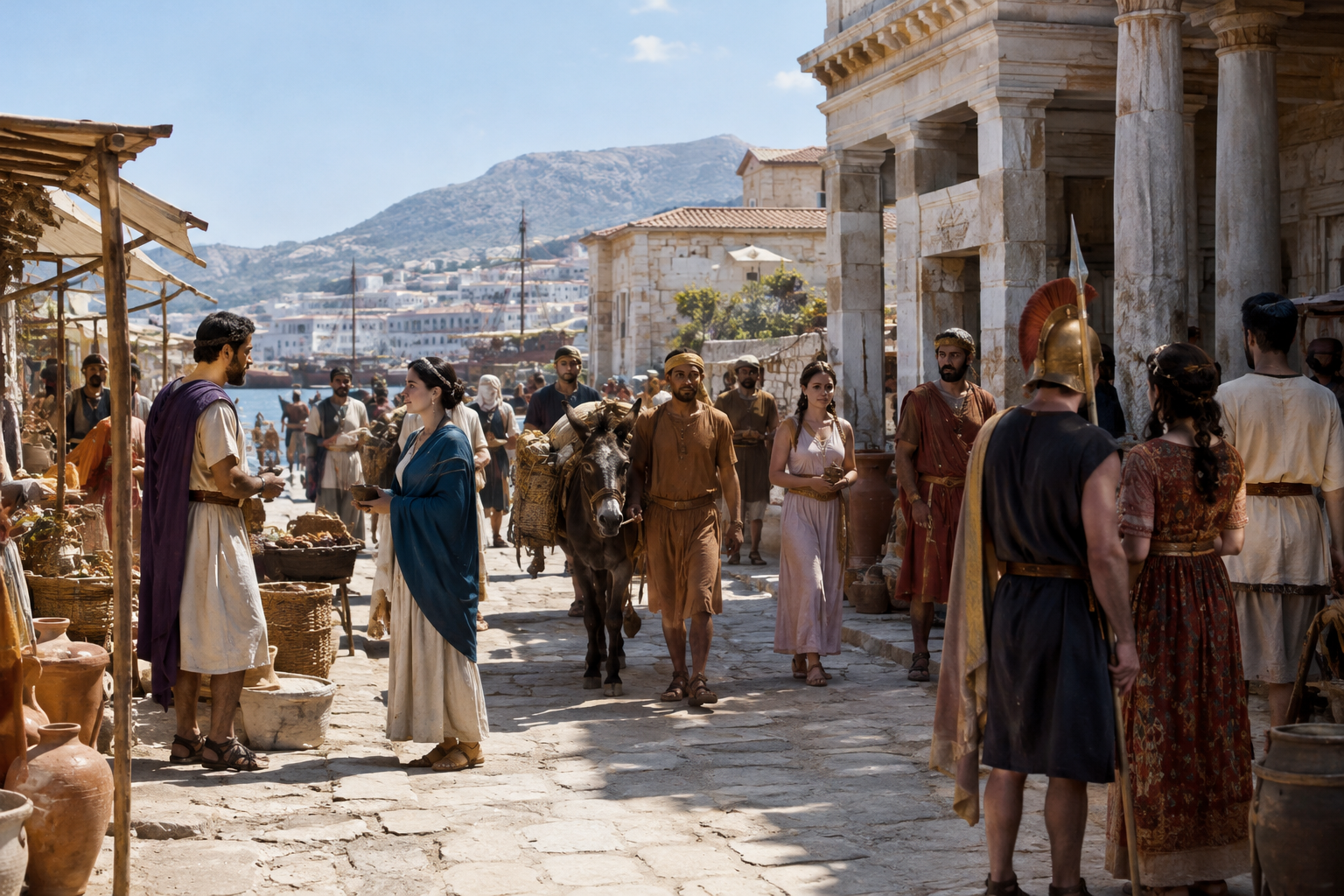
Some Y-chromosome haplogroups are easiest to picture as local stories. J2a1a1b1a1a is not one of them. Even at a glance, the ancient samples associated with this line point across a strikingly wide arc of the old world: Neolithic Armenia, Bronze and Iron Age Iran, Mycenaean Attica, Anatolia under Rome, and Punic Spain. That does not mean a single tidy migration can be drawn with a neat arrow across the map. Quite the opposite. It suggests a paternal lineage embedded in the long, complicated history of the eastern Mediterranean and western Asia, where farmers, merchants, soldiers, palace societies, and empires kept meeting one another for thousands of years.
It is worth pausing over what a Y-DNA haplogroup can and cannot tell us. A Y haplogroup traces one direct paternal line only: father to son to son across deep time. It does not represent a person's whole ancestry, still less their culture, language, or identity. But that single line can be extraordinarily useful. In the case of J2-related branches, ancient DNA has helped show how some paternal lineages were present in regions central to early farming, Bronze Age exchange, and later Mediterranean mobility. For a specific subclade such as J2a1a1b1a1a, caution matters doubly: the narrower the branch, the less we should casually project onto it the entire history of broader J2.
The broader J2 family is often discussed in connection with western Asia and the Mediterranean, and the sample list here fits that general setting rather well. What makes J2a1a1b1a1a historically interesting is not a dramatic tale of conquest, but its presence in places that were already crossroads very early on.
One of the oldest anchors in this set is I3931, from Ancient Armenia Aknashen, dated to 5836 BC. Aknashen belongs to that deep horizon of early settled life in the South Caucasus, a region that sat between Anatolia, northern Mesopotamia, and the Iranian plateau. A sample like this reminds us that paternal lines later seen around the Mediterranean may have roots in communities that belonged to the earliest village worlds of western Asia.
That matters because later history did not begin from nowhere. By the Bronze Age, these worlds were tied together by movement in metals, ideas, crops, craft traditions, and people. If you want the wider background to that early eastern Mediterranean setting, MyTrueAncestry readers may also enjoy this piece:
Explore Neolithic Expansion in the Aegean
By the 3rd and 2nd millennia BC, the same broad paternal story appears farther east and south as well as westward into the Aegean. I8728 from Iron Age Iran Sokhta Seistan Shahr-i is listed with the date 2550 BC, while I4274 from Bronze Age Iran Dinkha Tepe dates to 1825 BC. The label for I8728 is obviously awkward, because the date sits in the Bronze Age despite the wording supplied, but the important point is geographical: Iran was not peripheral. It was one of the main engines of Bronze Age civilization, stretching from plateau communities to urban networks linked with Mesopotamia, Central Asia, and beyond.
A haplogroup turning up in these settings is not evidence for one homogeneous "Iranian" or "Anatolian" people carrying it unchanged through time. It is better understood as a recurring paternal thread inside a very mixed historical landscape.
If one sample in this list catches the public imagination most readily, it may be GLI003, from Mycenaean Glika Nera Attica, dated to 1600 BC. Mycenaean Greece has long stood in popular history halfway between archaeology and epic - palaces, warrior graves, Linear B tablets, and the later shadow of Homer. Ancient DNA has had the delightful effect of making this world less mythical and more human. A Y-line found in a Mycenaean context helps place this paternal heritage firmly within the population history of the prehistoric Aegean.
Then there is I5396 from Katelai, dated to 850 BC, and I4353 from Iron Age Iran Hasanlu Period, dated to 975 BC. Hasanlu, in particular, belongs to a dramatic Iron Age frontier world of fortified settlements, regional powers, and violent destruction horizons. Such samples are useful because they show that related paternal branches were not confined to one cultural label. They appear in different political and archaeological settings across the eastern Mediterranean and adjacent Asia.
For readers interested in how archaeology and genetics illuminate these eastern Mediterranean populations more broadly, this related article makes an excellent companion:
Discover Prehistoric Aegean DNA
By the Roman period, the same wider pattern of movement becomes even easier to imagine. R76, from Anatolian Roman Viale Rossini, dated to 100 AD, sits in a world where soldiers, merchants, enslaved people, freedmen, officials, and families moved around imperial routes with astonishing regularity. Under Rome, Anatolia was not an edge-zone but a central, densely peopled region tied to Italy, the Balkans, the Levant, and North Africa.
So if J2a1a1b1a1a appears in such a setting, the sensible historical conclusion is not "this was a Roman haplogroup," whatever that would mean, but that paternal lines of this kind could travel and persist within imperial systems that joined older regional populations together.
The westernmost sample in this set is especially evocative: I26932, from Carthaginian Spain Malaga Calle Mrmoles, dated to 280 BC. Here we are in Punic Iberia, in the orbit of Carthage, on a coast shaped by Phoenician trade, local Iberian traditions, and later conflict with Rome. A sample like this is a useful corrective to tidy national histories. Southern Spain in the centuries before Rome was not simply "Iberian" in a narrow sense; it was tied into a maritime Mediterranean full of Levantine and North African connections.
That is exactly the sort of context in which a J2-related paternal line makes historical sense. Not because one haplogroup equals "Phoenician" or "Carthaginian" - it does not - but because ancient DNA reveals the biological side of the same connectivity archaeologists have long traced through pottery, inscriptions, and trade goods.
Readers who want to follow that Iberian angle further might enjoy these two MyTrueAncestry articles, both of which help frame the long afterlife of Mediterranean mobility in Spain:
Read About Ancient Punic Diversity
And for the later Roman dimension in Iberia:
Explore Roman Hispania's Legacy
What, then, do we do when this ancient Mediterranean story meets a later noble house? Carefully, and with interest. The supplied historical association here is the House of Villeneuve and the Chateau de Villeneuve at Villeneuve-Loubet in Provence. The castle began as a medieval fortress in the 13th century, built by the counts of Provence to watch the coast and the road between Nice and Antibes. That is exactly the sort of strategic geography that medieval lords cared about: not abstract territory, but movement - who passes, who trades, who marches, who controls the hill.
Over time the chateau passed through noble hands and changed from a defensive stronghold into a more comfortable residence while retaining its commanding hilltop setting. In the early modern period it became tied to local seigneurial power under the French crown. That is a rather fine reminder that castles were seldom frozen monuments. They were lived in, altered, reused, and folded into new political orders.
Now, one must not jump from an ancient Y-line in Armenia, Iran, Greece, Anatolia, or Punic Spain to the claim that the House of Villeneuve was directly descended from any of those ancient men. That would be absurdly overconfident. But one can say something more modest and more interesting: the western Mediterranean, including Provence, belongs to the same long corridor of mobility in which J2-related paternal lines have repeatedly appeared. Ports, coastal routes, Roman integration, medieval resettlement, and noble landholding all took shape on top of much older population histories.
In that sense, the Chateau de Villeneuve stands less as proof of lineage than as a memory-anchor in a region whose human history goes far deeper than its surviving walls.
Readers curious about the family itself can continue with the dedicated community feature here:
Discover the House of Villeneuve
J2a1a1b1a1a is historically compelling because it appears, through these ancient samples, in exactly the parts of the world where settled life, Bronze Age exchange, Aegean palace society, Iranian highland cultures, Roman connectivity, and western Mediterranean colonization all intersect. It is not the badge of a single people. It is a paternal line that turns up in several of history's most connected regions.
That is why Y-DNA is so useful when handled properly. It does not replace archaeology, written history, or family genealogy. It adds another layer. A castle in Provence, a burial in Mycenaean Attica, a Roman-period individual in Anatolia, and a Punic-era sample from Malaga do not form a simple family tree. But together they show how one paternal branch can illuminate the enormous depth of Mediterranean and western Asian history.
If your own Y-DNA falls within J2 or one of its downstream branches, ancient DNA comparisons may help place your direct paternal line into that bigger picture. Not as a fairy tale of instant noble descent, but as something better: a historically grounded glimpse into the real movements of men and families across millennia.
Upload your DNA to MyTrueAncestry to explore whether your results show links to ancient individuals, archaeological cultures, and historical populations like those discussed here. These matches do not prove direct descent from a specific ancient person or noble family, but they can open an extraordinary window onto your deep paternal past.






Comments