Haplogroup J2a1a1a2b2a2b3a

– 5 min read


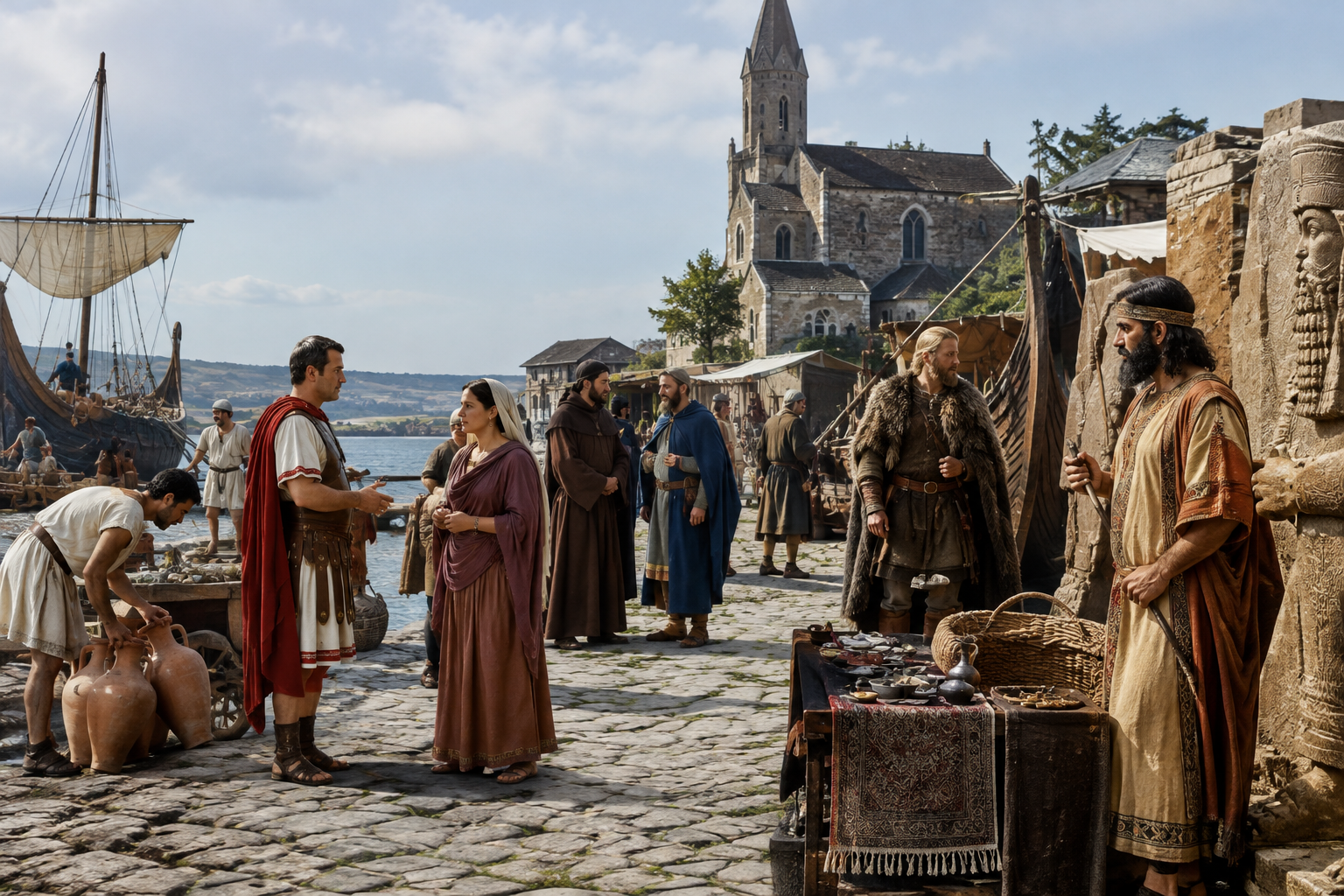
Some Y-chromosome lineages announce themselves with a fanfare of kings and conquerors. Others are more interesting precisely because they do not. Haplogroup J2a1a1a2b2a2b3a belongs to one of those paternal stories that is best understood not as a badge of a single people, but as a clue to movement: men crossing seas, serving in ports, settling in market towns, and leaving descendants in places very far from where their deeper line began.
That makes it a particularly revealing lineage for ancient DNA. Y-DNA haplogroups trace one direct paternal line only - father to father to father - and they do not describe a person's whole ancestry. Still, they are extraordinarily useful. In the case of J2-related branches, the wider family is often associated in broad terms with the eastern Mediterranean and Near East, and with the spread of farming, trade, and later urban life across parts of western Eurasia. For a very specific subclade such as J2a1a1a2b2a2b3a, caution matters. We should not simply pour the entire history of broad J2 into this narrower branch. But the samples we do have suggest a line that appears in Anatolia, turns up in Roman settings, and is later found in early medieval and even Viking Age Europe.
The earliest anchor in the supplied evidence is striking: MA2205, an Old Assyrian Anatolia individual dated to 1625 BC. That does not prove that this exact later subclade originated there, but it does place a related paternal line in Bronze Age Anatolia - a region that was never some remote edge of history, but one of its great crossroads. Merchants, soldiers, herders, scribes, and migrants passed through Anatolia for millennia. If you were looking for a place where a J2-derived paternal branch might become entangled with long-distance movement, this would be a very plausible candidate.
That Bronze Age setting matters because Anatolia linked Mesopotamia, the Aegean, the Levant, and eventually the Roman world. A lineage found there could later travel west not in one dramatic exodus, but through repeated episodes of mobility: trade networks, imperial administration, colonization, military service, marriage, and urban migration. Ancient DNA rarely gives us a neat arrow on a map. What it gives instead is a series of sightings. The sightings here point toward continuity of presence around the eastern Mediterranean and beyond.
Follow the DNA road from Anatolia to Rome
By the Roman imperial period, this paternal story becomes much easier to imagine in human terms. R81, from Anatolian Roman Viale Rossini dated to 100 AD, shows the lineage still present in an Anatolian context under Rome. Then there is R11109, from Imperial Rome Isola Sacra Ostia Antica Port dated to 200 AD. Ostia was the great port of Rome: a place of warehouses, ship crews, dockworkers, traders, freedmen, administrators, and families from all over the empire.
One should not romanticize this as some tidy tale of east-to-west replacement. Roman mobility was messy. People moved in multiple directions, and ports were magnets for diversity. But that is exactly why a J2-derived paternal line at Isola Sacra matters. It sits comfortably within what archaeology and genetics both tell us about the Roman Mediterranean: this was a connected world, and paternal lineages could travel with it.
The same impression is strengthened by VEN001, an Early Medieval Venosa Italy individual dated to 600 AD. Venosa, in southern Italy, had long been tied into wider Mediterranean circuits. By the early medieval period, the western empire had fallen, but movement had hardly stopped. Southern Italy remained a zone where Roman, post-Roman, Byzantine, Lombard, and local histories overlapped. A paternal lineage present in Roman Anatolia and imperial Ostia, and then again in early medieval Italy, hints at persistence through political upheaval.
That is one of the useful correctives of archaeogenetics. Political maps change faster than people do. Dynasties rise and vanish, but families continue.
Explore Roman to early medieval Italy through DNA
Then the plot thickens. The lineage is not confined to the Mediterranean in the supplied ancient evidence. ST2988, from Carolingian Belgium Sint-Truiden Groenmarkt dated to 795 AD, places it in the Frankish world. Sint-Truiden was no anonymous patch of countryside. It was part of the Carolingian realm of monasteries, markets, landed estates, and growing urban networks. Here again, we should be sensible: one burial in Carolingian Belgium does not make J2a1a1a2b2a2b3a a "Carolingian haplogroup." But it does show that paternal lines with deeper Mediterranean or Near Eastern associations had by this date become part of the population fabric of northwestern Europe.
And then there is VK317, from Viking Age Kaargarden Denmark dated to 950 AD. This is the sort of find that reminds us why simplistic genetic storytelling fails. A lineage with earlier evidence in Anatolia, Roman settings, and early medieval Italy appears in Viking Age Denmark. That does not mean Vikings were "really" Anatolian, nor that one man in Denmark rewrites Scandinavian population history. It means Viking Age societies, like Roman ones, were connected and mobile. Scandinavian worlds touched the British Isles, the Frankish realms, the Baltic, the rivers of eastern Europe, Byzantium, and beyond. Men carrying many different paternal lines could end up in a Danish burial ground.
The point is not surprise for surprise's sake. It is that ancient DNA makes Europe look properly historical: entangled, mixed, and full of people on the move.
Discover medieval Sint-Truiden and its DNA story
In this case, the supplied noble-family-and-castle field is blank. That is not a problem; in fact, it is a useful reminder of method. Too often, people want to leap from a Y-haplogroup straight to a named dynasty, a coat of arms, or a ruined keep on a hill. Genetics does not work like that. Without specific documented family evidence, it would be irresponsible to assign J2a1a1a2b2a2b3a to any particular noble house, clan, or castle.
But the absence is instructive. Many noble families emerged in regions - northern Italy, the Low Countries, the Rhineland, Denmark, and the wider Mediterranean - where lineages like this could already have been present for centuries through trade, military service, settlement, and local continuity. Medieval castles and aristocratic seats preserve the memory of lordship; ancient DNA preserves the memory of population history. They are not the same archive.
So if a reader carries this haplogroup today, the historically responsible question is not, "Which castle was mine?" but rather, "Through what chain of ordinary and extraordinary male-line lives did this branch pass from Bronze Age Anatolia to Roman ports, early medieval Italy, Carolingian Belgium, and Viking Age Denmark?" That is a much better question, and a more human one.
Read more about Viking Age genetic diversity
Haplogroup J2a1a1a2b2a2b3a is historically interesting because its ancient appearances sketch a believable arc across some of the most connected landscapes of the ancient world. The evidence supplied here begins with MA2205 in Bronze Age Anatolia, continues with R81 in Roman Anatolia and R11109 at the port of Ostia, reappears with VEN001 in early medieval southern Italy, and then turns up farther north with ST2988 in Carolingian Belgium and VK317 in Viking Age Denmark.
That sequence does not prove direct descent from any one ancient individual, nor does it define an ethnicity. What it does suggest is that this paternal branch belonged to the sort of men who so often vanish from conventional history: not emperors, but participants in the networks that made empires, towns, ports, and kingdoms work. Ancient DNA is good at recovering precisely those forgotten continuities.
For readers interested in the broader genetic background of such studies, it is worth stepping back and looking at how the whole field works - how archaeologists, geneticists, and historians extract these fragments of paternal history from burials across continents and centuries.
Learn how ancient DNA decodes human history
If you carry a lineage like J2a1a1a2b2a2b3a, MyTrueAncestry can help place it in a far wider historical setting - alongside ancient individuals from places such as Anatolia, Roman Italy, Carolingian Belgium, and Viking Age Scandinavia. These matches do not by themselves prove direct genealogical descent or membership in a noble family, but they can offer a fascinating window into the deep history of your paternal line and your broader ancestry.
Upload your DNA to MyTrueAncestry and see which ancient worlds your results may connect you to.






Comments