Haplogroup J2a1a1a2b2a1

– 7 min read


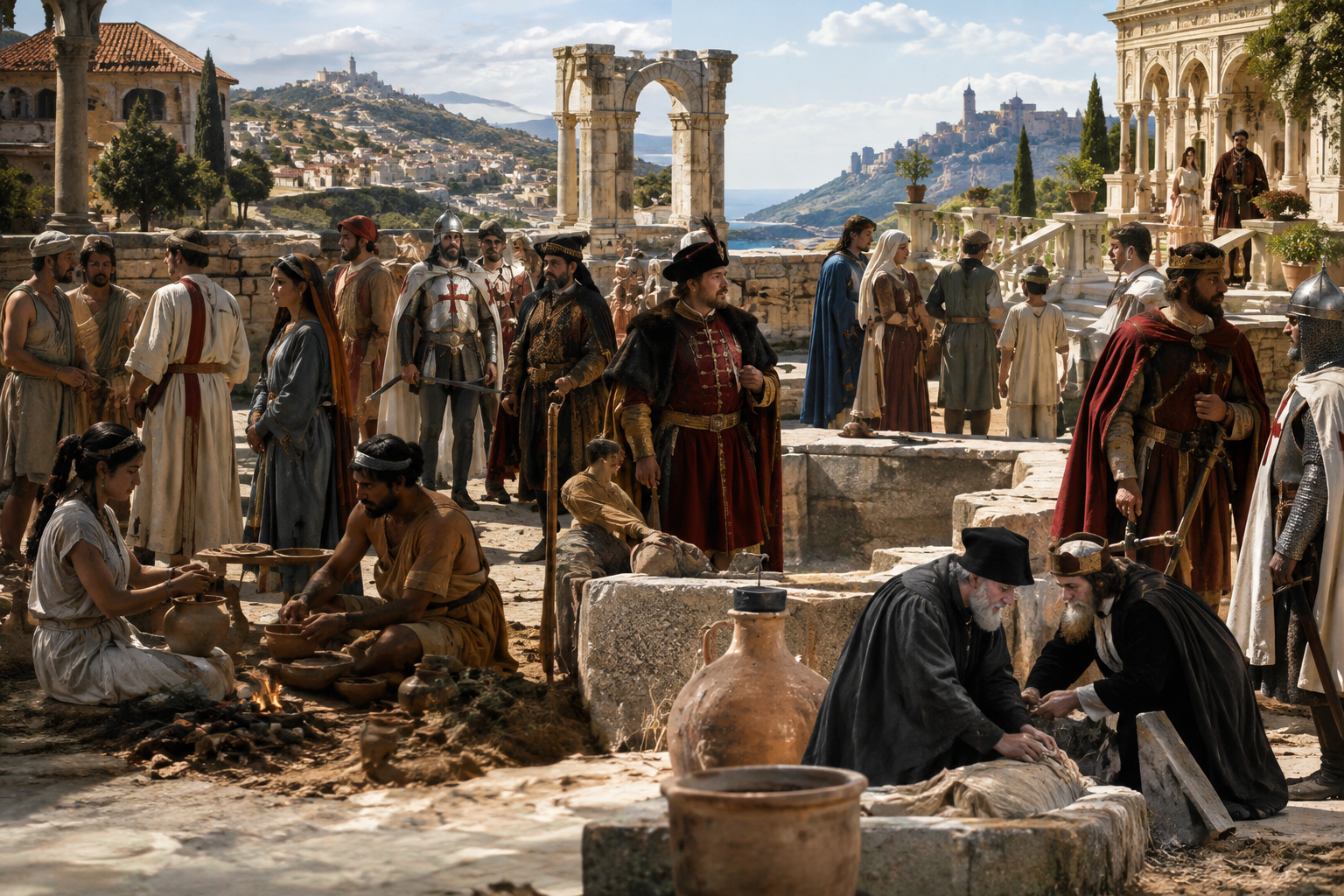
Some Y-chromosome lineages look tidy on a map. Haplogroup J2a1a1a2b2a1 does not. It turns up in places that force us to think historically rather than romantically: Neolithic Anatolia, Bronze Age Syria and the Levant, Iron Age Armenia, Punic North Africa, Roman and Byzantine contexts, medieval Central Europe, and even later noble settings. In other words, this is not the story of one tribe marching in a straight line across a continent. It is the story of men moving through farming villages, palace societies, trade routes, imperial networks, courts, and frontier worlds.
That is what makes this haplogroup so interesting. Y-DNA traces one direct paternal line only, not a person's whole ancestry, and certainly not a whole people. But when a lineage appears again and again in well-dated burials, it gives us a useful thread through the labyrinth. In the case of J2a1a1a2b2a1, the thread seems tied especially to the long connected zone stretching from Anatolia and the South Caucasus into the eastern Mediterranean, and later into parts of Europe through the ordinary but profound mechanisms of history: migration, marriage, military service, trade, religion, and lordship.
At the broader level, J2 is widely associated by researchers with parts of the Near East and eastern Mediterranean, and with the spread of farming and later complex societies. That broad background matters, but it must be handled carefully. A narrow branch like J2a1a1a2b2a1 is not identical to the full history of all J2, and we should not simply pour the entire Neolithic or Bronze Age into one subclade as though nothing changed for thousands of years.
Still, the earliest clues in the supplied material are striking. Two individuals from Neolithic Anatolia Arslantepe, dated to 4568 BC, ART011 and ART001, place this paternal line, or a very closely related one, in one of the great formative zones of western Asian prehistory. Arslantepe matters because Anatolia was no backwater. It was one of the crucial theaters in which early farming communities expanded, villages became more stratified, and the first experiments in power, storage, and administration took shape.
A little later, the branch appears in Early Bronze Age Southeast Anatolia Tatika, 2100 BC, sample I4478, and in Amorite Alalakh, 1820 BC, sample ALA004. Add to that the Late Bronze Age Canaanite Megiddo individual I4519, dated 1439 BC, and a pattern begins to emerge: this was a paternal line at home in the urbanizing, literate, diplomatically entangled world of the ancient Near East. Not proof of one dynasty, one language, or one ethnicity - but clear evidence of repeated presence in the societies linking Anatolia, northern Syria, and the Levant.
If you want a broader look at how ancient DNA has transformed exactly these kinds of historical questions, MyTrueAncestry readers may enjoy this overview of the field.
One of the pleasures of ancient DNA is that it takes us away from abstract arrows on a map and back to actual burials. The J2a1a1a2b2a1 signal in the supplied dataset is geographically broad, but not random.
In the South Caucasus and neighboring highlands, we have Iron Age Armenia Bragdzor Cemetery Year:850 BC ID:I16536 and Iron Age Northern Armenia Bragdzor Year:750 BC ID:I16546. These are important because Armenia sits at one of Eurasia's great hinges: between Anatolia, Iran, the steppe-facing Caucasus, and Mesopotamia. Their presence there suggests continuity or repeated movement of related paternal lines through a region that was politically fragmented but never isolated.
There is also a later Armenian sequence in Kingdom of Armenia Beniamin Year:50 AD ID:R11713 and Late Kingdom of Armenia Year:490 AD ID:R11542. That does not prove unbroken descent from the earlier Bragdzor men, but it does hint that this paternal branch remained part of the demographic furniture of the region across many centuries.
Then there is the Mediterranean. Carthaginian Kerkouane Tunisia Pantelleria Year:426 BC ID:I22232 places the lineage in the Punic world of North Africa and island exchange. Roman Villa Granada Spain Year:300 AD ID:I4054 and Post Roman La Palma Sardinia Year:603 AD ID:I12220 show it farther west in Roman and post-Roman contexts. Byzantine Roman Aegean Mugla Anatolia Year:604 AD ID:I20320 reminds us that eastern Mediterranean mobility did not stop with Rome; it simply changed its paperwork and its emperors.
Perhaps the most arresting samples are those that show how such lineages could move far beyond their earlier heartlands. In Nubia, three individuals from Kulubnarti - I17475 dated 750 AD, I6325 dated 760 AD, and I6255 dated 810 AD - place the lineage in Christian Makurian territory on the Middle Nile. No sensible historian would say, "Aha, therefore Nubia was Near Eastern in some simple paternal sense." But the samples do reveal how connected late antique and medieval worlds really were.
For readers interested in how these sorts of findings illuminate the southern Caucasus over the long term, this related article is a good companion piece.
Read South Caucasus DNA history
By the Middle Ages, the haplogroup appears in settings that many readers will find more familiar. In Central Europe there is Post Roman Era Szeleste Savaria Pannonia Prima Hungary Year:525 AD ID:SZL009, placing the lineage in the complicated aftermath of Roman provincial life in western Hungary. This was a world not of clean ethnic replacement but of overlap: post-imperial administration, military movement, local survivals, and incoming groups.
The branch also appears in medieval Polish contexts: Medieval Piast Era Poland Silesia Milicz Year:1100 AD ID:PCA0548 and Kingdom of Poland Lublin Zamosc Year:1150 AD ID:PDH003. Again, caution first: shared haplogroup is not proof of close kinship with rulers. But these samples do show that this paternal line had become part of the population history of medieval east-central Europe.
That makes the later elite examples particularly interesting. The supplied list includes Ancient Individual:Medieval Hungarian Bathory Male Nobility Pericei Year:1500 AD ID:PER04A. This is precisely the sort of find that tempts people into overstatement. We should resist it. One noble burial carrying this haplogroup does not prove that every Batory or Bathory man did, nor does it transform a genetic branch into an aristocratic badge. What it does do is anchor the lineage in a documented noble milieu of late medieval Hungary.
There is also Crusader Knight Armenian / Lebanon Year:1250 AD ID:SI-44, a reminder that crusading society in the Levant was never a simple story of western Europeans planted onto eastern soil. Medieval warfare, pilgrimage, alliance, and intermarriage all produced more complicated human biographies than the old schoolbook version allowed.
Two further samples from Late Medieval Ashkenazi Cemetery Erfurt Germany Year:1350 AD, I13870 and I13864, show that this paternal branch also formed part of Jewish medieval Europe. That is a useful warning against flattening haplogroups into single communal identities. The same broad paternal line can belong, at different times, to men living in Christian courts, Jewish towns, Armenian highlands, Roman villas, and Punic ports.
If the Polish material catches your eye, this article on the Piasts is well worth a look, especially for the intersection of dynastic history and genetics.
Discover Piast genetic history
The supplied noble connection here is not a medieval fortress on a crag but something, in its way, more revealing: Riddarshuset Lagerbielke Alvsjo gard in southern Stockholm. Alvsjo gard began as an old manor estate rooted in the medieval farming landscape around Lake Malaren. Over the early modern period it gained importance as agriculture and local trade shaped the district. The building seen today belongs largely to later rebuilding and estate development, and as Stockholm expanded, the old landed world was gradually broken apart and absorbed into suburbia.
That history is worth lingering over because it shows how noble identity is preserved not only in castles of war but in estates of management, fields, roads, rents, and regional influence. Alvsjo gard still carries the memory of a world in which landed families structured daily life across Sodermanland. It is a social landscape rather than a battlefield monument.
As for genetics, we should be exact. The appearance of J2a1a1a2b2a1 in a set of ancient and historical individuals does not prove that the Lagerbielke family as a whole belonged to that haplogroup, nor that every branch of the family shared a single paternal line. What the association offers is context: a noble Swedish house set against the much older and wider movements of paternal lineages across Europe. It is a reminder that the social map of aristocratic families sits atop a far deeper demographic map.
Readers interested in the family itself can follow that thread further here.
Explore the Lagerbielke family
So what does J2a1a1a2b2a1 reveal? First, that some paternal lineages were remarkably durable across the old connected worlds of Anatolia, the Caucasus, the Levant, and the Mediterranean. Second, that by the Roman, Byzantine, and medieval periods such lineages could be found far beyond any presumed homeland, in Hungary, Poland, Germany, Sardinia, Spain, Nubia, and the crusader Levant. Third, that ancient DNA is most interesting when it complicates our categories rather than confirming our stereotypes.
And what does it not reveal? It does not tell you a man's language, religion, rank, or national identity on its own. It does not prove direct descent from a Canaanite at Megiddo, an Armenian noble, a crusader knight, or a family at Alvsjo gard merely because of a shared paternal branch. But it does place your direct male line inside a historical pattern - and sometimes that is the most exciting thing of all. Not fantasy pedigree, but real human placement in the long, unruly record of the past.
If you have this haplogroup in your results, you are looking at a paternal line with a history tied to some of the most interconnected regions of the ancient world. Farmers, townsmen, nobles, merchants, soldiers, courtiers, and migrants may all stand somewhere in that background. The archive is genetic, but the story is thoroughly historical.
MyTrueAncestry lets you compare your DNA with ancient individuals from archaeological sites across the world, including the kinds of burials discussed here. Those matches can offer a vivid perspective on your deeper ancestry, even though they do not by themselves prove direct descent from any one ancient person or noble family. If you want to see whether your DNA links you to worlds like Arslantepe, Megiddo, medieval Hungary, or the lands around Stockholm, this is the place to begin.






Comments