Haplogroup I2a2b

– 6 min read


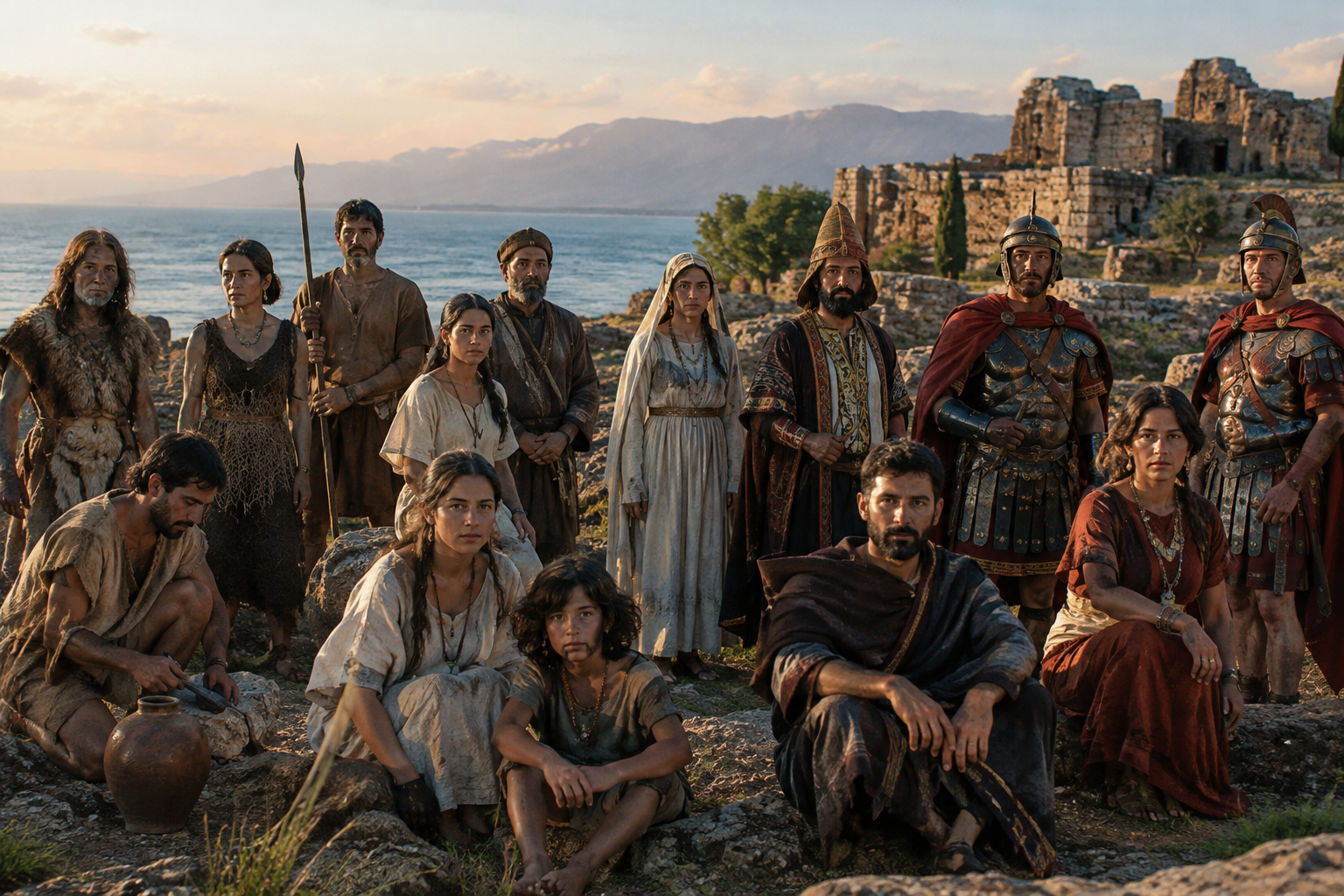
Some Y-DNA haplogroups announce themselves with a neat historical label. Others refuse to behave so tidily. I2a2b belongs very much to the second category. It sits within haplogroup I, one of the old European paternal branches, and its story is interesting precisely because it appears across very different times and landscapes: Mesolithic northern Europe, Neolithic central Europe, the Roman world, the Balkans, the Mediterranean, the South Caucasus, Armenia, and even the modern era in Crete.
That makes I2a2b valuable for historians and for family researchers alike. Y-DNA traces a direct paternal line only: father to son to son across generations. It does not describe a person's whole ancestry, culture, language, or identity. But when ancient DNA places related paternal branches in burials separated by thousands of years, it gives us a rare way of following one thin thread through an enormous and complicated human past.
Broadly speaking, haplogroup I is often associated with long-standing European paternal ancestry, especially among post-Ice Age hunter-gatherer populations. But one must be careful here. The full history of haplogroup I cannot simply be assigned wholesale to the narrower branch I2a2b. What the evidence does suggest is that lineages related to I2a2b were present in Europe very early and later became part of several different population histories.
The supplied ancient samples show just how wide that history may be. One of the oldest is SPI001, from Mesolithic Germany, Lower Saxony, East Frisia, Spiekeroog, dated to 5460 BC. This is a striking reminder that paternal lines related to I2a2b were present among people living in the North Sea world long before written history, before kingdoms, before castles, before even farming had fully transformed much of Europe.
Then there is DER021 from Neolithic Germany, Derenburg-Meerenstieg II, dated to 6000 BC. Whatever precise local context lay behind that burial, it places the haplogroup's story in the era when farming communities were taking shape across central Europe. That alone is historically fascinating: the same broad paternal branch appearing in both Mesolithic and Neolithic settings suggests not a single dramatic episode but long-term entanglement between foragers, farmers, and their descendants.
If the German samples hint at deep European roots, the later ancient DNA evidence shows something equally important: mobility, survival, and regional persistence across a very broad zone.
Take I15524, from the Late Roman Empire at Viminacium, Serbia, Grobalja Necropolis, dated to 250 AD. Viminacium was one of those Roman places that makes tidy ethnic labels look absurd. It was a military, administrative, and commercial center on the Danube frontier, full of soldiers, locals, migrants, traders, slaves, and families of mixed origin. Finding an I2a2b-associated paternal line there fits perfectly with what we know of the Roman Empire: not a static population, but a world of movement.
Far to the southwest, I22091 from Imperial Roman Era Sardinia, Tharros, dated to 200 BC, places the lineage in a major Mediterranean setting. Tharros was tied into Punic and then Roman worlds, a coastal town shaped by exchange and imperial rule. A paternal lineage like I2a2b appearing there does not tell us that Sardinia was somehow "defined" by that haplogroup; it tells us instead that Mediterranean history was peopled by lineages with deep and varied backgrounds.
The Armenian and South Caucasus samples are especially notable. We have CGG021779 from Iron Age Georgia, Digomi, dated to 875 BC. We also have a cluster from Armenia spanning centuries: I18277 from Late Bronze Age Armenia, Lchashen Cemetery, dated to 1250 BC; I19333 from Late Bronze Age Armenia, Karashamb Cemetery, dated to 1175 BC; I18168 from Late Bronze Age Armenia, Black Fortress, dated to 1100 BC; I18161 from Late Bronze Age Armenia, Urartian Harjis, dated to 1100 BC; I16220 from Iron Age Urartian Armenia, Karashamb Cemetery, dated to 1048 BC; R11536 from Assyrian Period Armenia, dated to 975 BC; and I1637 from Iron Age Armenia, Aghitu, dated to 60 AD.
That is not a random scatter. It suggests that related paternal lines were part of the long human history of the Armenian Highlands and neighboring Caucasus regions across the Late Bronze Age, Urartian horizon, Assyrian-era contact, and into the early centuries AD. That does not prove one continuous unbroken local dynasty of I2a2b men, of course. But it does show that this branch was present repeatedly in a region famous for fortified landscapes, mountain routes, and imperial borderlands.
Read South Caucasus DNA History
What emerges from these samples is not a single migration tale with a beginning, middle, and end, but something more historically plausible. I2a2b appears to have been part of several regional histories at once. In northern and central Europe, it reaches back into very early prehistoric populations. In the Balkans and Danube region, it appears in a Roman frontier context. In Sardinia and Crete, it surfaces in Mediterranean settings. In Armenia and Georgia, it appears in Bronze and Iron Age societies linked to fortresses, kingdoms, and great imperial neighbors.
The modern-era sample Sarakina_10 from Modern Era Crete, Rethimno, Sarakina War Victim, dated to 1941 AD, gives the whole story a human jolt. Suddenly we are no longer in prehistoric cemeteries or Roman necropoleis, but in the violence of the Second World War. That is one of the most powerful things about Y-DNA and ancient DNA together: the same paternal branch can be found in a Mesolithic islander off the German coast and in a war victim in twentieth-century Crete. Not because they were close genealogical relatives in any meaningful recent sense, but because paternal lines can endure, split, move, and reappear across astonishing spans of time.
For readers interested in the Balkan side of this picture, the broader prehistoric and historic background is especially worth exploring, since southeastern Europe was one of the key meeting grounds between old European lineages, incoming farmers, and later imperial populations.
Discover Balkan Hunter-Gatherers
The supplied noble family field here is blank, and that absence is worth stating plainly. We are not given a documented noble house, clan, or castle specifically tied to I2a2b for this article. So the responsible thing is not to conjure one into existence. That may sound disappointingly unromantic, but it is in fact the right historical method.
Too often, haplogroups are made to do work they simply cannot do. Sharing a Y-DNA branch with an ancient burial does not make someone the heir of a Bronze Age fortress, a Roman officer, or a medieval lord. Nor can a castle, however imposing, serve as proof of a paternal lineage. What castles and noble genealogies can offer is context: they preserve the memory of later societies built on top of much older population histories.
That is particularly relevant for a haplogroup like I2a2b, which turns up in regions later filled with fortifications, ruling houses, and competing kingdoms. The Armenian Highland samples, for example, come from worlds of cemeteries and strongholds long before the medieval castles most readers picture. The Roman frontier sample from Viminacium belongs to a landscape that later became part of the medieval Balkan patchwork of lords and fortresses. Genetics cannot leap directly from those ancient men to a named noble family without specific evidence. But it can remind us that the human foundations of later aristocratic landscapes were far older and more mixed than any single pedigree suggests.
I2a2b is historically interesting because it refuses to stay in one box. The evidence supplied here places it in Mesolithic Germany, Neolithic Germany, Roman Serbia, Roman-era Sardinia, Iron Age Georgia, multiple Bronze and Iron Age contexts in Armenia, and modern Crete. That distribution does not point to one simple ethnic story. It points to durability and movement.
For family historians, that is an important lesson. A Y-DNA haplogroup is not a nationality, not a coat of arms, and not a complete family tree. It is one paternal line among countless ancestral lines. But when that one line appears repeatedly in ancient burials across such varied settings, it becomes a remarkable historical tool. It allows us to see continuity where written records are silent, and complexity where old legends preferred simplicity.
That is where MyTrueAncestry becomes so compelling. Ancient DNA comparisons cannot by themselves prove direct descent from SPI001, DER021, I15524, or the men buried at Karashamb, Lchashen, Digomi, or Tharros. But they can place your DNA in conversation with the real archaeological past, and sometimes that is the more interesting discovery.
If your paternal line belongs to I2a2b, or to a nearby branch, you may be looking at a lineage with roots stretching across prehistoric Europe, the Roman world, and the mountainous crossroads of the Caucasus. That is not a fairy tale about noble blood. It is something better: history.
Upload your DNA to MyTrueAncestry and explore how your results compare with ancient individuals, archaeological cultures, and the deep paternal history revealed by discoveries like these.






Comments