Haplogroup I2a2a1

– 6 min read


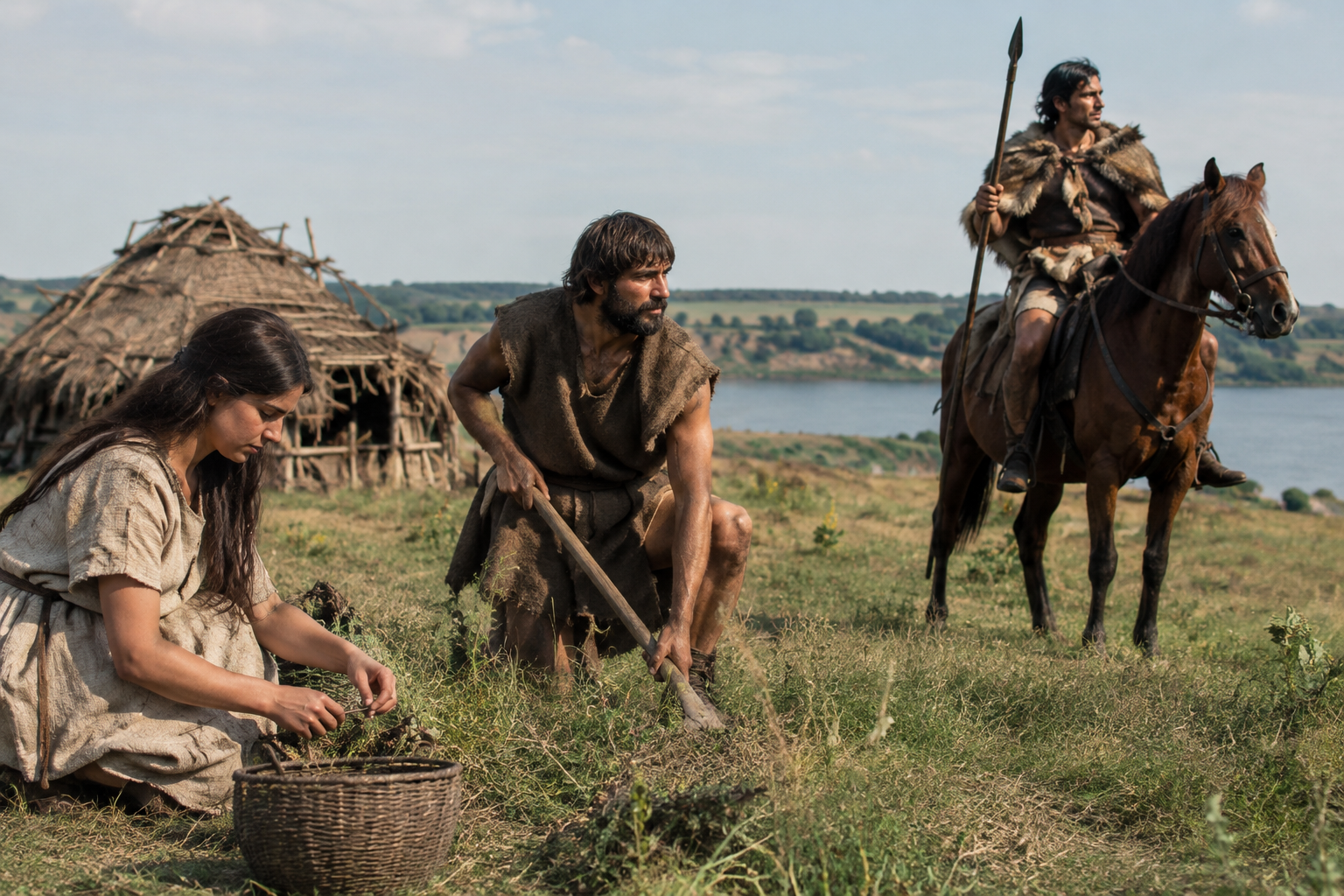
Some Y-DNA haplogroups announce themselves with imperial drama. Others are quieter, older, and in some ways more revealing. I2a2a1 belongs to that second category. It is a paternal lineage that helps us look past the noise of later kingdoms and surnames to something more deep-rooted: the long history of men living, moving, marrying, and being buried across eastern and southeastern Europe over thousands of years.
As always with Y-DNA, there is an important limit as well as a fascination. A Y-haplogroup tracks only one line of descent: the direct paternal line, father to son to son. It does not describe a person's whole ancestry, culture, language, or identity. But when ancient DNA places a lineage like I2a2a1 in real burials, with real dates and real landscapes, it gives us an unusually sharp way of following one thread through prehistory.
I2a2a1 is part of haplogroup I, one of the major Y-chromosome branches long associated with ancient European paternal ancestry. Broadly speaking, haplogroup I descends from very old lineages present in Europe after the Ice Age, while its later branches appear in different regions and periods with very different histories. That matters here, because we should not lazily pour the whole history of haplogroup I into the narrower vessel of I2a2a1.
What the supplied evidence does suggest is that this lineage was present in the broad zone stretching from the north Pontic region into the Balkans by the Neolithic and Bronze Age. That is already interesting enough. It places I2a2a1 in one of the great contact regions of Eurasian history: the lands between the Black Sea steppe, the river systems of Ukraine, and the farming worlds of southeastern Europe.
Those were not static places. They were corridors of movement, exchange, adaptation, and occasional upheaval. Ancient DNA has transformed our understanding of them, especially by showing that paternal lines could persist locally even as wider ancestry patterns shifted around them.
If you want a wider view of that deep regional background, one particularly useful companion piece is this study of the same broad world of foragers, farmers, and migrants in southeastern Europe.
Explore Balkan Hunter-Gatherer Roots
The most vivid way to understand I2a2a1 is not through an abstract tree diagram, but through the ancient men whose remains carried this lineage.
The earliest of the supplied examples is I3715, from Neolithic Vilnianka Zaporizhia Ukraine, dated to 5576 BC. That date places him in a period when the north Pontic region was already entangled with the spread of farming, yet still retained strong local traditions and populations. A Y-line such as I2a2a1 appearing here reminds us that the Neolithic was not simply a matter of one people replacing another in a neat line across a map. It was a messy human business of mixture, persistence, and local survival.
Then there is I2175, from Early Bronze Age Bulgaria, dated to 3100 BC. Now the scene shifts south into the Balkans. This is important because it shows the lineage in another key region at another turning point, when metalworking, changing burial customs, and new long-distance connections were reshaping European societies. Bulgaria in the Early Bronze Age sat at a hinge between the steppe, the Aegean, and the Danube world. A paternal lineage found there cannot be reduced to a single ethnicity or people, but it does show that I2a2a1 was part of that changing human landscape.
The third sample is perhaps the most evocative in archaeological terms: ILK002, described as Horserider Ilyatka Ukraine Bronze Age, dated to 2800 BC. The very label "horserider" instantly places him in the debates around mobility, pastoralism, and the emergence of horse-based lifeways in the steppe and forest-steppe zones. One should be cautious: the sample does not by itself prove a grand migration narrative. But it does place I2a2a1 in a world where faster movement across open country was becoming historically consequential.
Taken together, these three individuals do not give us a simple straight line. They give us something better: evidence that the lineage appears in both Ukraine and Bulgaria, across the Neolithic to Bronze Age transition, in settings linked to farming frontiers, regional continuity, and increased mobility.
Readers interested in that wider north Pontic context will find this article especially relevant, because it follows the same broad region through exactly the sort of era in which these samples matter most.
Read the North Pontic Migration Story
If there is a sensible historical picture to sketch from these samples, it is this: I2a2a1 seems at home in a broad interaction zone rather than in a single isolated homeland neatly sealed off from its neighbours. The lower Dnieper region, Zaporizhia, western steppe margins, and the Balkans were repeatedly drawn into contact. Farming spread. Herding expanded. River routes and overland corridors linked communities that might once have seemed very separate.
That is why Y-DNA is so useful, and so often misunderstood. A paternal lineage can persist through major changes in language, economy, burial rite, and political structure. The man buried in Neolithic Zaporizhia and the man buried in Bronze Age Bulgaria do not need to belong to the same "people" in any modern sense for their shared paternal branch to be historically meaningful.
Ancient DNA also helps correct a common fantasy about noble or national origins. No modern population, and certainly no medieval dynasty, springs fully formed from one prehistoric tribe carrying one haplogroup. What survives instead are lineages embedded in changing populations. I2a2a1 is best understood in that way: not as a badge of a single tribe, but as a durable paternal thread within the history of eastern and southeastern Europe.
For a broader look at how archaeology and genetics together have changed these discussions, this MyTrueAncestry article makes an excellent companion read.
Discover How Ancient DNA Rewrote History
In this case, the supplied field for associated noble families and castles is blank. Oddly enough, that is a useful reminder of method. It is tempting, when dealing with Y-DNA, to leap from a prehistoric burial to a medieval coat of arms, as if one naturally confirms the other. Usually it does not.
Castles, dynasties, and landed families preserve memory in stone and parchment. Y-DNA preserves a narrower biological line. Sometimes those worlds meet, especially where documented or tested paternal lines survive. But more often they sit alongside each other as different kinds of evidence. With I2a2a1, what we have here is a strong prehistoric and protohistoric context, not a securely supplied noble-house dossier.
That does not make the story poorer. Quite the opposite. It keeps our feet on the ground. We can say that later medieval regions in eastern Europe and the Balkans often stood on landscapes already inhabited for millennia by men carrying lineages like this one. We cannot say, from the evidence supplied here, that any particular castle lord or noble surname was descended in direct male line from I3715, I2175, or ILK002.
If you enjoy seeing how MyTrueAncestry handles historically documented dynasties when the evidence is available, one useful comparison is the article on the Basarab house, a later ruling lineage from a neighbouring part of eastern Europe.
The real fascination of I2a2a1 lies in scale. On the one hand, it is extremely intimate: one paternal line, passed from father to son. On the other, it opens onto the largest questions in European prehistory. Who lived in the north Pontic region before and during the spread of farming? Which male lines persisted into the Bronze Age? How did populations in Ukraine and Bulgaria connect across changing cultural worlds?
The samples I3715, I2175, and ILK002 do not answer all those questions. But they do anchor them. They tell us that I2a2a1 was present in these regions across major transitions, and that ancient DNA can now catch such lineages in the act of history rather than only in modern testing databases.
That is one of the pleasures of archaeogenetics. It does not flatten the past into a single identity label. It restores complexity. The same paternal branch can appear in a Neolithic individual in Zaporizhia, an Early Bronze Age man in Bulgaria, and a Bronze Age horserider in Ukraine, without those men being reducible to the same culture, language, or polity.
If your own Y-DNA includes I2a2a1, that does not make you a direct descendant of any one of these ancient men. But it may place your paternal line within the same deep historical world they inhabited - the river valleys, steppe margins, and Balkan corridors where so much of European prehistory was worked out.
Upload your DNA to MyTrueAncestry to explore how your results compare with ancient individuals such as I3715, I2175, and ILK002, and to discover how archaeology and genetics together can illuminate your past. Those matches may not prove direct descent or membership in any noble family, but they can offer a remarkably concrete view into the ancient populations connected to your ancestry.






Comments