Haplogroup I2a2a

– 7 min read


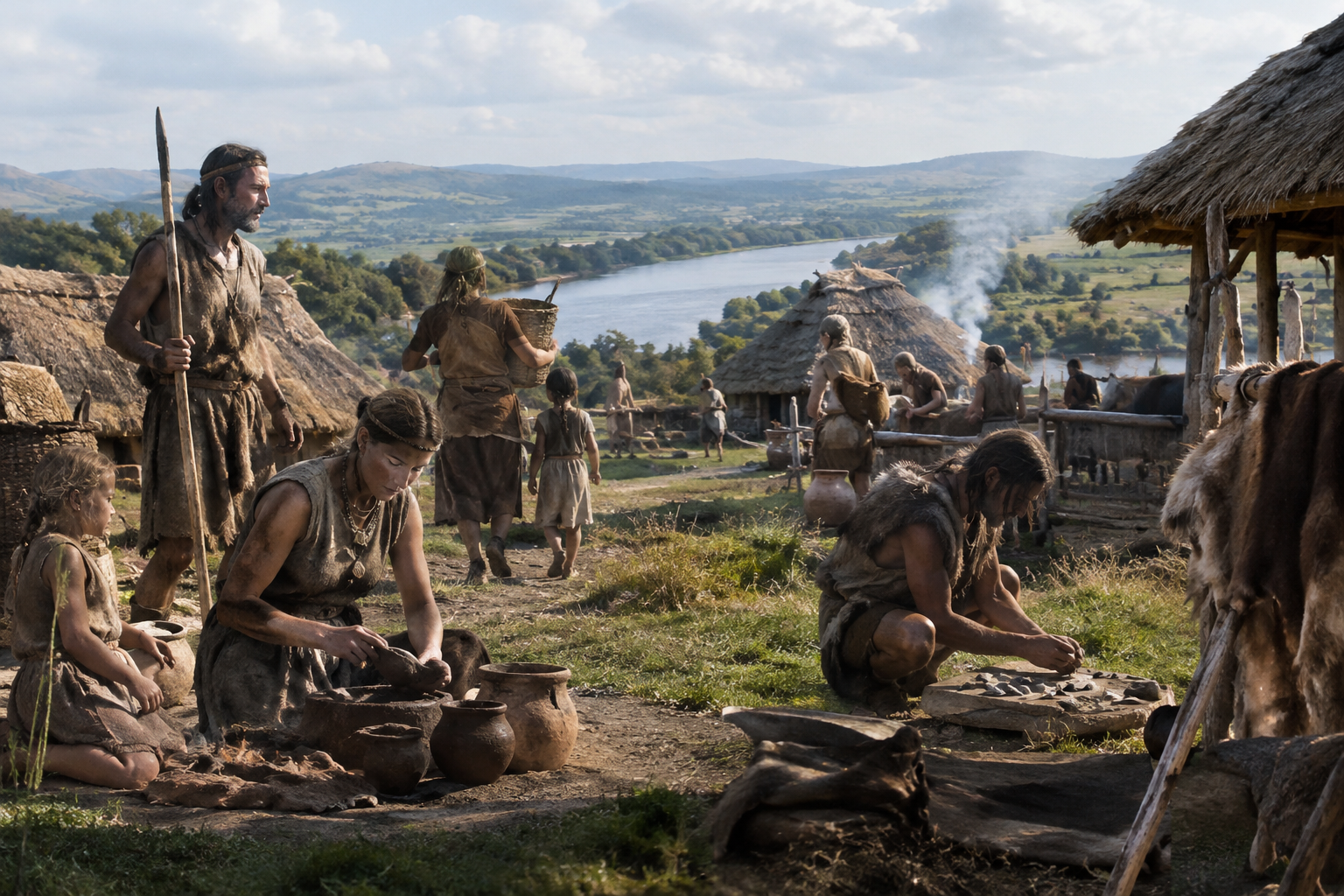
Some Y-DNA haplogroups appear in history like a flash of heraldry: a dynasty here, a conqueror there, a well-documented medieval line. I2a2a is more elusive, and in some ways more interesting. It belongs to the wider haplogroup I, one of the old European paternal lineages, and it turns up in a remarkable spread of ancient individuals from Mesolithic and Neolithic northern Europe to Bronze Age central Europe and on into later historical periods.
That does not mean one neat tribe, one language, or one people. Quite the opposite. Y-DNA traces only a direct paternal line, one line among thousands in any family tree. But when archaeologists recover that paternal line from graves, tombs, bog skeletons, and medieval cemeteries, it gives us a way to follow male-line continuity and movement across long stretches of time. With I2a2a, the story is not a simple march from point A to point B. It is a story of survival, mixture, local persistence, and repeated appearances in very different archaeological worlds.
How Ancient DNA Decodes the Past
Within the Y-chromosome tree, I2a2a sits inside a broader paternal family long associated with prehistoric Europe. In general terms, lineages within haplogroup I are often discussed in connection with ancient European hunter-gatherers and with later populations formed as foragers, early farmers, and incoming groups mixed over millennia. For I2a2a specifically, the evidence supplied here points to a very wide early footprint.
One striking sign of that depth is NEO254, from Ancient Denmark Koelbjerg Odense, dated to 8515 BC. That is an extraordinarily early appearance in Scandinavia. Other early northern finds reinforce the point: NEO91 from Ancient Denmark Groftemark Sjaelland, 7184 BC; NEO18 from Ancient Sweden Hanaskede, 7925 BC; and NEO27 from Neolithic Sweden Hindby Mosse, 7743 BC. These are not the remains of medieval kingdoms or famous houses, but of people living in post-Ice Age Europe, in landscapes of forest, coast, marsh, and waterway.
Yet I2a2a was not confined to the far north. The lineage also appears far to the southeast and east in early and middle Holocene contexts: NEO492 from Ancient Ukraine Vasilevka, 8705 BC; I2529 from Ancient Bulgaria Yabalkovo, 5640 BC; I5870 from Neolithic Ukraine Vilnianka Zaporizhia, 5413 BC; and I2384 from Middle Neolithic Hungary Hajdunanas Eszlari Ut, 5164 BC. That distribution suggests that by the Neolithic, paternal lines classified here as I2a2a or closely related branches were present across a broad swathe of Europe, from the Baltic and Scandinavian worlds to the Balkans and north Pontic zone.
This is where genetics becomes useful precisely because it resists tidy historical slogans. A lineage can persist through major cultural changes. Men carrying related paternal branches might end up in forager cemeteries, farming settlements, megalithic tombs, and later metal-working societies without belonging to one single enduring "ethnic" community.
The sample list also shows I2a2a in the great age of European monument building. In Britain and Ireland's wider world of megaliths, we find I5359 from Neolithic Wales Tinkinswood Glamorgan, dated to 3650 BC, and I2977 from the Neolithic Orkney Islands Tomb of the Eagles, dated to 3200 BC. Add to that I6750 from Neolithic Fussells Lodge Salisbury England, 3710 BC, and the Banbury Lane individuals I0520 and I0518 from Northamptonshire, 3230 BC.
These burials remind us that paternal lineages such as I2a2a were present in the societies that built chambered tombs and long barrows. That does not make I2a2a "the megalithic haplogroup" - history is never so obliging - but it does place the lineage squarely within the human communities who raised some of Europe's most haunting monuments.
The same broad pattern reaches Iberia. I0406 from Neolithic Spain La Mina, 3600 BC, NEO648 from Neolithic Northern Spain El Toral III, 4570 BC, and NEO631 and NEO632 from Neolithic Portugal Gruta do Caldeirao, dated to 5185 BC and 5397 BC, show that this paternal branch also formed part of the western Neolithic world. In other words, I2a2a is not merely a northern curiosity. It appears in Atlantic Europe too, among communities whose lives were tied to early farming, local foraging traditions, and monument landscapes.
Explore the Neolithic Expansion
If the Neolithic evidence is broad, the Bronze Age evidence is positively crowded in central Europe, especially Bohemia and neighbouring regions. Here I2a2a appears again and again in contexts linked to the Early Bronze Age and to the Unetice horizon.
There is LEU061 from Bronze Age Unetice Thuringia Leubingen Sommerda Germany, dated to 1950 BC, and I0114 from Bronze Age Unetice Esperstedt Germany, 2100 BC. In and around Prague and central Bohemia the list becomes almost a roll call: I7960, I7962, and I7963 from Early Bronze Age Czechia Praha-Stodulky-Mal-Ohrada Prague Unetice, all dated to 2000 BC; I13468 and I13469 from Early Bronze Age Stodulky Mala Ohrada Prague Czech, 1600 BC; I13471 from Bronze Age Prague Mala Ohrada Czech, 1900 BC; I15643 and I15646 from Prague-Stodulky Mala Ohrada Central Bohemia, 1600 BC; I7199 from Bronze Age Prague Jinonice Czech, 1950 BC; and I4884 from Bronze Age Jinonice Prague Czech, 1813 BC.
To these can be added BNL002, BNL003, BNL006, and BNL007 from Bronze Age Czech Brandys nad Labem, all at 1600 BC; ROU005 and ROU007 from Bronze Age Roudnice nad Labem Czech, also 1600 BC; PDA002 and PDA005 from Early Bronze Age Prague Miskovice, 1600 BC; PMI004 from Bronze Age Miskovice Czech, 1680 BC; MIS004 from Early Bronze Age Mikulovice Czech, 1600 BC; and CHL002 from Bronze Age Chieby Czech, 1900 BC.
That clustering matters. It suggests that in parts of central Europe, paternal lines assigned to I2a2a were not odd survivals but a repeated and visible component of Bronze Age society. Whether this reflects local continuity from earlier populations, integration into wider Bronze Age exchange networks, or a mix of both, it makes central Europe one of the key historical theatres for understanding this haplogroup.
Read About Bronze Age Central Europe
I2a2a does not vanish with bronze swords and burial mounds. It appears later in a string of historical settings that show how paternal lines can persist through changing political and cultural worlds. There is I36776, a Celtic Parisi Iron Age England East Yorkshire Wetwang Slack burial dated to 225 BC. There are Late Roman and Alemannic era finds from Basel-Waisenhaus in Switzerland: KH201114 at 387 AD, and KH201114a and KH201114b, both at 400 AD. Then Mln12 appears in a Merovingian Period Frankish context at Moemlingen Germany, dated to 650 AD.
Farther east, the lineage turns up in medieval contexts such as SHE007 from Medieval Russia Shekshovo, 1000 AD, and PDH009 from an Outlier burial in the Duchy of Sandomierz, Lublin Region Pidhirtsi, 1150 AD. These are not proofs of direct descent from prehistoric individuals, of course. They are reminders that broad paternal branches can remain part of regional populations for thousands of years, even as languages, kingdoms, and faiths change beyond recognition.
The map implied by these samples is enormous: Denmark, Sweden, Ukraine, Hungary, Bulgaria, Germany, Czechia, Britain, Iberia, Sardinia, Switzerland, Poland, and Russia. That is precisely why one should be cautious. A lineage this widespread cannot be reduced to one medieval nation or one aristocratic tradition. But it can be placed in meaningful regional histories.
The supplied field for associated noble families and castles is blank here, and that is worth saying plainly rather than dressing it up. Without family names, castle seats, or documented dynastic associations in the input, it would be irresponsible to attach I2a2a to any particular noble house. Genetics is already too often made to carry more than the evidence allows.
Still, the absence of named families does not leave us empty-handed. Many of the regions where I2a2a appears in ancient and medieval burials later became landscapes of castles, frontier lordships, and dynastic states: Bohemia, Thuringia, Poland, Denmark, and the Swiss-German borderlands. Ancient DNA gives us the deeper population background to those later worlds. Written genealogies usually begin with medieval elites; archaeology shows that the paternal lines in those regions often reach far beyond charters and chronicles.
So if a later noble family from Bohemia, Saxony, or Poland were ever linked by careful testing to an I2a2a branch, the correct historical framework would not be "this proves descent from a Bronze Age prince." It would be something more modest, and more interesting: that one paternal line found among later elites was also present in the same broad region many centuries earlier.
I2a2a is a good corrective to simple origin myths. It appears among very early northern Europeans, among Neolithic communities in the Balkans and Iberia, among megalith-building societies in Britain, and in force in Bronze Age central Europe. Later it remains visible in Iron Age, Roman-era, and medieval burials. That is a long history, but not a single uninterrupted story of one people marching through time under the same banner.
What it does reveal is how ancient DNA sharpens the old historical map. It can show that a paternal lineage was present in a region long before the first castle was built there, long before the first chronicler wrote a pedigree, and long before later populations gave themselves names we recognize. It complements history by peering below the level of kings and states, into the biological history of the people who made those worlds possible.
For readers with I2a2a in their own Y-DNA results, that can be especially compelling. Your paternal line may connect, in a broad ancient sense, with men buried in Danish wetlands, Welsh tombs, Bohemian Bronze Age cemeteries, or medieval eastern European settlements. But similarity in haplogroup is not the same thing as documented descent. It is a clue to deep ancestry, not a ready-made family tree.
If you want to see how your DNA compares with ancient individuals like LEU061, I5359, I2977, I0114, or SHE007, MyTrueAncestry lets you explore those connections in a way traditional genealogy cannot. You may discover links to ancient populations, archaeological cultures, and historical regions that add a new dimension to your family history, while remembering that ancient DNA matches illuminate the past without automatically proving descent from a particular person, dynasty, or noble house.






Comments