Haplogroup I2a1b1a2b1a2b

– 6 min read


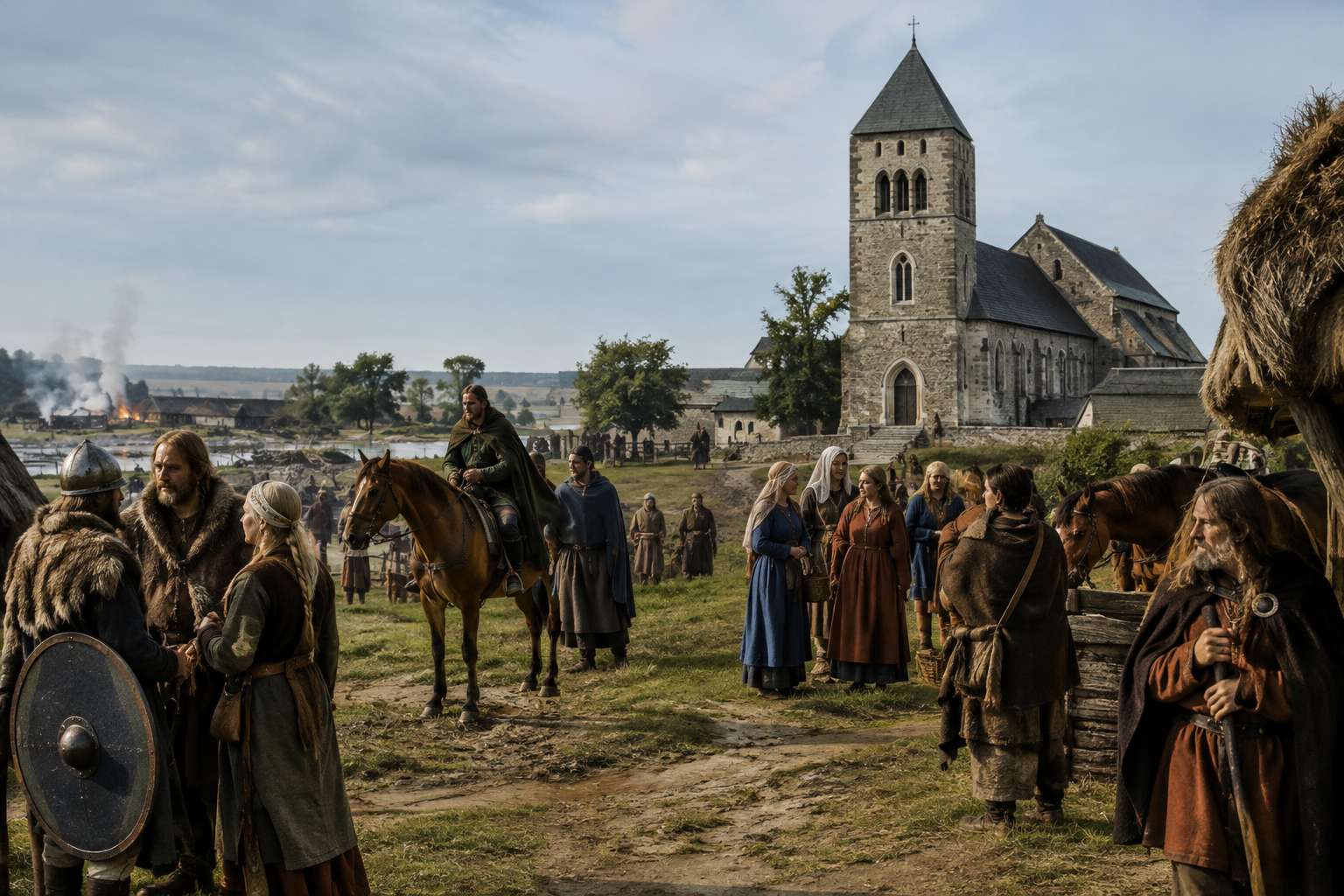
Some Y-DNA haplogroups announce themselves in the record with a grand sweep across continents. Others are more intriguing precisely because they appear as a set of stubborn, recurring traces in particular historical landscapes. Haplogroup I2a1b1a2b1a2b belongs to that second category. It sits within the wider Y-chromosome tree of haplogroup I, one of the major paternal lineages long associated with European prehistory and history, but this very specific subclade has to be handled with care. A narrow branch is not the same thing as the whole tree.
That caution matters. Y-DNA tracks one direct paternal line only: father to son to son, across generations. It does not represent a person's full ancestry, culture, language, or identity. Still, when a lineage like I2a1b1a2b1a2b appears repeatedly in ancient Scandinavian, North Sea, and early medieval contexts, it gives us a useful historical clue. Not a family saga in the old fashioned sense, but something better in its way: a map of where one paternal thread appears in the archaeological record, and how that thread intersects with the movements of peoples around the North Sea world.
In broad terms, the evidence supplied here points us toward Denmark, southern Sweden, Anglo-Saxon England, the Rhineland, and parts of migration-period central Europe. That does not prove a single migrating "tribe of the haplogroup." But it does suggest that this paternal branch, or very near relatives of it, formed part of the male line diversity of Germanic-speaking worlds from the Roman period into the Viking and early medieval centuries.
Explore Denmark's deeper genetic past
The ancient samples are especially striking because they cluster first in Denmark. That alone is historically interesting. Denmark was never some remote northern cul-de-sac. It was a hinge region: islands, peninsulas, marshes, sea lanes, and political communities tied into both the Baltic and the North Sea.
Among the earliest supplied examples is CGG019202, a Jute Early Roman Era individual from Denmark Jutland Bog War Alken Enge, dated 81 AD. Alken Enge is famous as a wetland war deposit, the sort of place where the violence of Iron Age politics ended up in bog and water. A paternal lineage appearing here reminds us that Y-DNA is not only about dynasties and pedigrees. Sometimes it survives in the remains of men caught up in conflict.
Then there is CGG107412 from Iron Age Denmark Eastern Sjaelland Varpelev, dated 115 AD, and CGG106726 from the Danii Tribe Denmark Sjaelland Kalundborg Simonsborg, dated 175 AD. Add CGG107480, a Jute Iron Age Denmark Jutland Bulbjerg sample dated 175 AD, and a pattern begins to emerge: this paternal branch was present in more than one part of Denmark and across more than one local context in the Roman-period north.
The later sample CGG107415 from the Danii Tribe Denmark Sjaelland Koge, dated 375 AD, carries the story forward into late antiquity. By then the Roman Empire was still powerful, but its frontiers were increasingly entangled with confederations and kingdoms beyond the limes. The men represented by these graves were not "Romans" in the imperial sense, yet they lived in a world being shaped by Roman trade, military pressure, and prestige goods.
So what can we responsibly say? Not that I2a1b1a2b1a2b was uniquely Danish, nor that every Jute or Danii male belonged to it. But the supplied record does make Denmark look like one important zone in the documented history of this paternal line.
The next step is where the story becomes properly historical rather than merely regional. This same lineage appears in places linked to the great movements of the migration period and early medieval centuries.
On Oland in Sweden, snb010 from Pre-Vendel Age Oland Sandby Borg, dated 475 AD, places the haplogroup in one of the most haunting archaeological sites in Scandinavia. Sandby Borg is remembered for a violent event frozen in place, a fortified settlement where the dead were left behind. Again, one paternal lineage does not explain the whole site. But it situates this branch in the eastern Scandinavian world at a moment of upheaval.
In England, the evidence is just as suggestive. BUK037 from the Early Anglo Saxon Period Buckland Dover England, dated 400 AD, offers an early foothold in the zone where continental migration met post-Roman Britain. Later examples include LAK004 from Angle Early Medieval Suffolk England Lakenheath, dated 650 AD, and SED017 from Anglo-Saxon Sedgeford England Norfolk, dated 760 AD. These are not identical historical moments. They span the first establishment of Anglo-Saxon communities and their later consolidation into kingdoms and Christian societies.
There is also IND006 from a Merovingian Grave North Rhine-Westphalia Germany Alt-Inden, dated 600 AD. That matters because the Rhineland was one of the classic contact zones of the early medieval west: Frankish, post-Roman, and deeply entangled with North Sea exchange. If Denmark gives us one likely center of gravity, the Rhineland shows the western mainland setting in which related paternal lines also circulated.
And then the horizon widens still further. A181019 from Gothic Kecskemet-Mindszenti Transtisza Hungary, dated 450 AD, and SZ3 from Germanic Lombard Szolad, dated 590 AD, suggest that this paternal branch or its immediate relatives were also present in the shifting Germanic worlds of central Europe. That does not make the haplogroup "Gothic" or "Lombard" in any simple ethnic sense. It shows instead that paternal lines seen in Scandinavia and the North Sea could also appear among mobile groups involved in the transformations of late antique Europe.
Discover post-Roman Britain through DNA
By the Viking Age, the pattern is still visible. CGG017609 from Viking Age Denmark Borre Enge, dated 793 AD, keeps the lineage rooted in Denmark just as Scandinavian expansion was beginning to transform Britain, Ireland, Francia, and beyond. Then there is VK150 from the Viking St. Brice Massacre Oxford, dated 1002 AD. Few contexts could be more dramatic, but the lesson is not melodrama. It is that paternal lines can turn up in very different kinds of evidence: settlement cemeteries, war deposits, elite contexts, and victims of state violence.
Finally, ST0552 from Medieval Belgium Sint-Truiden Onze-Lieve-Vrouwekerk, dated 900 AD, carries the story into an urbanizing medieval Low Countries setting. That is an important reminder that lineages do not stop when the sagas begin. They move into towns, churches, landed estates, and parish graveyards. The men of this haplogroup were not only migrants and warriors. Some became ordinary townsmen in the growing commercial and ecclesiastical societies of medieval northwestern Europe.
Readers interested in that setting may enjoy the separate MyTrueAncestry discussion of Sint-Truiden's population history, because it shows how medieval communities were shaped by both local continuity and broader movement.
Read about medieval Sint-Truiden DNA
What, then, do we do with the noble connection supplied here: House Grimason and Gorhambury House near St Albans?
The first thing is not to overdo it. A historical association with a haplogroup does not prove that every bearer of a surname, every cadet branch, or every later relative shared the same Y-DNA. Nor does the presence of this haplogroup in Anglo-Saxon and Scandinavian contexts prove any direct line from an ancient sample to a later household at Gorhambury.
But the setting is undeniably evocative. Gorhambury House stands in a landscape layered with English history: close to Roman Verulamium, later reshaped in the Tudor and Georgian periods, first developed in the late sixteenth century by Sir Nicholas Bacon, and associated with Francis Bacon as a retreat for study and politics. The later neo-classical house built for the Grimston family, who became Earls of Verulam, gave the estate its later aristocratic character. In one place, then, we have Roman urban memory, early modern ambition, and aristocratic reinvention.
That makes Gorhambury an apt historical anchor for this haplogroup's story. Not because the house proves the genetics, but because it sits in southern England, a region profoundly shaped by the same long sequence visible in the DNA evidence: Roman rule, post-Roman transformation, Anglo-Saxon settlement, Danish and Viking contact, and later noble appropriation of ancient landscapes. Estates like Gorhambury preserve the memory of region and power long after the paternal lines themselves have dispersed into the wider population.
For readers who want to continue from lineage history into family history, the related House Grimason feature offers that later chapter.
If there is a moral to haplogroup I2a1b1a2b1a2b, it is that narrow paternal branches often tell their best stories at the regional level. Here, the strongest supplied evidence links the lineage to Denmark, southern Scandinavia, Anglo-Saxon England, the Rhineland, and several migration-period contexts farther south and east. That is already plenty to work with.
It suggests a paternal history tied to the North Sea and Baltic worlds and to the mobility of late Iron Age, migration-period, and early medieval Europe. It also shows the great value of ancient DNA: written sources give us kings, saints, and chroniclers, while burials like CGG019202, BUK037, IND006, and VK150 give us something less polished and, in some ways, more revealing. They show where one paternal line actually turns up in real human remains.
For a broader look at how Scandinavian and North Sea mobility shaped Britain over the long term, there is a useful companion read in the MyTrueAncestry community.
Explore North Sea migrations to Britain
If your paternal line belongs to I2a1b1a2b1a2b, or to a nearby branch, these ancient individuals offer historical context rather than a simple pedigree. They may show where related male lines appeared in the past, without proving direct descent from any one burial or any one noble house. That is exactly what makes ancient DNA so interesting: it opens the door to deep historical comparison.
Upload your DNA to MyTrueAncestry and explore whether your results show links to ancient Scandinavian, Anglo-Saxon, Viking, or medieval populations, and see how your own story fits into the archaeological record.






Comments