Haplogroup I2a1b1a2b1a2a1a1a1a1a2

– 6 min read


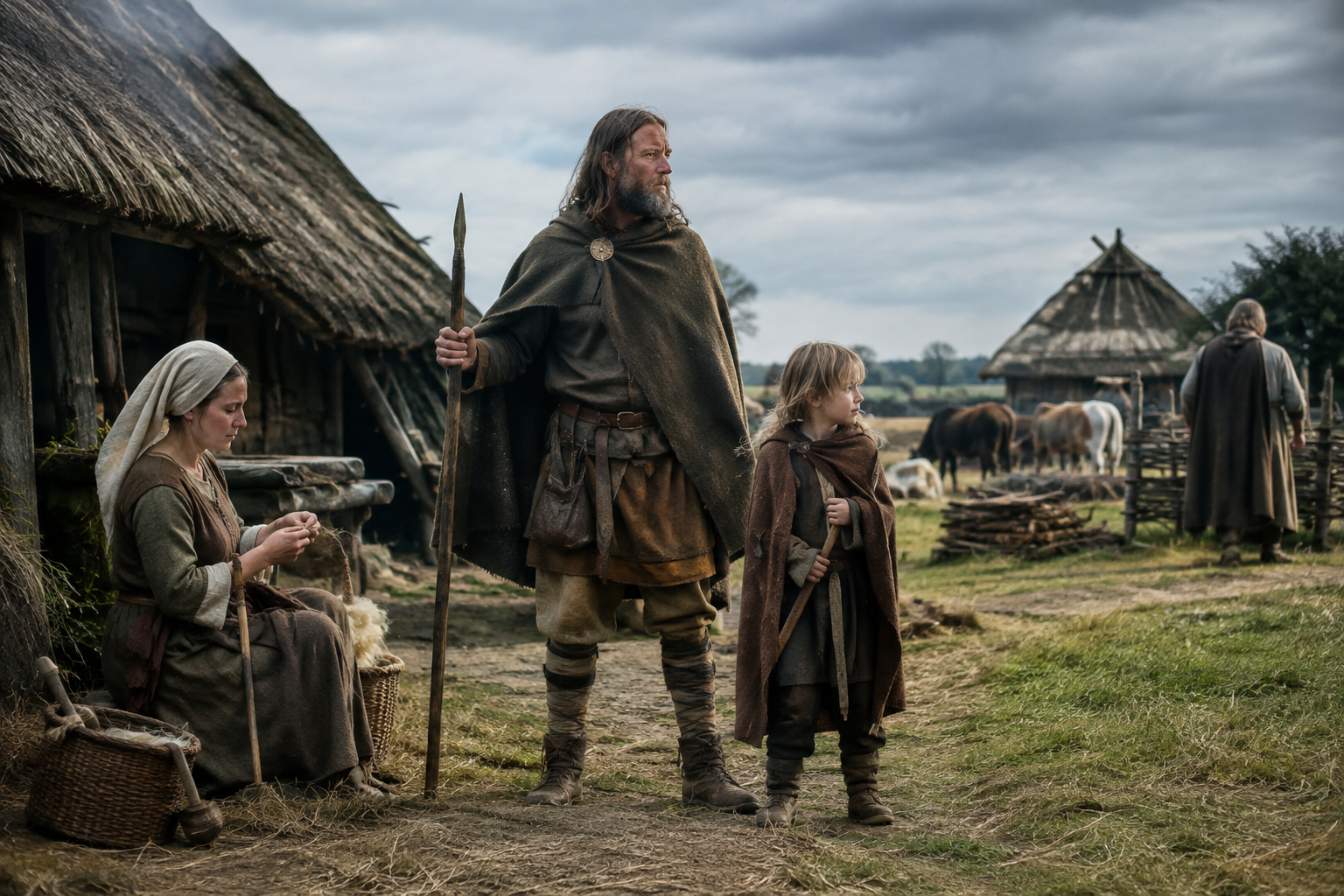
Some Y-DNA haplogroups arrive in history with trumpets. Others appear more quietly, in a grave, a churchyard, a field under East Anglian skies. Haplogroup I2a1b1a2b1a2a1a1a1a1a2 belongs to that second category: a very specific paternal branch whose importance lies not in grand claims, but in what it lets us see about continuity, movement, and the stubborn survival of male lines across centuries.
That formidable string of letters and numbers is a reminder of how Y-DNA works. Each extra branch marks a narrower paternal lineage within the wider human family tree. In plain English, Y-DNA haplogroups trace a direct father-to-son line only. They do not describe a person's whole ancestry, culture, or identity. Still, when ancient DNA places one of these lineages in a real burial, at a real site, in a known historical setting, the result can be wonderfully illuminating.
This haplogroup sits within the wider family of haplogroup I, one of the major Y-chromosome lineages long associated with deep European prehistory. Broadly speaking, branches of haplogroup I are often discussed in connection with ancient European hunter-gatherer populations and with later regional continuities that survived the arrival of farmers, Bronze Age mobility, and medieval state formation. But that broad background must be handled carefully. The very specific branch I2a1b1a2b1a2a1a1a1a1a2 is not the same thing as the whole of haplogroup I, nor can every episode in the history of I be assigned directly to this narrow subclade.
What we can say, responsibly, is that such a lineage belongs to a deeply rooted European paternal framework. Over thousands of years, branches of I2 appear in many different regions and archaeological contexts, sometimes suggesting long local persistence, sometimes movement and mixing with incoming populations. Ancient DNA has made this much clearer than old-fashioned ideas about neat, unmoving peoples ever could.
That matters because paternal lineages can outlast almost every other historical label. Kingdoms vanish, languages shift, dynasties marry in and out, but a Y-chromosome branch can persist quietly beneath all that noise. The challenge is to avoid turning that persistence into mythology. A haplogroup is evidence of a paternal line, not proof of ethnicity, not a badge of nobility, and certainly not a shortcut to a ready-made medieval identity.
The most important anchor here is the supplied ancient DNA sample LAK015, from Early Medieval Suffolk England Lakenheath, dated to 650 AD. That date places him in one of the most intriguing periods of English history: the generations after Roman rule, amid the formation of early kingdoms, changing burial customs, and the spread of Christianity across eastern England.
Lakenheath lies in Suffolk, part of the wider East Anglian world. By 650 AD this was not a blank canvas awaiting a single "Anglo-Saxon" people. It was a lived-in landscape shaped by earlier Iron Age and Roman populations, and then by migrants, settlers, marriage networks, and shifting political loyalties around the North Sea. A Y-DNA lineage found there does not tell us that LAK015 belonged to one simple ethnic category. What it does tell us is that this paternal branch was present in early medieval eastern England, embodied in a real man living in a period of social change.
This is where ancient DNA is at its best. Instead of abstract arguments about invasions or continuity, we have an individual: LAK015, in Suffolk, in 650 AD. His Y-line adds one more point to the growing map of paternal ancestry in post-Roman Britain. He may represent local continuity, migration from elsewhere in Britain or the North Sea zone, or a lineage already mixed into early medieval communities before his lifetime. With one sample alone, certainty would be too much to claim. But it is a valuable clue.
Read Roman and Early Medieval Britain DNA
Readers interested in this world may also want to compare broader work on Britain after Rome. The genetics of early medieval England increasingly show variation from site to site, family to family, and region to region. That is exactly the sort of setting in which a lineage like this becomes historically interesting: not as a slogan, but as part of a complicated human landscape.
How might a branch like this have reached Suffolk by 650 AD? The honest answer is that there are several possibilities, and ancient DNA helps narrow them without reducing them to a single tale.
One possibility is long-term survival of an older European paternal line through prehistoric and Roman Britain into the early medieval period. Another is movement through the North Sea world, where eastern England was connected to regions across what is now the Netherlands, northern Germany, and Denmark. Yet another is that such lineages had already been shuffled repeatedly by earlier migrations in later prehistory and antiquity, so that by 650 AD they no longer belonged neatly to one "origin place" at all.
That may sound untidy, but history usually is. Human populations are not chess pieces. They mix, move, settle, and reassemble. A haplogroup branch can be geographically stable for centuries, then turn up somewhere else through marriage patterns, elite mobility, military service, or settlement. The Y-chromosome gives us a line of descent, not the whole biography.
For that reason, articles on the broader formation of early English ancestry are especially helpful context for LAK015 and his world.
Explore Anglo-Saxon Migration DNA
In this case, the supplied field for associated noble families and castles is blank. Oddly enough, that is rather useful, because it forces us to keep our feet on the ground. Too many discussions of haplogroups rush from an ancient burial to a medieval coat of arms as if the distance between them could be leapt in a single bound. It cannot.
A Y-DNA match, or even a shared broad haplogroup, does not prove descent from a noble house, let alone from every man who ever bore a famous surname. Medieval families were shaped by adoptions, illegitimacy, collateral branches, inheritance through daughters, name changes, and all the ordinary human untidiness that written pedigrees often try to tidy away.
Castles, too, are not genetic documents. They are political and architectural ones. A castle may preserve the memory of a family, a lordship, a conquest, or a frontier, but it does not in itself prove a paternal lineage. What genetics can do is offer a different sort of record alongside the written and built remains of the past. In the absence of supplied noble-house data here, the wiser course is not to manufacture connections, but to note how valuable such connections can be when they are actually documented.
For readers interested in how MyTrueAncestry handles historical houses when the evidence is stronger and more specific, one useful comparison is the East Anglian and English noble world explored in family features such as the Wingfields.
Discover the House of Wingfield
The real significance of I2a1b1a2b1a2a1a1a1a1a2 lies in scale. Not imperial scale, but human scale. It shows how a direct paternal line, one narrow branch on the Y-chromosome tree, can be identified in the bones of a man buried in early medieval Suffolk. That is enough to connect genetics with place, period, and archaeology in a meaningful way.
LAK015 is not "the founder" of anything we can name. He is not proof of a later dynasty. He is not a label for all of East Anglia. He is something better: evidence. Evidence that this paternal branch existed in seventh-century England, and that the peopling of early medieval Britain was made up of real individuals with lineages both old and mobile.
That is also why narrow haplogroups are so fascinating. The broader parent haplogroup may stretch far back into European prehistory, but the downstream branch is where the story becomes more intimate. With enough ancient samples over time, a distribution emerges. A pattern forms. Not a fairy tale, not a tribal destiny, but a historically grounded map of fathers, sons, burials, and movement.
If you want to follow more of Britain's population story beyond one Suffolk burial, the wider North Sea setting is worth exploring too.
If this haplogroup appears in your own Y-DNA path, the most sensible response is curiosity rather than certainty. It may point toward a paternal line with deep European roots and, in this case, a documented appearance in early medieval England through sample LAK015 at Lakenheath in 650 AD. But it does not by itself prove that your direct paternal ancestors lived in Suffolk, belonged to any named medieval family, or descended from any one historical individual.
What it can do is open the door to a richer kind of ancestry research, where genetics sits beside archaeology and history rather than trying to replace them. That is the pleasure of this subject. One Y-chromosome branch, one excavated burial, one corner of Suffolk - and suddenly the early Middle Ages feel less like a dark blur and more like a world inhabited by identifiable people.
Upload your DNA to MyTrueAncestry to explore ancient matches, discover how your paternal line fits into the larger human story, and see whether your results connect with ancient individuals like LAK015. These comparisons can offer remarkable historical perspective, even when they do not prove direct descent or membership in a noble family.






Comments