Haplogroup I2a1b1a2a1b

– 6 min read


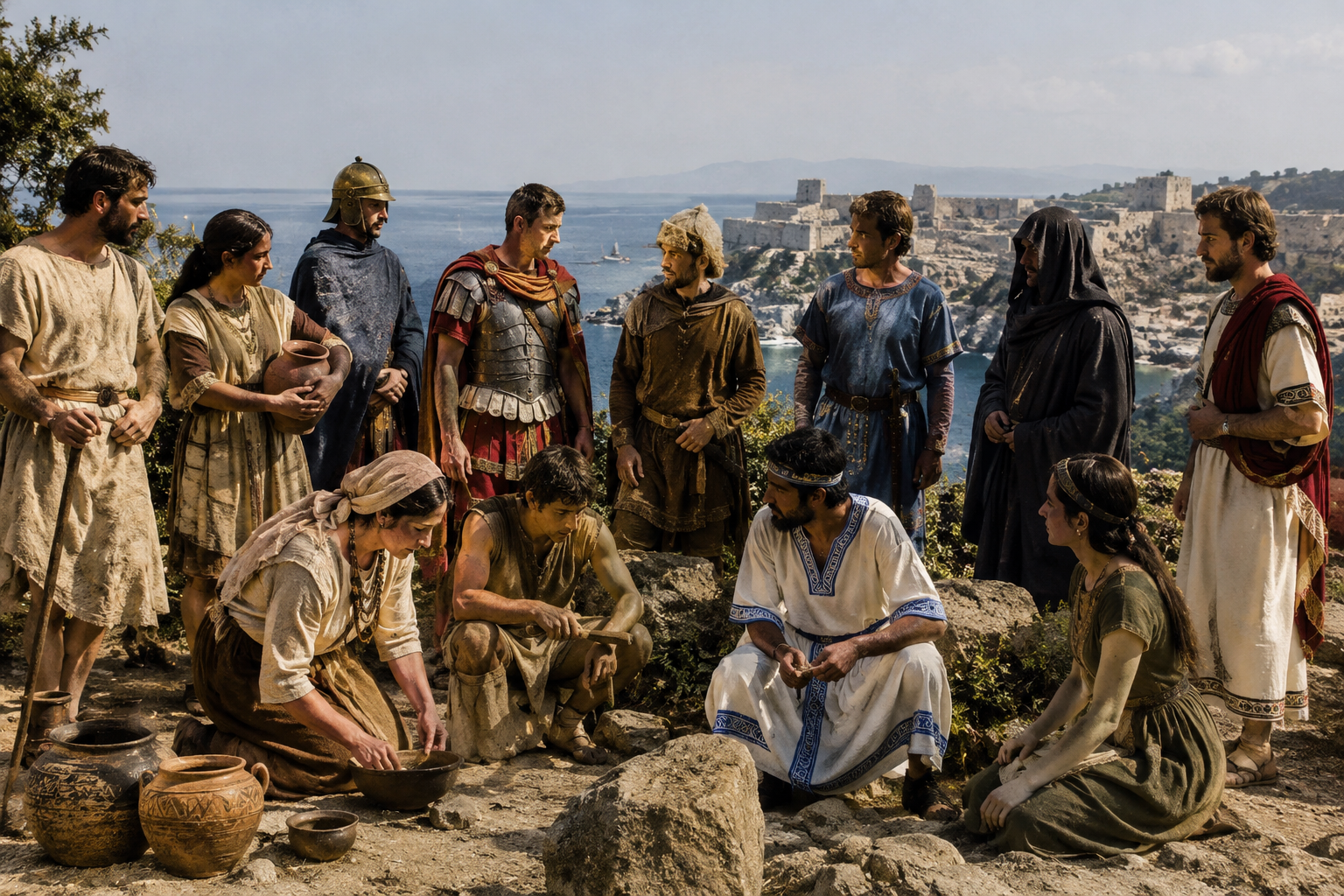
Some Y-chromosome lineages arrive in history with trumpets and banners. Others appear more like a series of stubborn fingerprints left across millennia: in a Neolithic farming settlement on the lower Danube, in a Roman-era grave on the Balkan frontier, in a Gothic burial in late antique Bulgaria, and then, much later, in the historical landscapes of central Europe where dynasties built castles to remember themselves. Haplogroup I2a1b1a2a1b belongs to that second category. It is interesting not because it can be made to fit a single easy story, but because it refuses one.
As a Y-DNA haplogroup, I2a1b1a2a1b traces one very narrow line of ancestry: the direct paternal line, father to son across many generations. That is powerful, but it is also limited. It does not describe a person's whole ancestry, culture, language, or identity. What it can do is illuminate one thread in the much larger fabric of European and Mediterranean history. In this case, the surviving ancient DNA evidence points to a paternal lineage with deep roots in southeastern Europe and a history shaped by mobility, mixture, and regional continuity rather than by any single people marching neatly across a map.
The wider haplogroup I is one of Europe's old paternal families, and branches within I2 are often discussed in connection with long-term European prehistory. But we need to be careful here: the full history of broad I2 cannot simply be pasted onto the very specific branch I2a1b1a2a1b. What the evidence supplied here does suggest is that this lineage, or closely related paternal lines, had a notable presence in southeastern Europe and adjacent regions over a very long period.
The earliest supplied samples are especially telling. At Pietrele Magura Gorgana in Giurgiu, Romania, two Neolithic individuals, PIE060 and PIE061, are dated to 4100 BC. That matters because it places this paternal signature in a settled farming landscape on the lower Danube thousands of years before Rome, before Gothic migrations, and before the medieval kingdoms of central Europe. If one wants to understand later appearances of this lineage in the Balkans and nearby regions, those Neolithic finds are a sensible place to begin: not as proof of unbroken descent to any modern family, but as evidence that this paternal tradition was already part of the human world of southeast Europe very early on.
From there, the record widens rather than narrows. A Bronze Age Bosnia-Herzegovina Klakar sample, I19561, dated to 1500 BC, shows the lineage in the western Balkans. That does not mean every later Balkan or central European carrier descended from him in any traceable genealogical sense. It does mean that by the Bronze Age, this paternal branch or a very close one was present in another part of the peninsula, in a period when communities were linked by metal exchange, local mobility, and changing social structures.
The pattern becomes still more intriguing when we look east and south. An Early Bronze Age Izmir Aegean Anatolia individual, I5737, dated to 1960 BC, and an Ancient Dorian Halikarnassos Aegean Coast sample, I3311, dated to 177 BC, suggest that related paternal lines also appeared in the Aegean world. Add to that I7648, a Hellenic Individual Carthaginian-Era Mozia Western Sicily dated to 400 BC, and we are no longer looking at an isolated inland lineage. We are looking at a paternal branch that turns up in the connected worlds of the Balkans, the Aegean coast, and the central Mediterranean.
Ancient DNA becomes most interesting when it stops being an abstract map and starts being a set of lives. The Roman and post-Roman samples supplied here are a fine example.
At Mursa in Croatia, the Roman-period Warrior OSIJ004, dated to 260 AD during the Third Century Crisis, places this lineage in one of the Roman Empire's most unstable military centuries. This is not surprising in itself. Frontiers, roads, armies, and market towns moved people about relentlessly. What is striking is that the paternal line shows up not only in a Roman military setting, but also elsewhere in the Carpathian and Balkan zone.
In Rakoczifalva Szolnok, Hungary, we have RKF242 dated to 250 AD and RKF261 dated to 750 AD. Those two dates span the collapse of Roman order in the region and the formation of a different early medieval world. One must not leap from that to a claim of simple continuity, because populations changed dramatically in those centuries. Still, the appearance of this paternal signature in the same broad region before and after the Migration Period strongly suggests that lineages of this sort remained part of the human landscape through political upheaval.
Then there is I40571, the Late Roman Gothic Grave Aquae Calidae Bulgaria Roman Era sample, dated to 350 AD. This is exactly the sort of find that reminds us how misleading ethnic labels can be if handled carelessly. A Gothic grave tells us something about archaeological context and perhaps cultural affiliation, but not that the lineage was somehow exclusively "Gothic." On the contrary, this sample fits a broader picture in which late antique communities were mixed, mobile, and often assembled from people of different origins.
Even farther west, ST1201, a Medieval Belgium Outsider Sint-Truiden Onze-Lieve-Vrouwekerk individual dated to 900 AD, hints at how far such paternal lines could travel, or how widely they could already be distributed by the early Middle Ages. The word "outsider" is important. Medieval towns and churches were not closed genetic boxes. They attracted traders, pilgrims, soldiers, clerics, and migrants. A paternal lineage found there tells us about movement and connection, not tidy ethnic compartments.
So what does all this have to do with the historical world of central European noble houses? Not a direct genealogical proof, certainly. But it provides a setting.
The medieval and early modern lands that later produced famous ruling families were built upon much older demographic foundations. The Balkans, the Danube corridor, Pannonia, the Aegean, and the Alpine forelands were tied together for thousands of years by farming expansion, trade, imperial administration, warfare, and resettlement. A haplogroup like I2a1b1a2a1b, showing up repeatedly in southeastern Europe and adjoining regions, belongs to that long background history from which later states and dynasties emerged.
That is why it is useful to think geographically rather than romantically. When a paternal lineage appears in Neolithic Romania, Bronze Age Bosnia-Herzegovina, Roman Croatia, late antique Bulgaria, and early medieval Hungary, it tells us that the map behind later German and central European history was already crowded with old lineages that had survived, mixed, and moved many times over.
Explore post-Roman Central Europe
That brings us to the House of Hohenzollern, one of the most famous dynasties in German history. Their ancestral seat, Hohenzollern Castle, stands on Mount Hohenzollern in Baden Wurttemberg. The family's rise from medieval Swabian counts to kings of Prussia and German emperors is a reminder that noble history is often as much about remembered origins as actual power.
The first fortress on the site was mentioned in the 11th century and destroyed in 1423 after a long siege. A second, larger castle was built in the 15th century and served as a family stronghold, at times also connected to Habsburg interests, before declining into ruin by the late 18th century. The spectacular structure seen today is not a straightforward medieval survival, but a 19th-century reconstruction begun by Crown Prince Frederick William of Prussia, later King Frederick William IV. Inspired by romantic medievalism, he rebuilt the site in grand neo-Gothic form, completing a monument not just to defense but to dynastic memory itself.
This is where genetics and history make an illuminating pair. Castles preserve stories, claims, and symbols of lineage. Ancient DNA preserves biological traces of real paternal lines moving through real populations. But the two are not the same thing. The existence of a castle, however ancestral, does not prove a haplogroup. And the presence of a haplogroup in ancient regional samples does not prove descent from a ruling house. What it does do is place dynasties like the Hohenzollerns back into the much older human history of the regions from which they emerged.
In other words, before there were emperors on Mount Hohenzollern, there were already thousands of years of paternal lineages circulating through the Danube basin, the Balkans, and central Europe. Noble genealogy starts in charters and chronicles. Genetic history starts much earlier, often in graves whose occupants left no written names at all.
Discover the House of Hohenzollern
The story of I2a1b1a2a1b is not the story of one tribe, one kingdom, or one family. It is the story of a paternal lineage appearing across different archaeological settings over a very long stretch of time: Neolithic Romania, Bronze Age Bosnia-Herzegovina, Aegean Anatolia, classical and Hellenistic coastal worlds, Roman military and frontier zones, Gothic-period Bulgaria, early medieval Hungary, and even medieval Belgium.
That spread makes the haplogroup historically valuable. It suggests endurance, mobility, and entanglement across the eastern and central Mediterranean-European world. It also provides a salutary warning against easy labels. A Y-line can persist while languages change, empires rise and fall, and identities are remade again and again.
For MyTrueAncestry users, that is the real fascination. Your Y-DNA haplogroup is not a heraldic badge assigning you to a single people. It is one narrow but remarkable line of connection to the deep past. Sometimes that line leads into the world of early farmers. Sometimes it runs through Roman frontiers and Migration Period cemeteries. Sometimes it sits in the same broad historical landscapes later dominated by castles and dynasties.
If you want to explore how ancient DNA comparisons can place your own ancestry beside individuals like PIE060, PIE061, OSIJ004, I40571, or RKF261, MyTrueAncestry can help you investigate those connections. The results may reveal striking similarities to ancient populations and regions, while still stopping short of proving direct descent from any specific ancient person or noble house.






Comments