Haplogroup I2a1b1a1a1b1a

– 6 min read


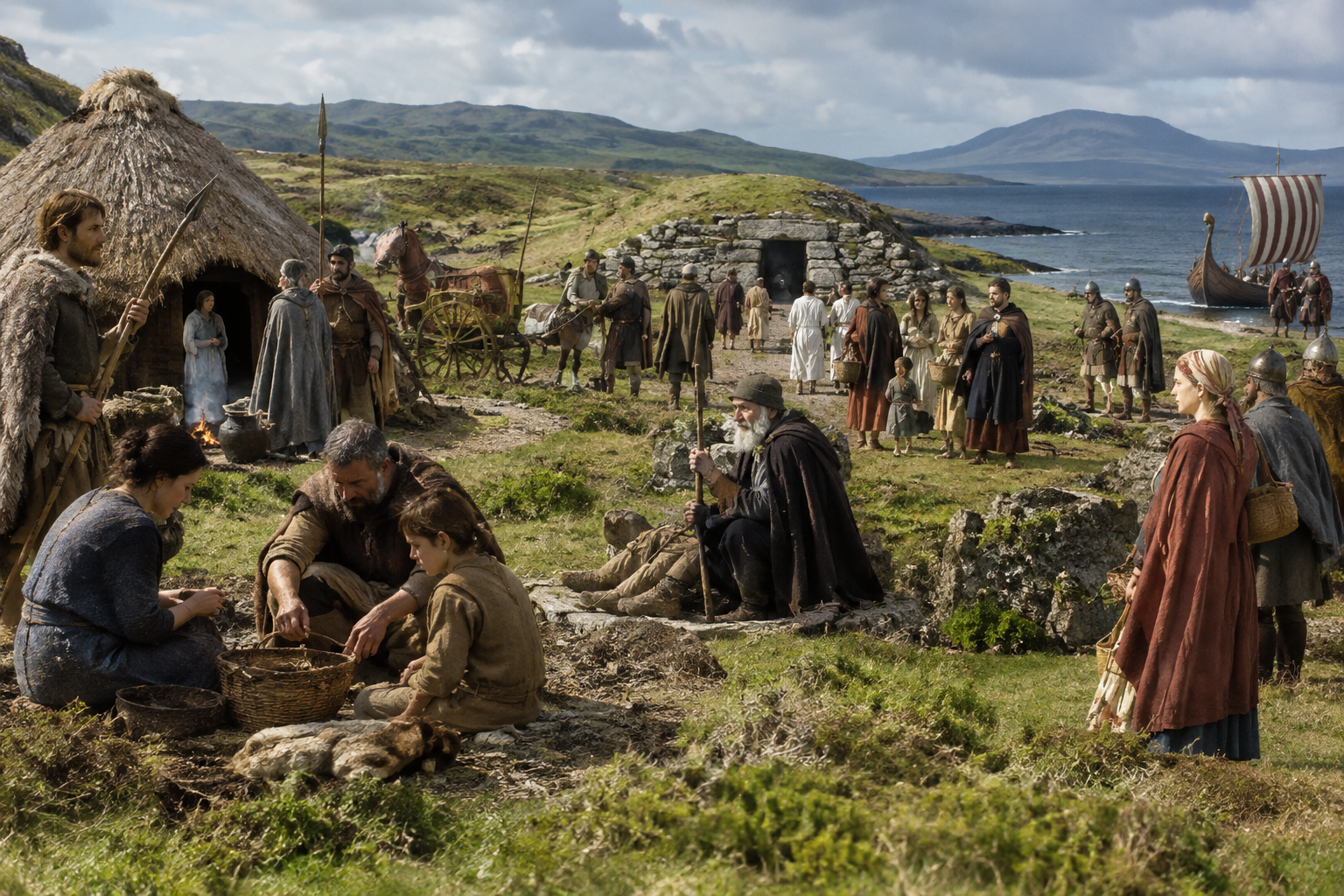
Some Y-chromosome lineages behave like historical footpaths. They do not tell us everything about a person, a people, or a kingdom, but they show where one direct paternal line has appeared across time. Haplogroup I2a1b1a1a1b1a is one of those lineages that becomes especially interesting when ancient DNA starts turning up in burials from Neolithic Ireland and Britain, Iron Age eastern Yorkshire, Roman and post-Roman Britain, Viking-age Scandinavia, and the medieval north of Europe.
That pattern matters because Y-DNA traces a direct father-to-son line only. It is not a summary of someone's full ancestry, culture, language, or identity. Still, when a haplogroup appears again and again in ancient graves from particular regions, it can help us follow long-term paternal continuity, local survival, and movement across landscapes that later became associated with tribes, monasteries, lordships, and noble houses. In this case, the evidence points above all to a lineage deeply entangled with the story of the British Isles and the North Sea world.
The haplogroup named here, I2a1b1a1a1b1a, sits within the wider haplogroup I, one of the major ancient European Y-chromosome families. Broadly speaking, lineages within haplogroup I are often associated with very old European paternal ancestry, but one must be careful here: the deeper history of parent haplogroup I is not automatically the same as the later story of this much narrower downstream branch.
What the supplied ancient samples do allow us to say, with some confidence, is that paternal lines related to this branch were present in the islands off northwestern Europe remarkably early. The cluster of Neolithic samples from Ireland, western Scotland, Orkney, and southern England suggests that this lineage, or closely related paternal lines, had already become established in Atlantic-facing communities long before the Roman Empire, the Vikings, or the Normans entered the picture.
That does not mean a simple, uninterrupted, one-line march through history. Paternal lineages can expand, contract, vanish locally, or survive as small family lines for centuries before reappearing in the record. But the ancient DNA here strongly hints that this was not some fleeting arrival in the Middle Ages. It was already part of the human landscape of Britain and Ireland in the Neolithic.
The oldest anchors in this story come from some of the most evocative sites in Britain and Ireland. In Ireland, several Neolithic individuals are listed with this haplogroup or its relevant paternal context: ASH1 from Ashleypark, Tipperary, dated to 3566 BC; GNM1007 from Glennamong, dated to 3357 BC; GNM1076 from Glennamong, dated to 3193 BC; NG10 from the Newgrange Main Chamber in Meath, dated to 3180 BC; and ANN1 and ANN2 from Annagh, Limerick, both dated to 3000 BC. Also in Ireland are CAK68, CAK531, and CAK532, each listed simply as Neolithic Ireland, dated to 3000 BC.
These are not random dots on a map. They belong to the world of monument-building farmers, tomb users, and kin groups whose dead were placed in architecturally charged settings. Newgrange alone is enough to make one pause: a paternal lineage found in the orbit of one of Europe's most famous passage tombs reminds us that Y-DNA is not an abstraction. It belonged to real men whose communities invested enormous labor in ritual landscapes.
Britain offers equally striking early evidence. In Dorset, wrb003 from Cranborne Chase Wor Barrow, dated to 3500 BC, and muw001 from the Neolithic family burial at Monkton Up Wimborne, dated to 3225 BC, place this paternal signature in southern England very early indeed. Farther north and west, the story continues with I3134 and I3135 from Distillery Cave, Oban, Argyll and Bute, dated to 3450 BC, along with I2660 from the same area dated to 3433 BC. Then there is I2933 from Bronze Age Isbister, Orkney, dated to 2927 BC.
What emerges is a line with considerable antiquity around the Irish Sea and Atlantic Britain. Not proof of a single tribe or dynasty, certainly, but evidence of a paternal presence rooted in the islands across thousands of years.
Discover Neolithic Irish kinship
Then the record becomes wonderfully concrete. In Iron Age East Yorkshire, the cemetery at Wetwang Slack provides a small concentration of men from the Celtic Parisi world: I37343, I36991, I36982, I36795, I36760, I36769, and I41272, all dated to 225 BC. Nearby, the elite Celtic Parisi chariot burial at Melton produced I28925, dated to 270 BC.
Now this is where the archaeology does some of the storytelling for us. Chariot burials and furnished graves in East Yorkshire have long attracted attention because they speak of status, region, and local custom. The recurrence of this paternal lineage among Parisi-associated burials suggests that it was not merely present in Iron Age Britain, but present in a socially visible community. That does not make the haplogroup "Celtic" in any simple ethnic sense. It does, however, place it firmly among populations living in Iron Age Britain before the Roman conquest.
Other British Iron Age samples deepen the picture: I20622 from the Celtic hill fort at Fin Cop, Derbyshire, dated to 60 BC, and I20988 from the Belgic tribe hillfort at Danebury, Hampshire, dated to 59 BC. Add WBK07, a Celtic Durotriges individual from Duropolis, Winterborne Kingston in England, dated to 125 AD, and we can see this paternal line persisting into the Roman period in southern Britain as well.
This is precisely the sort of evidence that makes ancient DNA so useful. Written sources tell us almost nothing about the Y chromosomes of the Durotriges, Parisi, or the communities around Danebury. The graves do.
The later samples show that the lineage did not disappear with Rome. In Orkney, VK201, a Pictish burial from Buckquoy on the Mainland, dated to 500 AD, places it in the post-Roman north. Then come the Viking-age finds: VK280 from Galgedil, Funen, Denmark, dated to 925 AD, and VK173 from the St. Brice Massacre in Oxford, dated to 1002 AD. These suggest that the lineage also participated in the wider North Sea world linking Scandinavia and England.
By the medieval period we find OBM035, a Western Slav sample from Obermoellern in Thuringia, Germany, dated to 1050 AD, and CGG100797 from Tjrb y, Randers Municipality, Denmark, dated to 1325 AD. That spread across Britain, Denmark, and central Europe is a reminder that paternal lines travel with people, but not always in neat ethnic packages. A lineage can be ancient in the British Isles, appear among Viking-age Scandinavians, and also turn up in medieval Slavic territory without needing a melodramatic migration saga to explain every step.
Sometimes the simplest explanation is that northern Europe was mobile, interconnected, and full of local continuities at the same time.
The medieval historical association supplied here brings us to Normandy and the House Paynel. That is a shift from ancient burials to documented lordship, and it needs to be handled carefully. A historical association with this haplogroup does not prove that every member of the Paynel family carried I2a1b1a1a1b1a, nor does it establish direct descent from any ancient sample above. What it does provide is a regional and social setting in which one may think about how old paternal lines can persist into the age of charters, abbeys, and noble patronage.
The family's great monument in the supplied material is Hambye Abbey in Normandy, founded in the twelfth century by William Paisnel. It became a flourishing Benedictine monastery with a large church, cloister, and monastic buildings in a quiet valley. Like so many medieval religious houses, it prospered, suffered in war, and then declined catastrophically after the French Revolution, when the monastic community disappeared and the buildings were stripped and left to decay.
And yet the ruins survived. That is the important point. Hambye Abbey still stands as historical memory in stone: not genetic proof, but a surviving frame for the world in which lineages, families, landholding, and pious patronage were all bound together. If the ancient samples show us fathers and sons in tombs and cemeteries, Hambye shows us what that same long human business of continuity looks like once it enters written history.
Normandy is especially evocative here because it was itself a meeting place of older regional populations, Viking settlement, aristocratic consolidation, and cross-Channel connections with England. That wider context makes the Paynel association feel less like an isolated anecdote and more like part of the long northern European story this haplogroup already seems to inhabit.
If there is a lesson in I2a1b1a1a1b1a, it is that paternal history can be both stubbornly local and unexpectedly wide-ranging. The lineage appears in Neolithic tomb landscapes in Ireland and southern England, in cave and island contexts in western Scotland and Orkney, in Iron Age British tribal settings, in a Pictish burial, in Viking-age Scandinavia and England, and in medieval Denmark and Germany.
That does not prove a single uninterrupted pedigree from Newgrange to Normandy. History is not so obliging. But it does show how one paternal branch can remain visible across radically different worlds: megalith builders, hill-fort communities, chariot-burying Iron Age elites, Roman-era Britons, Picts, Vikings, and medieval northerners.
For MyTrueAncestry users, this is exactly where genetics becomes most rewarding. Not because it turns you into a Parisi nobleman or a Norman lord, but because it places one small part of your ancestry into a deep and properly archaeological timescale.
If you would like to explore the noble background connected with this Norman association, the community article on the family is a natural next stop.
Upload your DNA to MyTrueAncestry to see whether your results show links to ancient individuals, historic populations, and the paternal landscapes discussed here. These matches can offer remarkable clues about the deeper past of your ancestry, while still remaining distinct from proof of direct descent from any one ancient person or noble house.






Comments