Haplogroup I2a1b1a1a1a

– 6 min read


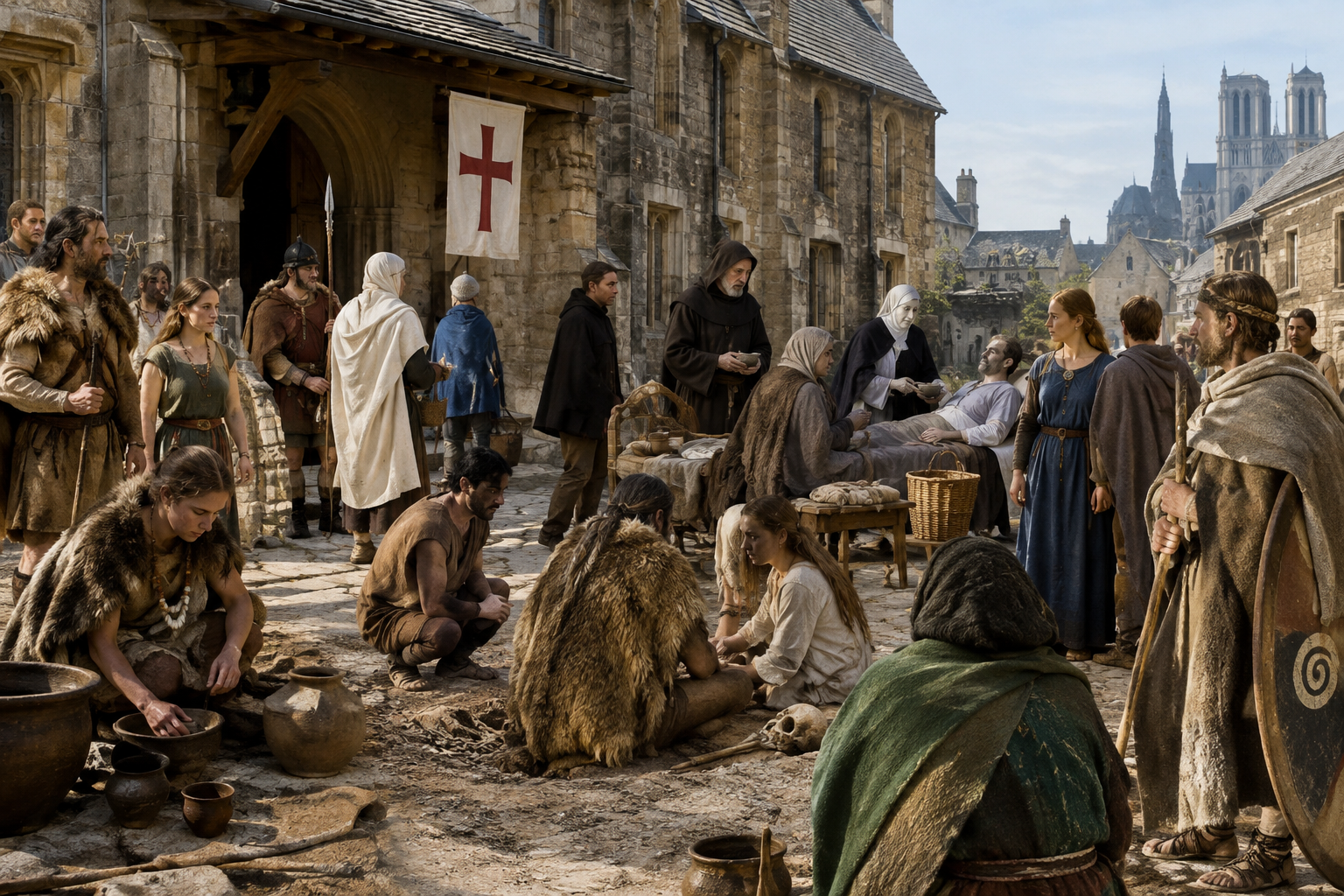
Some Y-chromosome lineages arrive in history with trumpets: tied to famous dynasties, sweeping migrations, or neatly labelled peoples. Haplogroup I2a1b1a1a1a is more interesting precisely because it does not behave so tidily. It appears, from the material supplied here, in a striking spread of ancient individuals across Britain and Ireland, from the Neolithic into the Iron Age and on into the medieval world. That makes it useful not as a badge of one nation or clan, but as a reminder that paternal lines can endure through enormous cultural change.
That is worth pausing over. A Y-DNA haplogroup traces one direct paternal line only: father to father to father. It does not describe a person's whole ancestry, culture, language, or identity. Even so, when ancient DNA places related paternal branches in tombs, caves, monasteries, ports, and towns across millennia, it gives us a rare way to follow one narrow line through landscapes that written history only partly illuminates.
Haplogroup I is one of the major old European Y-chromosome lineages, and branches of I2 are often associated in broad terms with deep prehistoric roots in Europe. For a narrow subclade such as I2a1b1a1a1a, however, caution matters. We should not simply pour the entire history of all I2 men into this one twig of the tree. What the supplied evidence does suggest is that related paternal branches were present in Britain and Ireland over a very long span of time, especially in western and northern Atlantic settings.
The archaeological settings are telling. We find this lineage in Neolithic barrows in Dorset, in cave contexts in Wales and western Scotland, in Irish prehistoric burials, in an Iron Age individual from East Lothian, and later in medieval England and France. That does not prove uninterrupted descent from one excavated skeleton to another, but it does point to a durable paternal presence in regions where local continuity and later migrations both shaped the population.
If you want to see how ancient DNA changes the story, begin in Neolithic southern Britain. Several supplied samples come from Dorset and nearby landscapes: che002 from Chedworth Down Barrow, lot005 from Sales Lot, muw002 from Monkton Up Wimborne, and slb001 and slb004 from Sisters Long Barrow, all dated around 3500 BC to 3233 BC. These are not just dots on a map. They belong to the world of early farming communities, monument building, and carefully structured burial places.
That cluster matters because it places this paternal branch, or very near relatives of it, within the social world of early monument-building Britain. Long barrows were not casual graves. They were statements about ancestry, land, and memory. When the same broader paternal signal appears in several such sites, it suggests that this lineage had found a place within those early settled communities.
Nor is Dorset alone. In Wales, I16491 from Orchid Cave, Denbighshire, dated to 2780 BC, adds another western British example. In Scotland, I2657 from MacAurthur Cave, Oban, Argyll and Bute, dated to 3850 BC, pushes the story into the western seaways. And on the Isle of Lewis, I2655 from Pabay Mor, dated to 1350 BC, shows that related paternal ancestry appears again in island Scotland during the Bronze Age.
Ireland is equally important here. The supplied list includes prs012 from Primrose Grange, dated 3700 BC, prs010 from Primrose Grange, dated 3572 BC, car004 from Carrowmore, dated 3567 BC, and CAK534 from Neolithic Ireland, dated 3000 BC. Taken together, these are not proof of one unbroken family line. But they strongly suggest that this haplogroup belonged to the human world of Atlantic megalithic and early farming communities on both sides of the Irish Sea.
Discover Neolithic Irish Kinship
One of the most intriguing features of the supplied evidence is that the story does not stop with the first farmers. The Bell Beaker period appears here too, with I4949 from Upavon, Wiltshire, dated 3467 BC. That date should be preserved as supplied, and without forcing a bigger claim than the evidence allows. Still, the presence of this sample in the dataset is a useful reminder that paternal lines can persist through periods often described in terms of major demographic change.
By the Iron Age, we are on firmer historical ground, though not necessarily firmer genealogical ground. I14866, a Celtic Briton from Cliffs End Farm in England dated to 285 BC, shows this lineage in a recognisably later British context. So too does I16418 from Iron Age East Lothian, Scotland, dated to 102 BC. These samples do not mean that haplogroup I2a1b1a1a1a was "the Celtic haplogroup" - that would be much too crude. But they do show that this paternal ancestry formed part of Iron Age populations in both southern and northern Britain.
That matters when we think about historical identities. Archaeology and language tell us about Britons, regional communities, and later kingdoms; Y-DNA tells us that some paternal lines ran right through those changing worlds. The same landscape could host shifts in speech, politics, and material culture while some male lines remained in place or were repeatedly reabsorbed into new societies.
The medieval samples make the picture richer, and more human. ATP_PSN_527, from the Augustinian Friars in medieval England and dated 1290 AD, places this haplogroup in a religious setting rather than a barrow or cave. That is exactly the sort of shift ancient DNA lets us observe: the same paternal heritage now turning up in an urban, ecclesiastical world shaped by monasteries, literacy, and royal government.
Then there are the Paris samples: PRS010, PRS010a, and PRS010b, all from the Hopital de la Croix de la Reine in medieval France, dated 1337 AD. These are especially evocative because they show the lineage in a major medieval city across the Channel from Britain. Paris in the fourteenth century was no remote village. It was a capital, crowded, connected, and full of movement. A paternal lineage seen in Neolithic Atlantic burials and later in England also appearing in medieval Paris hints at how thoroughly intertwined western European populations had become.
Again, one must not overstate it. Shared haplogroup does not prove close kinship between a Dorset barrow burial, an East Lothian Iron Age man, an English friar, and a Paris hospital burial. What it does show is continuity of a paternal branch across very different social worlds.
Read About Ancient DNA in Post-Roman Britain
If we now move from graves to stone walls, the supplied noble connection brings us to Clan Durie and Rossend Castle in Burntisland, Fife. This is exactly the kind of place where genetic imagination needs discipline. A historical association in a haplogroup article does not prove that every Durie, every Melville, or every laird of Rossend carried this Y-lineage. But the regional context is fascinating, especially given the Iron Age Scottish sample from East Lothian and the broader pattern of long paternal presence in Britain.
Rossend Castle began as a medieval tower house, probably in the late 1300s or early 1400s. As Burntisland developed into an important port on the Firth of Forth, the building grew into a larger residence associated with the Melville family and other local lairds. In the 1500s and 1600s it was altered and enlarged, becoming less a stark fortress and more a noble house behind its defensive core. That transformation is a little history lesson in stone: Scottish castles were not static military objects but working residences shaped by changing politics, wealth, and fashion.
There is also the tradition that Mary Queen of Scots stayed there in 1562, though the supplied material rightly notes that this cannot be proved for certain. Later came decline, neglect, and twentieth-century restoration. So Rossend survives not only as architecture, but as memory: of local power, of maritime Fife, and of the way noble households occupied landscapes whose human history ran far deeper than medieval charters.
And that is really the point. Ancient DNA and castle history do different jobs. The castle preserves the documented and visible world of later centuries. The Y-chromosome samples show that the male-line background of such regions may stretch back into prehistory, through communities who left barrows, cave burials, and island graves long before surnames or heraldry existed.
What makes I2a1b1a1a1a historically interesting is not a single dramatic conquest or a simple ethnic label. It is the breadth of its appearances. In the evidence supplied here, related paternal ancestry shows up in Neolithic England, Wales, Ireland, and Scotland; in an Iron Age Briton and an Iron Age Scot; in medieval England; and in medieval France. That is a story of persistence through change.
For family historians, that is both exciting and sobering. Exciting, because a Y-DNA haplogroup can place one paternal line within very old regional histories. Sobering, because it cannot by itself identify a noble ancestor, a clan chief, or a specific ancient individual as "yours." Genetics works best when it sits beside archaeology and history, not when it tries to replace them.
If your own Y-DNA falls on a branch like this one, MyTrueAncestry can help you explore whether your deeper paternal history shows connections to the kinds of ancient populations discussed here, from Neolithic monument builders to medieval town-dwellers. Those matches do not prove direct descent from a particular burial or noble house, but they can open a remarkably concrete view onto the worlds your distant ancestors inhabited.






Comments