Haplogroup I2a1b1

– 6 min read


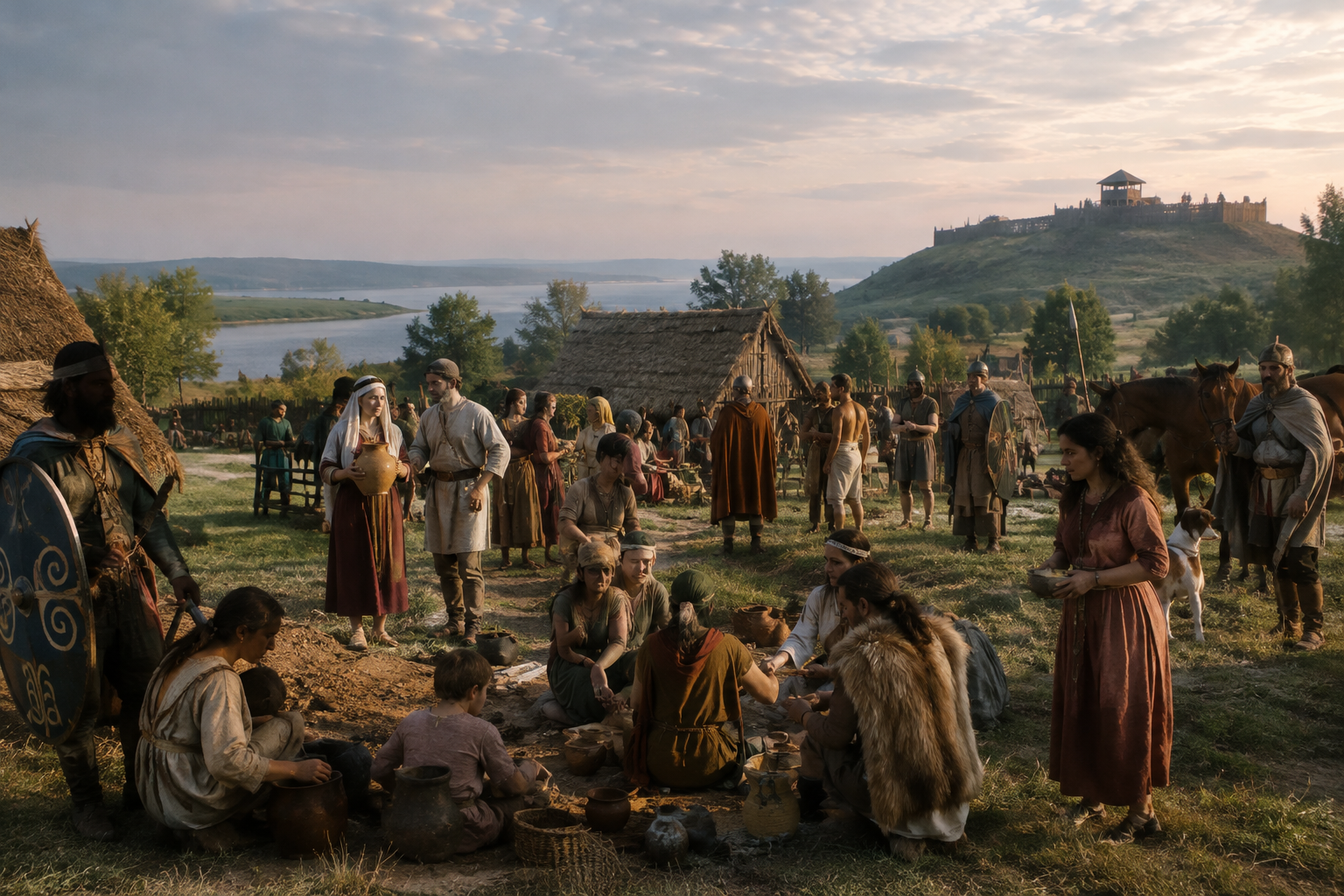
Some Y-chromosome haplogroups announce themselves with a single dramatic homeland or a neat historical label. I2a1b1 does not quite behave so politely. What makes it interesting is precisely that it keeps turning up in a remarkably wide range of ancient settings: among very early Scandinavian forager contexts, in Neolithic graves from western and northern Europe, in Bronze Age central and eastern Europe, in Iron Age burials, and again in medieval settings. That pattern reminds us of something archaeogenetics has taught again and again: paternal lineages can persist for a very long time while the cultures, languages, kingdoms, and identities around them change completely.
It is also a useful case study in what Y-DNA can and cannot tell us. Y-DNA haplogroups trace one direct paternal line only: father to father to father. They do not represent a person's full ancestry, and they do not by themselves prove ethnicity, language, or noble descent. Still, when a lineage like I2a1b1 appears across so many archaeological horizons, it gives us a powerful thread through the maze of European prehistory and history.
I2a1b1 belongs within the wider haplogroup I family, one of the old European branches of the Y-chromosome tree. In broad terms, lineages within haplogroup I are strongly associated with ancient European hunter-gatherer ancestry, though particular downstream branches had very different later histories. For a branch as specific as I2a1b1, caution is essential: we should not simply pour the entire history of haplogroup I or even all of I2 into this one subclade.
What the sample set does suggest is impressive durability. At Kanaljorden, Motala, Sweden, four Neolithic individuals dated to 5710 BC - I0013, I0015, I0017, and I0016 - place this paternal line in a famous Scandinavian forager context very early indeed. These are not medieval nobles or Iron Age warlords; they belong to a world of hunter-fisher communities whose ritual practices still puzzle archaeologists.
That early northern presence makes I2a1b1 especially relevant for readers interested in the old peopling of Scandinavia and the Baltic world.
Yet the story does not stay in Scandinavia. We find related paternal continuity or presence in early farming and mixed Neolithic worlds too: MAD01 from Madonna Bianca, Alpine Italy dated to 6300 BC; I18068 from Pommeroeul, Belgium dated to 2890 BC; I0172x from Esperstedt, Germany dated to 3086 BC; and I18428 from Moussey PLA, France dated to 3450 BC. Add to this the cluster from northern Scotland and Orkney - I2634 at Tulach an t Sionnaich dated to 3618 BC, I2635 at Tulloch of Assery dated to 3502 BC, I36003 at Holm of Papa Westray dated to 3193 BC, and I2979 from the Tomb of the Eagles, Orkney Islands dated to 3200 BC - and the picture becomes clear enough: this was not a fleeting local curiosity.
One of the pleasures of working with a haplogroup like I2a1b1 is that the evidence comes from such different kinds of places. Some samples come from tombs and domestic communities; others from scenes of conflict and movement.
Take the Bronze Age. In the Tollense Valley battlefield, Mecklenburg-Vorpommern, two individuals dated to 1250 BC - WEZ24 and WEZ48 - connect this paternal line to one of Europe's most striking prehistoric conflict zones. Tollense is not a legend from epic poetry but a real battlefield, with weapons, trauma, and bodies left by large-scale violence. A lineage turning up there tells us not that I2a1b1 was "the" lineage of Tollense, but that men bearing it were part of the social world of Late Bronze Age conflict in northern Europe.
Elsewhere in Bronze Age Europe we see a broad spread: S2 from the Balaton Region Kisapostag Encrusted Pottery, Hungary dated to 1980 BC; I7197 from Prague Jinonice, Czech dated to 1950 BC; poz506 from Bocheniec, Poland dated to 1750 BC; and KD064_2 from Westray Links of Noltland, Orkney dated to 1400 BC. That geographic range argues for persistence across multiple regional societies rather than a single compact migration.
Then come Iron Age and classical-era appearances. EV18, from Etruscan Italy, Monteriggioni Colle di Val d'Elsa, dated to 600 BC, is particularly arresting because it places this paternal branch in the Etruscan world of central Italy. So too does SAL011 from Daunian Salapia, Apulian Foggia, Italy, dated to 500 BC, suggesting that lineages of this sort formed part of the patchwork of Iron Age Italy rather than belonging to one single "people."
In temperate Europe, the Iron Age samples are equally telling: 2909 from Prague dated to 100 BC, I20518 from Teplice, Czech Republic dated to 280 BC, BFT228 the Gallic Warrior from Bucy-le-Long, France dated to 400 BC, and I36826 from the Celtic Parisi burial at Wetwang Slack, East Yorkshire dated to 225 BC. Here again the evidence supports presence across Celtic-speaking or Celtic-associated zones, but not a simplistic claim that the haplogroup was uniquely "Celtic."
Explore Celtic DNA and Origins
By late antiquity and the early Middle Ages, I2a1b1 is still very much with us. PC1008 from the Late Roman Period, Boczne, Poland dated to 350 AD, SZL059 from Post Roman Period Pannonia Savaria Szeleste Barbaricum, Hungary dated to 525 AD, and SZ6 from a Germanic Lombard Grave dated to 590 AD all show this paternal line moving through the unsettled centuries when the Roman imperial framework broke apart and new polities emerged.
The same is true farther north and west. BUK068 from Buckland Dover, England dated to 400 AD, DUN012 from Dunum, Lower Saxony, Germany dated to 840 AD, and ATP_PSN_356 from Cambridge St Johns Hospital, England dated to 1025 AD place it in the medieval North Sea world. Meanwhile VK347 from Viking Age Oland, Sweden dated to 950 AD is a particularly nice Scandinavian marker for a line whose northern credentials were already ancient millennia earlier at Motala.
For readers interested in how such lineages persisted into later Scandinavian and Baltic populations, the Viking and post-Viking context is well worth following up.
What all this suggests is not a single migration arrow on a map, but a lineage that survived repeated demographic turnovers, cultural shifts, and regional re-formations. Some branches may have been local holdovers from earlier populations; others may have travelled within wider Bronze Age, Iron Age, Roman, or medieval mobility networks. Ancient DNA gives us the distribution. The harder work is resisting the temptation to turn that distribution into a fairy tale of one tribe marching unchanged through time.
If we jump forward to early modern Sweden, we move from burials and bone samples into the world of heraldry, landed estates, and noble self-fashioning. The supplied family connection here is Riddarhuset Sparre and Sparreholm Castle in Sormland, Sweden. The site began as a medieval estate and took its present name and much of its form in the 1640s, when Carl Sparre built the manor and named the place after himself.
There is something almost comically human in this. After thousands of years in which paternal lines must be reconstructed from petrous bones and fragmentary remains, the early modern nobility steps onto the stage determined to label the estate, shape the landscape, and leave paper trails. Sparreholm later passed through several aristocratic families and was altered over the centuries, while retaining its grand country-house character. In modern times it became known for its carriage collections and as part of Swedish heritage tourism.
None of that proves that the Sparre paternal line was I2a1b1, nor would it justify claiming that a Motala forager or a Viking Age man from Oland was an ancestor of Carl Sparre. That would be precisely the sort of nonsense we ought to avoid. What we can say is more interesting and more responsible: noble houses like the Sparres occupied regions where very old paternal lineages had deep prehistoric roots, and castles such as Sparreholm preserve the social memory of lineage in a way that complements, but does not replace, genetic evidence.
If you want to explore the family itself in more detail, MyTrueAncestry has a dedicated article on the subject.
I2a1b1 is a splendid reminder that paternal ancestry does not follow the tidy boundaries of textbook history. This lineage appears in Mesolithic-Neolithic Scandinavia, in Neolithic Britain and France, in Bronze Age central Europe, in Iron Age Italy and Celtic Europe, and in medieval northern populations. That is exactly why ancient DNA matters: written history begins late, and even then it mostly notices elites. Genetics lets us see a deeper chronology of male-line continuity and movement that written sources cannot reach.
For anyone carrying I2a1b1 today, the real interest lies not in claiming a ready-made identity, but in appreciating how many different societies could contain men from the same broad paternal branch. Your direct paternal line may connect, at a great distance, to some part of this story. But the details depend on downstream subclades, family history, documentary evidence, and broader autosomal ancestry as well.
That is the fun of MyTrueAncestry: not turning DNA into mythology, but using it to ask better historical questions. You may find links to ancient Scandinavia, to Bronze Age Europe, to Iron Age communities, or to medieval populations. Those matches can illuminate the past without pretending to settle every genealogical mystery.






Comments