Haplogroup I2a1a2b1a1a1b

– 5 min read


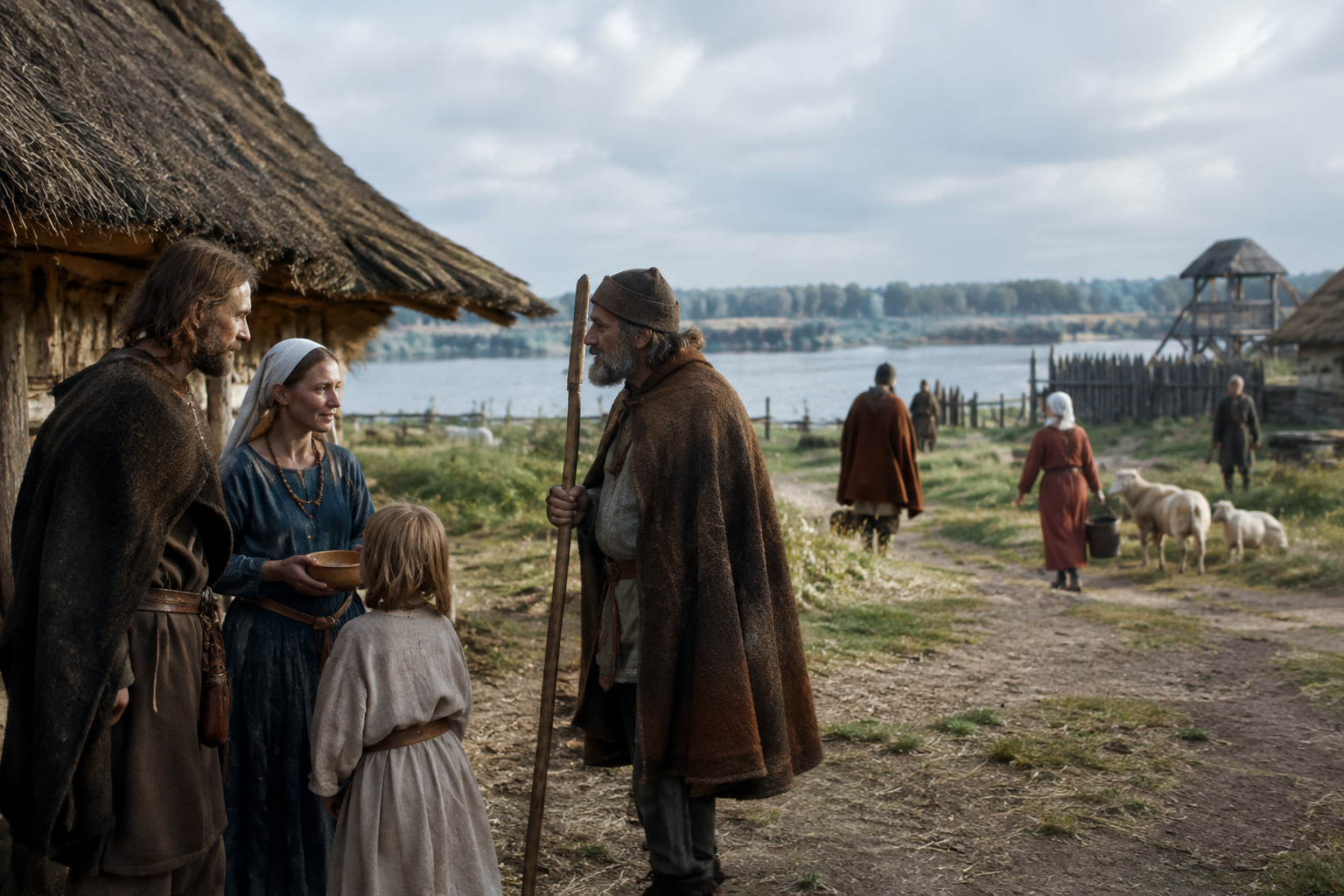
At Pohansko in Moravia, one early medieval man has become a small but useful signpost for the history of a paternal line. The individual known as POH36, dated to around AD 975, was buried at a major settlement landscape in what is now the Czech Republic, a place tied to the last centuries of Great Moravia and the reshaping of central Europe after its fall. He is reported in connection with the Y-DNA haplogroup I2a1a2b1a1a1b, a very narrow paternal branch that sits deep within the wider I2 family.
That matters because Pohansko is not some vague dot on a map. It is one of the best-known early medieval sites in Moravia: fortified, strategically placed, and entangled with the political world that linked the Danube basin, Bohemia, Bavaria, and the Slavic-speaking societies of central Europe. When a lineage like I2a1a2b1a1a1b turns up here, the interest is not in claiming a kingdom for it, but in seeing how a direct male line persisted inside a historically busy frontier zone.
Pohansko, near Breclav, is famous for its scale and for the archaeological problems it poses. Was it primarily a power centre, a fortified estate, a border stronghold, or at times all three? By the 9th and 10th centuries, Moravia was a region of churches, elite compounds, craft production, and changing political loyalties, and Pohansko sits squarely inside that world.
Sample POH36, dated to about AD 975, belongs to the century after the high point of Great Moravian power. That is a particularly revealing moment. The great political structures of the 9th century had fractured, yet local communities did not vanish. A Y-chromosome lineage found in such a burial is therefore best read as evidence of continuity through change: men living on in a landscape where rulers, alliances, and ecclesiastical networks were shifting rapidly.
Y-DNA, of course, tracks only one line of descent: father to son to son. It does not describe a person's whole ancestry, language, or social rank. But in an archaeological setting like Pohansko, it can show that one paternal branch associated today with parts of eastern and southeastern Europe was already present in Moravia in the late 10th century.
The first thing to say, and it is worth saying plainly, is that I2a1a2b1a1a1b is not the same thing as the whole of haplogroup I2. The broader I2 family has a deep European history reaching far back before the Middle Ages. But one should not simply pour all of that older story into this much narrower branch as though nothing changed along the way. Subclades are historical filters: they represent only one part of a larger paternal family tree.
What POH36 gives us is a securely placed medieval example in central Europe. That does not prove where the branch first formed, nor does it identify a tribe, dynasty, or language group by itself. What it does suggest is that this paternal line was part of the male population living in Moravia during the period when Slavic polities, Christian institutions, and regional aristocracies were all taking shape.
That makes the haplogroup especially interesting for MyTrueAncestry users whose direct paternal line falls somewhere in this part of the tree. Rather than imagining a single dramatic migration, it may be better to think in terms of long residence within the interconnected zones of the Carpathian basin, the Balkans, and central Europe, where communities endured even as political labels came and went.
Early medieval Moravia was never sealed off. Trade routes, marriage networks, church ties, warfare, and seasonal movement all tied it to neighbouring regions. The men buried there were part of societies that dealt with Franks, Bavarians, Bohemians, steppe-linked groups, and other Slavic-speaking populations. A lineage such as I2a1a2b1a1a1b appearing at Pohansko fits that picture of a connected world rather better than any fantasy of an untouched ethnic enclave.
In practical terms, this means that the presence of the branch at Pohansko may reflect local paternal continuity, movement from nearby regions, or both over generations. Archaeology often forces us to accept that populations do not behave as neatly as old textbook maps suggest. Communities can keep local roots while also absorbing newcomers, and paternal lines can persist through exactly that kind of historical muddle.
That wider central European setting also helps explain why Moravian samples matter beyond the Czech Republic itself. They sit near the hinge of several historical regions. For descendants testing today, a medieval Moravian signal can speak to ancestries later found across Czech, Slovak, Hungarian, Croatian, Serbian, Bosnian, Polish, or other neighbouring family histories, without collapsing those histories into one undifferentiated block.
There is a temptation, when only one ancient individual is available for a very specific branch, to dismiss the evidence as too slight. That would be a mistake. Single samples do not tell the whole story, but they can anchor it. POH36 gives this haplogroup a real archaeological foothold: an identifiable person, from an identifiable site, in an identifiable historical period.
That is more valuable than broad modern distribution maps on their own. Modern populations have been reshaped by migration, war, epidemics, and social change. An excavated early medieval individual places the lineage in a known setting before many later upheavals. For a branch as specific as I2a1a2b1a1a1b, that kind of anchor is exactly what turns abstract genetics into history.
It also reminds us that medieval central Europe was built from ordinary local lives as much as from royal chronicles. Not every useful genetic clue comes from a palace, princely tomb, or famous battlefield. Sometimes it comes from a burial at a settlement like Pohansko, where the real work of continuity happened on the ground.
The late 9th and 10th centuries are often described in terms of collapse and replacement: Great Moravia falls, the Hungarians arrive in the Carpathian basin, new powers emerge, frontiers shift. All true, up to a point. But ancient DNA keeps adding a more stubbornly human picture. Beneath the headlines of political history, populations show mixtures of persistence, adaptation, and selective mobility.
POH36 belongs to that quieter history. His reported association with I2a1a2b1a1a1b suggests that this paternal line was already part of the male landscape of Moravia at the close of the first millennium AD. That does not make it uniquely "Moravian," still less the signature of all Slavs. It does, however, place the branch within one of the formative regions of early medieval central Europe.
For that reason, this haplogroup is best understood not as a badge of a single people, but as one paternal thread running through the complicated centuries in which central European societies were reorganised. If you carry this branch today, the strongest ancient clue presently points not to legend, but to a documented man from Pohansko living in the aftermath of Great Moravia.
Paternal line shifts in Croatia
The distinctive value of haplogroup I2a1a2b1a1a1b lies, at present, in its early medieval visibility at Pohansko through sample POH36. That is a modest claim, but a solid one: this direct paternal line was present in Moravia around AD 975, in a region central to the political and cultural transformations of the age. For anyone researching this haplogroup today, the best historical lesson is not a grand royal origin story, but a more interesting truth: your paternal line may belong to the durable male histories that carried communities through one of central Europe's most unsettled centuries.






Comments