Haplogroup I2a1a1b1a1a
– 5 min read


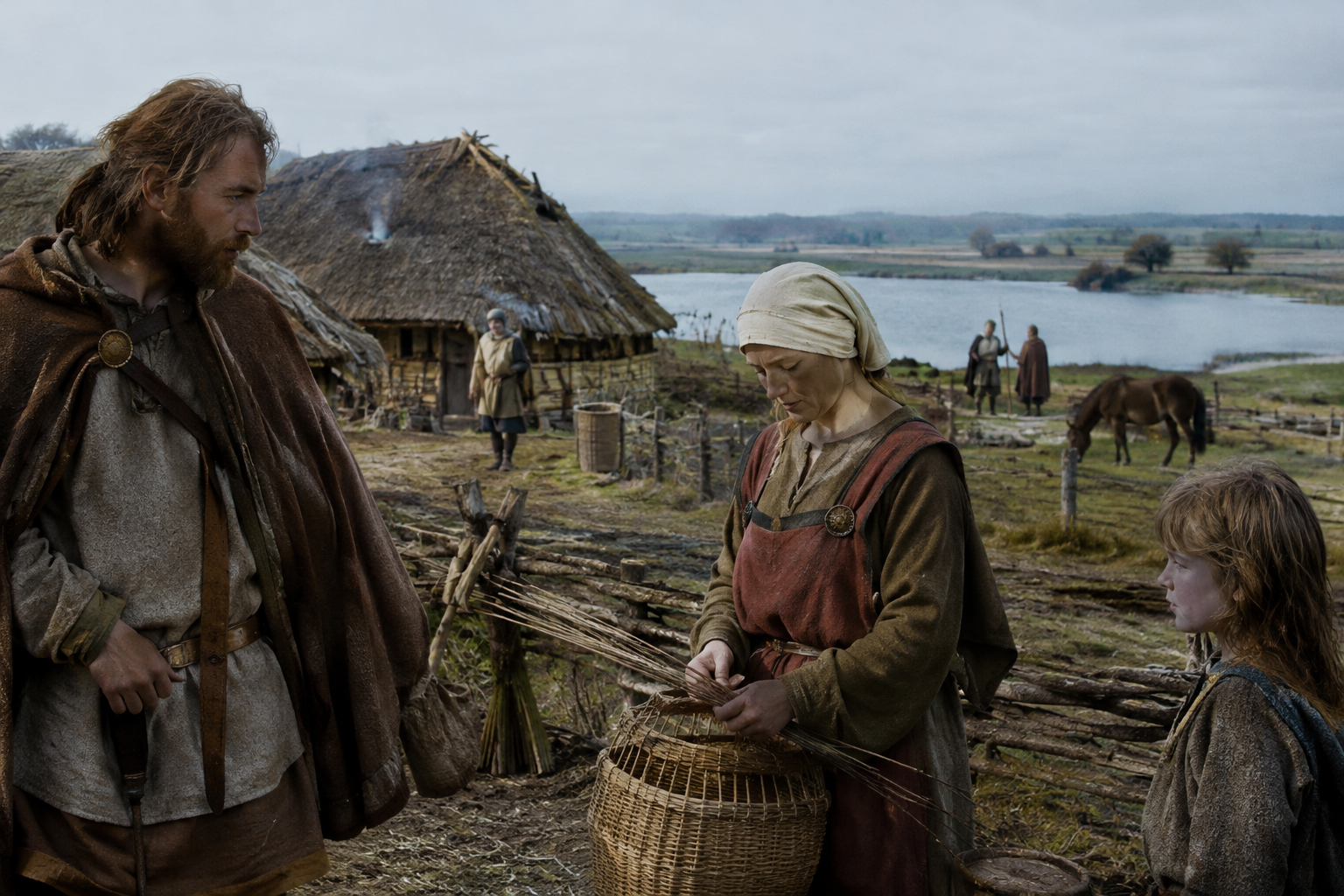
At Lakenheath in Suffolk, one early medieval burial has become a small but telling marker in the history of paternal ancestry in England. The individual known as LAK006, dated to around AD 650, belonged to the Y-DNA haplogroup I2a1a1b1a1a - a very specific branch carried down the direct male line. One burial cannot stand for an entire people, of course, but in a century when eastern England was being reshaped by migration, language change, and new political identities, even a single paternal lineage can sharpen the picture.
What makes LAK006 interesting is not that he represents some isolated curiosity, but that he appears in exactly the sort of landscape where archaeologists and geneticists have been trying to understand how post-Roman Britain became early medieval England. Suffolk, lying within the old kingdom of East Anglia, was part of the North Sea world: a zone of movement linking Britain with communities across the southern North Sea. In that setting, haplogroup I2a1a1b1a1a offers a reminder that the making of Anglo-Saxon England was not a story of one lineage, one ancestry, or one neatly bounded population.
Lakenheath sits in a region thick with evidence for the social changes of the 5th to 7th centuries AD. Roman rule had ended, older systems of power had fractured, and new kingdoms were taking shape. By around AD 650, when LAK006 lived, Christianity was advancing in some areas, older burial customs had not entirely disappeared, and East Anglia was part of a politically ambitious and culturally connected world.
The sample itself is valuable because it anchors the haplogroup in a specific time and place. Rather than floating in an abstract family-tree diagram, I2a1a1b1a1a is here attached to a real man buried in early medieval Suffolk. That matters because Y-DNA is often discussed far too broadly. It traces one paternal line only, not a person's whole ancestry, language, or identity - but when tied to an archaeological context, it can still reveal how different male lines persisted or arrived within particular communities.
An ancient DNA study examining early English populations, available here on ResearchGate, has helped frame these burials within the wider population history of early medieval England. The larger point is not that every man in eastern England shared the same paternal origin, but that migration into Britain involved a mixture of lineages and produced local communities with varied male ancestry.
Anglo-Saxon migration and England
The haplogroup name looks forbidding, but the important thing is scale. I2a1a1b1a1a is not the whole of haplogroup I, nor even the whole of I2. It is a narrow twig on a much older European branch. The broader I line is deeply rooted in Europe, with different sub-branches turning up in very different ancient settings, from hunter-gatherer contexts to later historic populations. That does not mean every downstream branch shares the same historical story.
For this article, the secure point is the early medieval English evidence represented by LAK006. It suggests that this paternal line was present in the population of Suffolk by the 7th century AD. Whether that line reached Britain generations earlier, arrived through migration in the post-Roman centuries, or had a more complex path through North Sea networks is a question that needs more directly comparable ancient samples before it can be answered confidently.
That restraint is important. Genealogical enthusiasm often outruns the evidence, especially with narrow Y-DNA branches. A precise modern haplogroup label can tempt us into imagining a single tribe or one dramatic migration event. Archaeology usually tells a messier and more interesting story: lineages move through families, and families move through changing political worlds.
If LAK006 belonged to I2a1a1b1a1a in AD 650, the most useful historical frame is not some grand pan-European sweep but the North Sea zone of the early Middle Ages. Eastern England was not cut off. It was tied by trade, migration, and marriage links to regions across what is now the Netherlands, northern Germany, and Denmark. Material culture, burial customs, and later language history all point to those connections.
Genetics has increasingly shown that these connections were real at the population level as well. Early medieval cemeteries in England often contain people with varying ancestry profiles, some closer to continental northern Europeans, others more continuous with earlier British populations, and many likely drawn from mixtures of both. In that setting, the presence of a lineage such as I2a1a1b1a1a in Suffolk is entirely plausible as part of a diverse male ancestry pool rather than a badge of one exclusive ethnic identity.
This is one of the most useful correctives provided by ancient DNA. Historical labels like "Anglo-Saxon" describe cultural and political worlds; they are not identical to one Y-chromosome branch. A man buried in 7th-century Suffolk could take part in the society of early England regardless of whether his paternal line had deep roots in Britain, recent continental ties, or a mixture of histories further back in time.
Roman to early medieval Britain
There is a temptation to dismiss lone ancient samples as too slight to say anything useful. But archaeology often advances through exactly these modest, well-contextualized finds. LAK006 does not prove a dynasty, a tribe, or a regional majority. What he does provide is a fixed point: by around AD 650, this direct paternal branch was present in an early medieval community in Suffolk.
That fixed point becomes more valuable when set against the broader transformation of Britain after Rome. The old Roman provincial order gave way to a mosaic of local powers. Cemeteries, settlement forms, and objects show both disruption and continuity. Ancient DNA adds another layer, revealing that population change could be substantial in some places without erasing all local complexity. A lineage like I2a1a1b1a1a belongs inside that complicated mosaic.
For people exploring their own paternal ancestry today, this is often the most meaningful level of interpretation. Ancient DNA rarely hands over a grand heroic identity. Instead, it shows that a modern Y-line may have passed through very specific historical settings - in this case, an early medieval landscape in eastern England shaped by migration and cultural blending.
So the most responsible way to read haplogroup I2a1a1b1a1a is through place, period, and scale. At present, the strongest ancient anchor supplied here is LAK006 from Lakenheath, Suffolk, around AD 650. That places this paternal branch in the lived world of early medieval East Anglia, where old British landscapes and new North Sea connections were being woven together into something recognisably English.
For a modern tester, that does not amount to a guaranteed claim of Anglo-Saxon identity, still less to a single family legend. What it does offer is something better grounded: your direct paternal line has an attested presence in one of the key regions where early medieval England was formed, and where archaeology and genetics together show a society created by movement, mixture, and continuity all at once.






Comments