Haplogroup I1a3g

– 6 min read


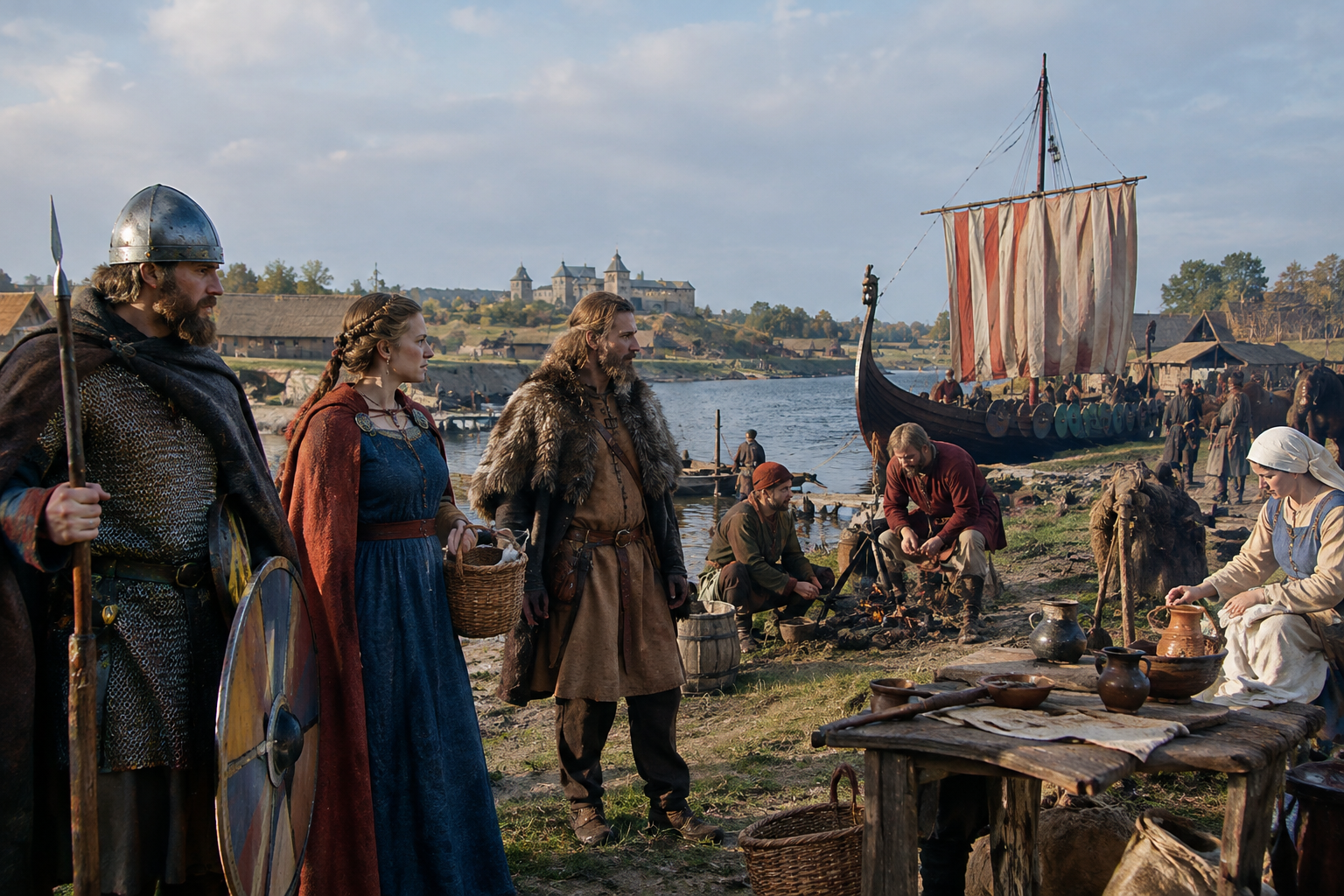
Some Y-DNA haplogroups arrive in the record like a fanfare. Others come into view more quietly, by turning up again and again in the graves of men who lived in very different centuries and political worlds. Haplogroup I1a3g belongs to that second category. It is a narrow paternal branch, but one that sits within a broader northern European Y-chromosome story that becomes particularly visible in Scandinavia, the North Sea world, and the early medieval societies that linked Denmark, England, Germany, and beyond.
As always with Y-DNA, a warning is also part of the fascination. A Y-haplogroup traces one direct paternal line only: father to father to father. It does not describe a person's whole ancestry, still less their culture, language, or identity. But when a lineage such as I1a3g appears in ancient burials across Bronze Age Denmark, Migration Period Germany, Anglo-Saxon England, and Viking Age Scandinavia, it gives us an unusually sharp way of watching paternal continuity and movement across the centuries.
I1a3g is a subclade within the wider haplogroup I1, a branch of haplogroup I that is strongly associated, in broad terms, with northern Europe. The larger I1 family is often discussed in connection with Scandinavian and Germanic-speaking regions, though any careful historian should add at once that haplogroups are not ethnic labels. What matters here is that this narrower branch, I1a3g, appears in a pattern that strongly points toward a northern European and especially Scandinavian-centered history.
The sample list supplied for this haplogroup is striking because it does not begin in the Viking Age, where many readers might expect it to. Instead, it reaches back into the Bronze Age. That matters. It suggests that the paternal history behind I1a3g was already present in southern Scandinavia long before written sources began describing Danes, Angles, Saxons, or Vikings. We should be cautious about projecting a later branch too neatly into earlier periods, but the recurrence of related male lines in Denmark and southern Sweden across so many centuries is historically important.
If you want to see the deep roots of this story, begin in prehistoric Scandinavia. The ancient individual oll009, from Ollsjo Battleaxe Sweden dated to 1840 BC, places this paternal line's wider background in a world of early Bronze Age societies shaped by exchange, mobility, and changing social hierarchies. Not far behind comes CGG106712 from Early Nordic Bronze Age Denmark Lolland Uglemose dated to 1675 BC, and NEO590 from Nordic Bronze Age Denmark Sjaelland Magleo dated to 1347 BC.
These are not just dates on a chart. They place the lineage in the islands and peninsulas that later became central to the Danish world: Lolland, Sjaelland, and the southern Scandinavian corridor. In other words, the historical setting of I1a3g is not simply "Germanic" in some vague textbook sense. It is grounded in very real landscapes of bogs, coasts, islands, and sea routes.
By the Iron Age, that same regional concentration is still visible. We find CGG106524 in Iron Age Denmark Jutland Hestehavens mose dated to 237 BC, CGG106718 in Danii Tribe Denmark Sjaelland Kalundborg Simonsborg dated to 175 AD, and CGG107392 from Iron Age Denmark Asnos dated to 188 AD. Add CGG024145 from Pre-Vendel Sweden Oland Stoerlinge dated to 175 AD, and the pattern becomes hard to ignore: this was a paternal line at home in the southern Scandinavian sphere for a very long time.
That does not prove uninterrupted descent from one named Bronze Age man to one named Viking. Ancient DNA rarely gives us that sort of tidy genealogy. But it does show repeated appearances of the lineage in the same broad region across nearly two millennia.
Discover Battle Axe Scandinavia
Then the map widens. By late antiquity and the early Middle Ages, men carrying this lineage appear far beyond Denmark itself. That is exactly what we might expect in an age of war bands, federate service, migration, and shifting kingdoms.
There is A181017 from Gothic Kecskemet-Mindszenti Transtisza Hungary dated to 450 AD, OBM052 from Thuringii Tribe Germany Obermoellern dated to 500 AD, and DRH024 from Thuringii Tribe Germany Deersheim Saxony-Anhalt also dated to 500 AD. We also have AED249 from Dark Ages Baiuvarii Tribe Bavaria dated to 485 AD, LBU010 from Migration Period Liebenau Lower Saxony Germany dated to 550 AD, and GHD021 from Longobard Period Pannonia Arrabona Gyirmot Barbaricum Hungary dated to 550 AD.
This is not evidence that one single tribe "owned" the haplogroup. Quite the reverse. It shows how paternal lines moved through multiple early medieval populations. The same broad northern lineage could appear among Thuringians in central Germany, Longobard-associated communities in Pannonia, Gothic-linked burials in Hungary, and Baiuvarii settings in Bavaria. Written sources often divide these peoples into neat categories. DNA, less politely, shows a messier human world.
The Croatian sample VEM059 from Early Medieval Croatia Velim-Velistak dated to 775 AD pushes that point even further south. This does not make I1a3g a "Croatian haplogroup." It shows that the male line had entered, or persisted within, the wider networks of early medieval Europe extending into the Balkans.
The English evidence is especially interesting because it lets us watch the lineage in more than one historical context. I20674, from the Early Anglo Saxon Cemetery West Heslerton Yorkshire dated to 550 AD, and I16508, from the Kingdom of Mercia England Wolverton Buckinghamshire dated to 690 AD, place this paternal branch in early medieval England during the centuries when new kingdoms were forming out of Roman collapse, migration, and local adaptation.
Later, the Viking Age makes the North Sea links even plainer. VK144, from the Danish Viking Clan St. Brice Massacre Oxford dated to 1002 AD, is one of those wonderfully specific finds that bring history into focus. Here the lineage is not just somewhere in Scandinavia or England, but in a moment tied to political violence recorded in the written sources. Alongside it stand VK367 from Viking Age Bogovej Langeland Denmark dated to 900 AD, VK316 from Viking Age Hessum Funen Denmark dated to 950 AD, and CGG106776 from Viking Age Denmark Bogovej dated to 975 AD.
Even VK409 from Viking Age Staraya Ladoga dated to 1000 AD fits the wider picture. Staraya Ladoga was one of the great eastern nodes of the Viking world, linking Scandinavia to river routes into Eastern Europe. Again, no claim of direct descent is warranted. But the presence of the lineage there is entirely consistent with a Scandinavian male line participating in the Viking expansion eastward as well as westward.
Read About Anglo-Saxon England
So where does this leave the medieval noble connection? The supplied family here is Clan Le Poer, associated with Dunhill Castle in County Waterford. The castle stands above the Anne Valley on a rocky outcrop, and its story begins with the Anglo-Norman invasion in the late 12th century, when a fort was first established under the Power family, one of the great dynasties of the region. What survives is largely a later medieval tower house and bawn, altered over centuries in a landscape marked by conflict.
This is exactly the sort of place where genetics and history should be brought together carefully. Dunhill Castle does not prove a haplogroup. The Power family cannot be assigned to I1a3g merely because they appear beside it in a modern association. But historically, the connection is still suggestive and worth exploring. The Le Poer or Power family belonged to the Anglo-Norman world, itself a product of layered ancestry: Scandinavian influence in Normandy, Frankish and French political culture, and later transplantation into Ireland. If a northern European paternal lineage such as I1a3g turns up in later families moving through these worlds, that would sit comfortably within the broader history revealed by the ancient DNA.
Dunhill itself tells the later chapter in stone. It was a stronghold, a statement of lordship, and eventually a ruin shaped by the upheavals of the 16th and 17th centuries. In that sense it mirrors the haplogroup story rather well: not a simple line of pure continuity, but a record of survival through conquest, rebuilding, and political change.
I1a3g is a useful reminder that paternal history often works on two timescales at once. On the long scale, the evidence points toward deep roots in southern Scandinavia, visible from the Bronze Age through the Iron Age. On the shorter historical scale, the same lineage appears in the mobile societies of the Migration Period, in Anglo-Saxon England, in Viking networks from Oxford to Staraya Ladoga, and in the background world from which later medieval noble families emerged.
Ancient DNA cannot tell us everything. It cannot turn every ruined castle into a certified family Y-line. It cannot collapse a thousand years of social history into a neat paternal label. But it can do something just as interesting: it shows that behind kingdoms, tribes, dynasties, and chronicles there were real male lines moving through real landscapes, sometimes staying close to home for centuries, sometimes crossing half of Europe.
If your own Y-DNA belongs to a branch like I1a3g, MyTrueAncestry offers a chance to place that paternal line against the archaeological record: from Bronze Age Denmark and Iron Age Sweden to Mercian England, Viking burials, and the later medieval world of castles like Dunhill. These matches do not by themselves prove direct descent from any ancient individual or noble house, but they can open a remarkably vivid window onto the deep history of your paternal line.






Comments