Haplogroup I1a3a1a2

– 7 min read


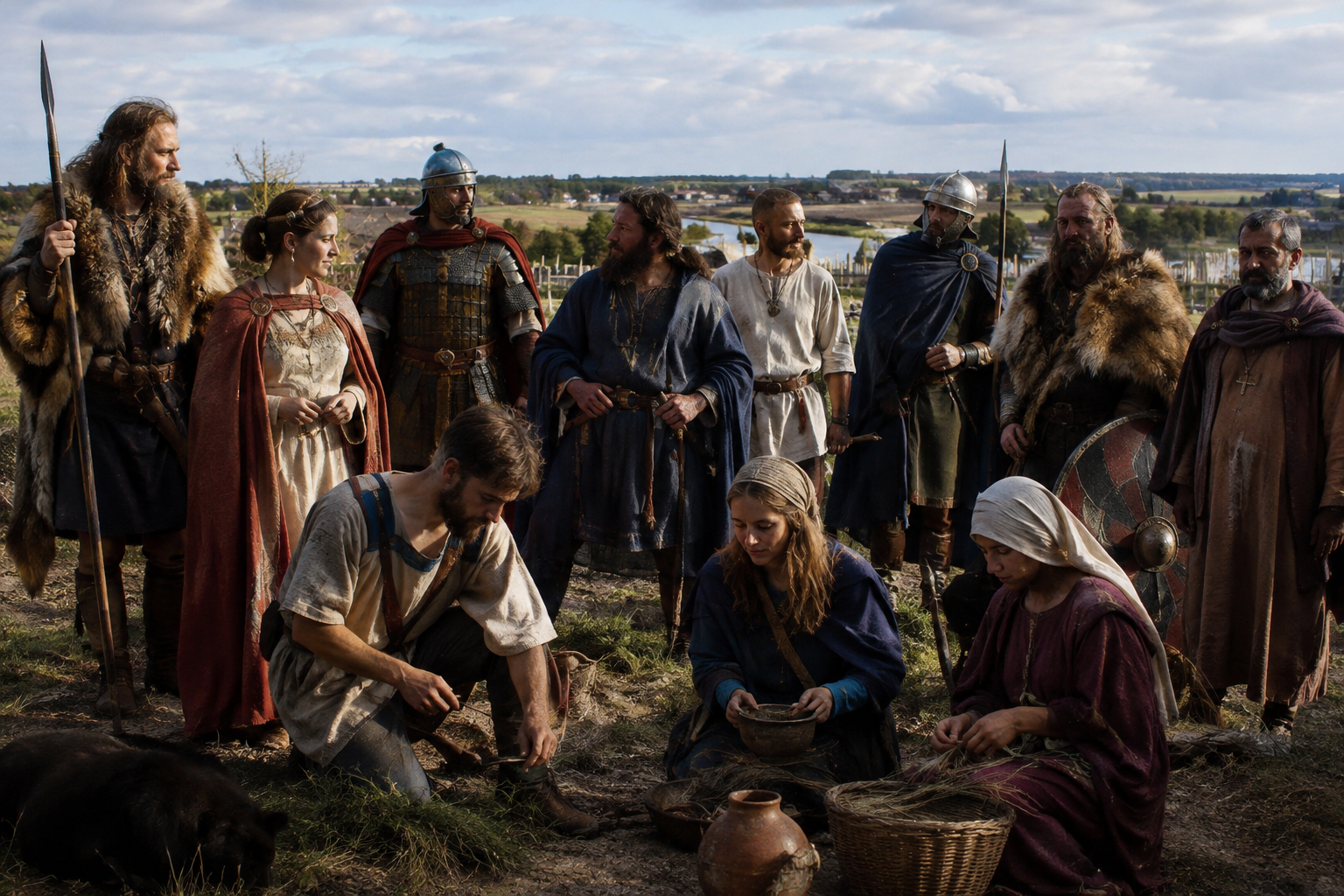
Some Y-chromosome lineages are easy to trap inside modern national labels. Haplogroup I1a3a1a2 is a good reminder of why that can be misleading. What ancient DNA shows instead is a paternal line moving through a world of shifting frontiers: Gothic communities in Poland, a Germanic warrior in Roman Croatia, post-Roman burials in Hungary, an early medieval man in Buckinghamshire, and even a monastery context in Anatolia. This is not the story of a single "people" marching neatly across a map. It is the story of male lineages travelling through the untidy, human business of migration, war, settlement, alliance, and assimilation.
As ever with Y-DNA, a caution is essential. A haplogroup traces only one direct paternal line: father to father to father. It does not describe a person's whole ancestry, culture, language, or identity. For a narrow branch such as I1a3a1a2, we must be especially careful not to dump onto it the entire history of broader haplogroup I1. Still, when ancient samples recur across several centuries and regions, they offer something rare: a glimpse of how one paternal thread ran through the great upheavals of late antiquity and the early Middle Ages.
I1 belongs to the wider haplogroup I family, one of the major ancient European paternal lineages. In broad terms, I1 is most often associated by researchers with northern Europe, and it appears frequently in discussions of Germanic-speaking populations and later Scandinavian connections. But that broad background must not be mistaken for a simple identity card for the much narrower branch I1a3a1a2.
What makes this subclade historically interesting is not a grand claim about origins, but the pattern of the supplied ancient evidence. The samples cluster strongly in contexts tied to the late Roman and Migration Period worlds of central and eastern Europe, especially among groups archaeologically described as Gothic or Germanic. That suggests that at least some lines within I1a3a1a2 were circulating in the populations involved in the reorganisation of Europe after the Roman Empire's crisis.
In other words, this is less a story about a static homeland than about movement: from the Baltic-connected world of the Wielbark horizon into the Danube basin, the Roman frontier, early medieval England, and beyond.
See How Ancient DNA Rewrites History
The clearest early cluster comes from Poland. Sample PL048, from Gothic Tribe Poland Grodek Wielbark dated to 250 AD, places this paternal line in a setting long associated by archaeologists with populations linked to the Gothic sphere. Nearby, at Maslomecz, three more samples - PL057, PL059, and PL062 - are also listed as Gothic Tribe Poland Maslomecz Wielbark, likewise dated to 250 AD. One should not turn these men into a single family, still less into a pure ethnic bloc. But taken together, they show that this lineage was present in the communities occupying that archaeological world.
This matters because the Wielbark and related horizons sit in one of the most debated zones of European migration history. Here archaeology, written sources, and genetics all circle around the same large question: how were the populations later called Goths formed? The answer, increasingly, is that they were not a biological tribe in any neat sense. The recurrence of I1a3a1a2 in these contexts adds one paternal strand to that mixed and mobile picture.
The Roman frontier offers another striking glimpse. Sample OSIJ007, described as a Roman-period Germanic Warrior Mursa Croatia Third Century Crisis and dated to 260 AD, stands in the world of imperial emergency. The third century was not a serene age of fixed borders; it was a time when armies, recruits, raiders, federates, and displaced communities moved across Europe in both directions. A northern-associated paternal lineage found in Roman Croatia fits neatly with that instability.
Then there is GRK021, from Migration Period Poland Grodek nad Bugiem dated to 400 AD. By this point, the Roman order was fraying badly in the west, and eastern-central Europe was a corridor of movement. This sample suggests continuity or recurrence of this paternal branch in the same broad zone as the earlier Gothic-associated finds.
For readers interested in how archaeogenetics is reshaping our picture of Gothic communities, the MyTrueAncestry article on mixed Gothic origins is especially relevant.
By the early medieval period, the geographical range broadens further. Two samples from Migration Period Hungary Rakoczifalva - RKF054 and RKO003, both dated to 650 AD - place this paternal line in the Carpathian Basin. That region was one of Europe's great funnels, where remnants of Roman provincial populations, Germanic groups, steppe arrivals, and later Slavic and Avar-period communities met and mixed. It would be foolish to make these two men stand for an entire people. But they do show I1a3a1a2 in precisely the kind of crossroads where late antique and early medieval identities were being remade.
Another Hungarian sample, TMH-509 from Frankish Empire Post Avar Hungary Tiszafured-Majoros-halom dated to 800 AD, carries the line into a later political world again. The label itself is telling: post-Avar, within a Frankish imperial horizon, but still in Hungary. It captures the central lesson of Y-DNA in history. Paternal lineages can outlast kingdoms and pass from one political order into another with no fuss at all.
England enters the picture with S16508, an Early Medieval Buckinghamshire Wolverton Radcliffe sample dated to 600 AD. Here we are in the age of early Anglo-Saxon England, where continental migrations and local continuity are still being debated in detail. A lineage seen in central and eastern European late antique contexts appearing in early medieval Buckinghamshire is exactly the sort of pattern that makes sense in a North Sea and continental migration framework, while still not proving a direct link between any one ancient man and any later English pedigree.
And then the map stretches farther still. I14832, from Byzantine Roman Zeytinliada Monastery Anatolia dated to 800 AD, and R110, a Vasconic-Roman Mix Crypta Balbi sample dated to 500 AD, show that paternal lines of this kind could appear deep inside the Mediterranean world. That is not surprising if we remember how soldiers, monks, migrants, merchants, and captives moved through the late Roman and Byzantine spheres.
If you want to place the English evidence in a wider framework, MyTrueAncestry's work on post-Roman Britain is a useful next step.
Discover DNA in Post-Roman Britain
One of the most evocative later finds is VK157, the Viking Age Elite Warrior Bodzia Poland sample dated to 1015 AD. Bodzia has become famous precisely because it sits at the intersection of local, Scandinavian, and wider eastern European connections. The presence of this lineage there does not mean that I1a3a1a2 was a "Viking haplogroup" in any exclusive sense. It does, however, show how a paternal branch already visible in late antique Poland could still be part of elite or martial networks centuries later, in a transformed political and cultural setting.
This is where ancient DNA becomes so valuable. Written history tends to follow kings, bishops, and chroniclers. Y-DNA gives us something different: continuity without biography. It lets us see that some paternal lines persisted through Gothic formations, Roman military crisis, Migration Period mobility, and the Viking Age, even when the men themselves are otherwise nameless.
The later medieval connection supplied here is the House of de Warenne and Castle Acre Castle in Norfolk. Built soon after the Norman Conquest by William de Warenne, Castle Acre was both fortress and statement. Its earthworks and stone structures were meant to dominate the local landscape and advertise new lordly power. Around it grew a planned town with defences and an important priory, making the site a regional centre in the 11th and 12th centuries before its later decline.
This is precisely the kind of place where genetics and history brush against one another without becoming the same thing. A Norman castle does not prove a haplogroup, and a haplogroup does not prove descent from a Norman lord. Still, the de Warenne story belongs to the same broad European theatre in which lineages like I1a3a1a2 had already been circulating for centuries: a continent remade by migration, military service, settlement, and elite takeover.
Castle Acre is especially evocative because it shows how conquest changed ordinary life as well as noble display. The ruins and earthworks are the surviving marks of a new social order imposed on England, one layered over earlier Roman, Anglo-Saxon, and Scandinavian histories. If a lineage such as I1a3a1a2 appears in early medieval England before the Norman period, it reminds us that the male ancestry of later medieval Britain was already a deep and mixed inheritance long before Norman aristocrats arrived to build their strongholds.
Readers interested in the family itself can continue with the MyTrueAncestry feature on the de Warenne house.
Read About the House of de Warenne
What does haplogroup I1a3a1a2 reveal, then? Not a tidy ethnic label, and not a ready-made noble pedigree. What it reveals is mobility. In the supplied evidence, this paternal line appears in Gothic-associated Poland, on the Roman frontier in Croatia, in Migration Period and post-Avar Hungary, in early medieval England, in Viking Age Poland, and in Mediterranean contexts as far as Rome and Anatolia. That is a remarkable spread for a single paternal branch.
It also shows why ancient DNA is such a useful companion to archaeology and written history. Chronicles may tell us who ruled; castles may tell us who controlled; graves may tell us how people were buried. Y-DNA adds another layer: how some direct paternal lines persisted, moved, and resurfaced across centuries of political change.
If your own paternal line falls within I1a3a1a2, that does not make you a Goth, a Viking warrior, or a Norman lord. But it may place one thread of your ancestry in the same broad historical worlds inhabited by men like PL048, OSIJ007, S16508, or VK157. That is quite exciting enough without overclaiming.
Upload your DNA to MyTrueAncestry to explore whether your results show similarities to ancient individuals and historical populations connected to lineages like I1a3a1a2. These matches can offer a powerful new perspective on your past, even if they do not by themselves prove direct descent from any ancient person or medieval noble house.






Comments