Haplogroup I1a2b1b

– 6 min read


Some Y-chromosome lineages announce themselves in the grand manner, spread across famous royal pedigrees or attached to vast prehistoric expansions. Others are more interesting precisely because they force us to work like historians: patiently, cautiously, and with an eye for the odd survival. Haplogroup I1a2b1b belongs to that second category. It is a narrow paternal branch, and narrow branches are often where the story becomes most human. They remind us that history is not just made of empires and migrations in the abstract, but of particular male lines carried through villages, cemeteries, kingdoms, and families whose names may appear centuries later in stone and parchment.
As ever with Y-DNA, a warning worth repeating: this kind of evidence traces only one direct paternal line, father to son to son. It does not describe a person's full ancestry, culture, language, or identity. Still, it can be extraordinarily revealing. In the case of I1a2b1b, the supplied ancient evidence places this paternal story in a distinctly northern European setting, with one foot in prehistoric Denmark and another in post-Roman and early Anglo-Saxon England. That combination alone makes it historically compelling.
I1a2b1b is a downstream branch within the wider haplogroup I1, a Y-chromosome lineage long associated in broad terms with northern Europe. That broad statement is well established; what requires more care is moving from the parent lineage to this much narrower subclade. We should not lazily assign to I1a2b1b the entire history of I1 as a whole. But it is reasonable to note that its appearance in Denmark and early medieval England fits a northern and North Sea world rather well.
The supplied samples suggest a pattern that historians of migration-period Britain will instantly recognize: links between southern Scandinavia and eastern England. That does not prove a single migration event, nor does it prove that every carrier of this branch moved in the same historical wave. But it does place I1a2b1b in a landscape shaped by movement across the North Sea, by settlement as much as by conquest, and by the long mingling of local and incoming populations after Roman rule in Britain broke apart.
If you want the wider background to those earlier Scandinavian worlds, the Mesolithic to Neolithic transition in Denmark is an excellent place to start.
The oldest supplied anchor for this lineage is CGG106702, from Neolithic Denmark Karlstrup, dated 1769 BC. One must be careful here: a single Bronze Age or late Neolithic-era Danish sample does not mean the entire subclade originated at Karlstrup, nor that its later carriers in Britain descended directly from this particular man. But it gives us something precious all the same - proof that a relevant paternal branch was present in southern Scandinavia deep in prehistory.
Karlstrup sits in a region that mattered enormously in European prehistory. Denmark was not a cul-de-sac. It was a hinge between the Baltic, the North Sea, and continental Europe. Men carrying branches of I1 in such settings could become part of communities shaped by farming, maritime contact, exchange, and later by the social rearrangements of the Bronze Age. For a narrow haplogroup like I1a2b1b, that ancient Danish sample is less a genealogical claim than a firm geographic clue.
Then the trail jumps forward more than two millennia, and it jumps westward to England. That sort of gap is common in archaeogenetics. The record is patchy not because the people vanished, but because ancient DNA survives unevenly and only some sites are sampled. Yet when the lineage reappears, it does so in a striking cluster.
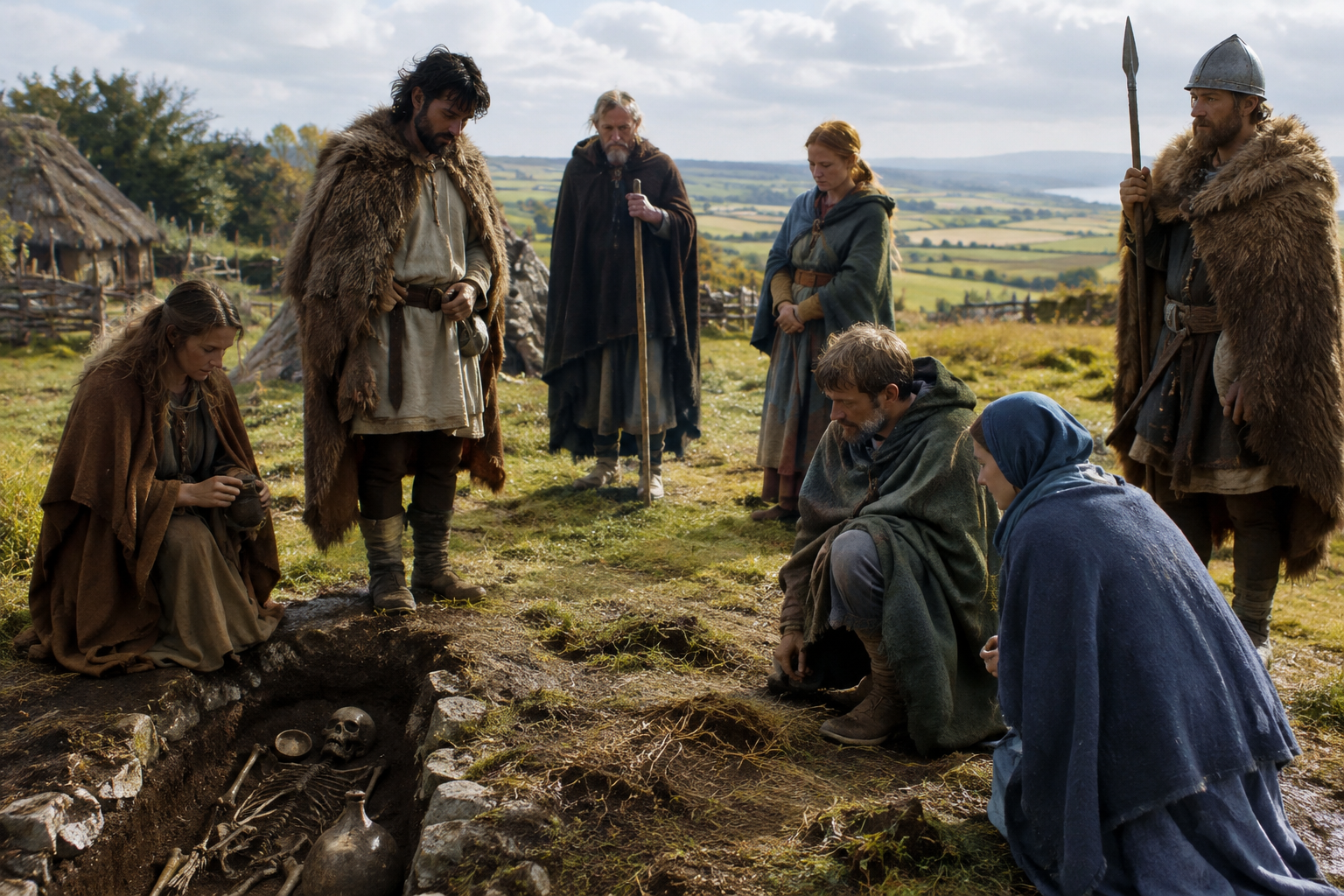
The strongest cluster in the supplied material comes from Yorkshire. At West Heslerton, an Early Anglo Saxon Cemetery, four individuals dated to 550 AD appear in the dataset: I20639, I20646, I20661, and I20656. That concentration matters. A single burial can be a curiosity; four from one cemetery begins to look like a real local paternal presence.
West Heslerton is one of those sites that make early medieval England tangible. This was not the age of neat ethnic boxes. It was a period of settlement, intermarriage, shifting loyalties, and the slow formation of what would become the English kingdoms. A cluster of related paternal branches there is exactly the kind of evidence that lets us glimpse how male lines could become established within particular communities.
Nearby in the same broad region, the Post-Roman England North Yorkshire Vale of Pickering sample I20638, dated 500 AD, adds another piece to the puzzle. So does I20637 from the Post Roman Era Worth Matravers Dorset England, dated 600 AD. Together these finds suggest that this paternal branch was not confined to a single Yorkshire cemetery alone, but had a place in post-Roman and early medieval England more broadly.
None of this proves direct kinship among all these men. Shared Y-DNA can indicate a common paternal ancestor far back in time, not necessarily a recent family link. But archaeologically the picture is attractive: a northern-associated paternal branch present in both post-Roman and Anglo-Saxon contexts in England.
Readers interested in how genetics is changing our view of these centuries will find a closer look at the broader English evidence worthwhile.
Read About Post-Roman Britain DNA
This is exactly where responsible language matters. It would be easy, and wrong, to say that I1a2b1b is simply an "Anglo-Saxon haplogroup." Haplogroups do not map neatly onto ethnic labels, and early medieval identities were political and cultural as much as biological. What we can say is that the supplied evidence places this branch in environments strongly associated with migration-period and early Anglo-Saxon England, while also pointing further back to prehistoric Denmark.
That makes a North Sea setting the most sensible historical frame. The men buried in Yorkshire and Dorset lived in a world tied by sea routes, war bands, marriage alliances, and farming settlements. Some paternal lines may have arrived recently from across the sea; others may already have been present in Britain before those centuries and then folded into new social identities. Ancient DNA is powerful precisely because it complicates simple origin myths.
For a broader discussion of how migration and settlement helped shape the early medieval English gene pool, this community article is especially relevant.
Explore Anglo-Saxon Migration DNA
The supplied later historical association brings us north to Clan Burnett and Crathes Castle in Aberdeenshire. Here we must keep our feet on the ground. The presence of Clan Burnett in this article does not prove that all Burnetts belonged to haplogroup I1a2b1b, nor that the ancient men from Yorkshire or Denmark were direct ancestors of the family. What it does offer is a historical setting in which a northern British paternal lineage could be imagined in the long medieval and early modern landscape of eastern Scotland.
Crathes Castle itself is wonderfully telling. Built mainly in the late 1500s by the Burnett family on lands granted to their ancestors by Robert the Bruce in 1323, it stayed with the family for centuries. That arc - royal grant, local consolidation, tower house, then lairdly residence - is a classic story of Scottish landed society. Over time the castle accumulated the painted ceilings and furnishings for which it is famous today, before later passing to the National Trust for Scotland, which now preserves both building and grounds.
It is easy to think of castles as purely military objects, but Crathes is also a machine for memory. It preserves the public history of a family far better than DNA alone ever can. Genetics can hint at the movement of paternal lines across regions and centuries; castles show us how some of those lines, whatever their exact haplogroup, became rooted in place, authority, and inheritance.
For readers who want to continue with the historical side of that story, the Burnetts deserve a closer look in their own right.
So what does haplogroup I1a2b1b reveal? First, it shows how a narrow paternal lineage can link very different kinds of evidence: a prehistoric individual from Karlstrup in Denmark, a cluster of early medieval burials in Yorkshire, another post-Roman sample in Dorset, and the later historical landscape of northern Britain and Scotland. Second, it demonstrates the value of restraint. The story is not less interesting because we cannot draw a straight line from sample CGG106702 to I20639 or from West Heslerton to the Burnetts of Crathes. On the contrary, the interest lies in seeing how fragments from archaeology, genetics, and family history illuminate the same broad North Sea world from different angles.
That is perhaps the most Mary Beard-ish lesson in all this: history is rarely a single tidy pedigree. It is messy, regional, interrupted, and often unexpectedly local. A Y-DNA branch like I1a2b1b does not hand us a noble ancestor on a platter. It gives us something better - evidence that real paternal lines persisted through profound changes in language, rule, burial custom, and political identity.
If your own Y-DNA falls near this branch, or if your autosomal DNA pulls you toward these old North Sea populations, MyTrueAncestry can help place those results beside ancient individuals and historical populations. That does not prove direct descent from any one ancient burial or noble house, but it can offer a vivid and well-grounded way to explore where parts of your ancestry may fit into the deeper human past.






Comments