Haplogroup I1a2a1a1a5

– 6 min read


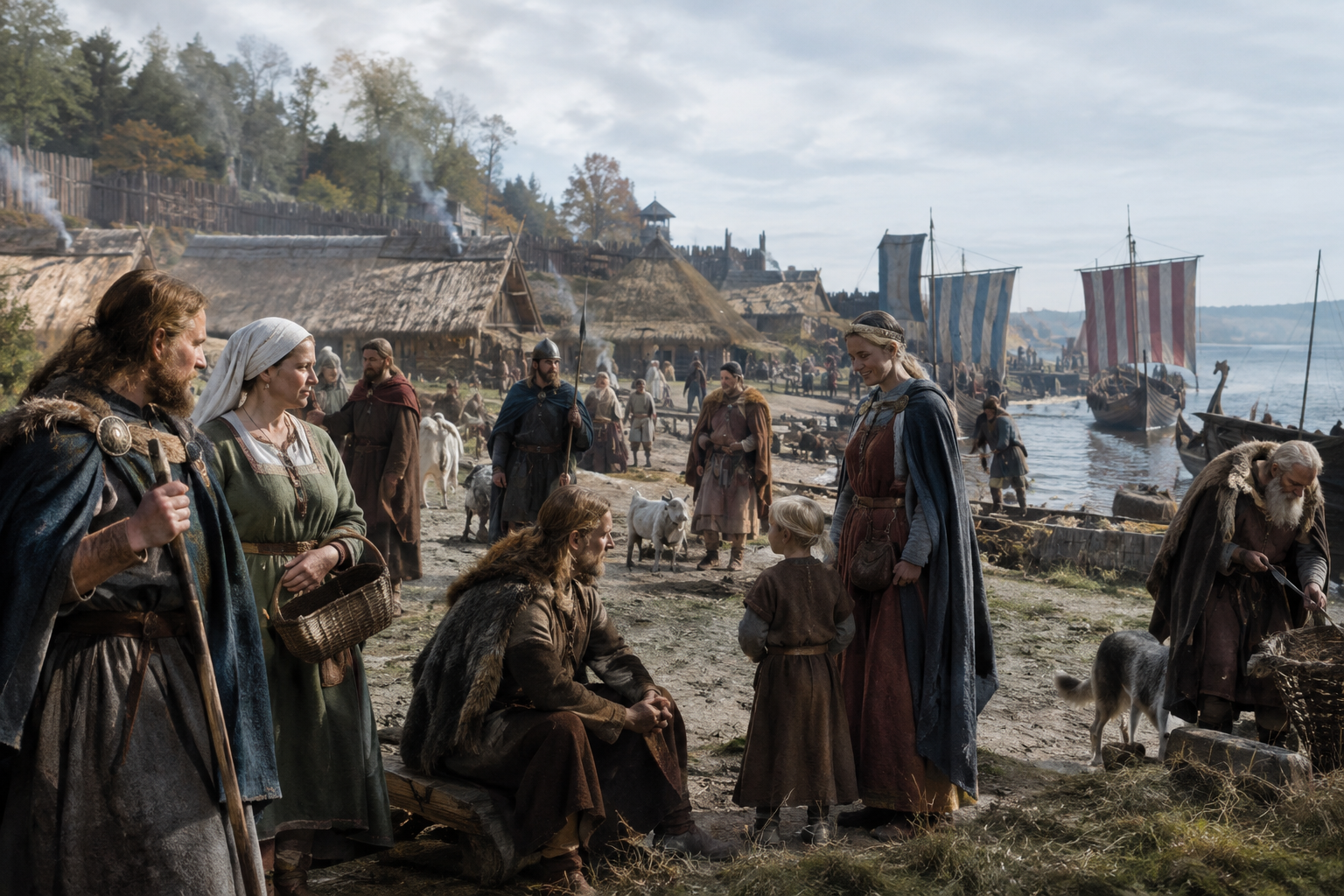
Some Y-DNA haplogroups announce themselves with imperial fanfare. Others turn up more quietly, in graves, marshes, fortress towns, and medieval cemeteries, and only gradually reveal the shape of a long male-line history. Haplogroup I1a2a1a1a5 belongs to that second category. It is a very specific branch within the wider Y-chromosome tree, and what makes it historically interesting is not a single grand claim, but a striking pattern: its associated ancient samples appear again and again across Scandinavia and the wider Germanic world, from Bronze Age Denmark to Gothic, Longobard, Anglo-Saxon, and Viking contexts.
That matters because Y-DNA traces one narrow line of ancestry: the direct paternal line, from father to son, and so on. It does not describe a person's total ancestry, culture, or identity. But when ancient DNA places related paternal branches in well-dated archaeological settings, it gives us something precious: a way of watching one lineage move through real historical landscapes. In the case of I1a2a1a1a5, those landscapes include Danish islands, Migration Period frontiers, Viking Age Sweden, and later medieval towns.
The broader haplogroup behind this branch is I1, a lineage long associated in ancient DNA research with northern Europe, especially Scandinavia. That does not mean every man in ancient Scandinavia belonged to I1, nor that every I1 lineage followed the same historical path. Quite the reverse: the deeper one goes into subclades like I1a2a1a1a5, the more careful one must be. A narrow branch has a narrower story.
Still, the samples supplied here strongly suggest that this particular paternal line, or closely related lines around it, were present in Scandinavia early and then appeared in populations involved in the movements of the Roman Iron Age, Migration Period, and Viking Age. That pattern fits what archaeologists already know about northern Europe: not a static homeland, but a zone of mobility, alliance, raiding, trade, and migration.
One of the most important early clues comes from Denmark. A sample from the Nordic Bronze Age Denmark Strandlunden II Gerlev, dated 1265 BC and identified as CGG106515, places this paternal tradition deep in southern Scandinavian prehistory. We should not overstate that find. It does not mean that modern carriers of I1a2a1a1a5 can draw a simple straight line back to one Bronze Age man. But it does place the wider paternal background of this lineage in a region that would remain central to later Germanic history.
Later Danish finds sharpen the picture. The Danii Tribe Denmark Sjaelland Vester Egesborg Vordingborg sample CGG107507, dated 175 AD, and the Germanic Tribe Iron Age Denmark Sjaelland Holbaek Fjord Trundholm Mose sample CGG106734, dated 205 BC, suggest continuity of closely related paternal lines in Zealand and nearby areas over a very long span. Add CGG107416 from Southern Sjaelland Praesto Endegaarde, dated 375 AD, and one begins to see why Scandinavia looks less like a backdrop and more like a center of gravity for this branch.
The really fascinating part begins when these paternal lines appear beyond Scandinavia in the centuries around the fall of Roman power in the west. Here the archaeology is wonderfully untidy in the best sense: Goths, Longobards, Thuringians, frontier communities, and mixed post-Roman societies all crowd into the record.
Take the Gothic-period material. In Serbia, I15549 from Timacum Kuline Ravna Village dated 395 AD, and I15545 from the Timacum Slog Necropolis dated 480 AD, show this branch or its close relatives in a late antique Balkan setting associated with Gothic-era populations. Another sample, A181016, comes from Gothic Kecskemet-Mindszenti Transtisza Hungary and is dated 450 AD. These are not proof of a single migrating tribe carrying a single haplogroup banner. Ancient peoples were always more mixed than the old textbooks liked to admit. But such finds do show northern-linked paternal lines embedded in the Gothic world of the Danube and Balkans.
The same is true for the Longobard horizon in Pannonia. Three samples - HMU069 from Scarbantia Hegyko Barbaricum Hungary, and SZL041 plus SZL028 from Savaria Szeleste Barbaricum Hungary - are all dated 525 AD. That is an evocative little cluster. It places related paternal ancestry in a region famous for the political and military reshuffling of the early medieval age, where groups later remembered as Longobards operated before their movement into Italy.
Then there is OBM005 from Thuringii Tribe German Obermoellern, dated 500 AD, and R3660 from Migration Period Scitarjevo Croatia, dated 500 AD. Together they underline a broader point: this was not a lineage confined to one coast or one kingdom. It appears across a belt of northern and central European societies connected by war bands, kin groups, shifting confederations, and local settlements.
An especially telling western appearance is SED014, from Anglo-Saxon Sedgeford England Norfolk, dated 600 AD. This does not prove that the lineage "belongs" to the Anglo-Saxons in any exclusive sense. But it does fit a larger pattern in which paternal lines rooted in the North Sea and Scandinavian sphere also appear in early medieval England. That is precisely the sort of evidence that helps explain how paternal ancestry can travel with migrations, while culture and identity are being remade on the ground.
If the Migration Period samples show movement, the later Scandinavian finds suggest persistence as well. In Sweden, the lineage appears in VK337 from Viking Age Oland Sweden dated 858 AD, gor164 from Viking Age Sweden Stockholm Gorla dated 1050 AD, and VK357 from Viking Age Oland Sweden dated 1053 AD. By this point we are no longer looking at frontier barbarians in Roman eyes, but at the societies that produced ships, towns, silver networks, royal experiments, and Christian cemeteries.
The medieval sample mbs022 from Sigtuna Sweden, dated 1100 AD, is a particularly nice bridge between eras. Sigtuna was one of medieval Sweden's early urban and royal centers. So here the story of this paternal branch runs from Bronze Age Denmark, through Iron Age tribal landscapes and Migration Period upheaval, into the settled and increasingly literate world of Scandinavian kingship and towns.
That kind of continuity is exactly why ancient DNA is so useful. Written genealogy usually begins late and favors the wealthy. Genetics reaches much further back, though with different limits. It can show that related paternal branches were present in a region centuries before surviving family records. It cannot, by itself, tell us a man's language, surname, or coat of arms.
The noble connection supplied with this haplogroup is the House of Sureau, linked with the Chateau des ducs de Bretagne in Nantes. Here one must keep one's historical balance. A noble family's association with a haplogroup in a community context is not the same thing as laboratory proof that every bearer of that surname shared the same Y-DNA line. Medieval and early modern families, even very prominent ones, could branch, merge, adopt heirs, and acquire legends faster than they acquired documentary certainty.
Even so, the setting is irresistible. The Chateau des ducs de Bretagne began as a fortress in the 13th century and became the main residence of the dukes of Brittany in the 15th century, especially under Francois II and his daughter Anne of Brittany, who helped shape its grand yet defensive appearance. That phrase captures Brittany rather well: grandeur with battlements, ceremony with anxiety.
After Brittany was joined to France, the castle ceased to be a ducal home and served the French crown as a military stronghold, barracks, and arsenal. It suffered fire, war, an explosion in 1800, and bombing in the Second World War, yet survived and was restored. Today it stands as one of Nantes' major historic monuments and houses a museum of the city and of Brittany.
Why mention such a castle in an article about a Scandinavian-centered paternal lineage? Because noble houses and castles preserve regional memory, while ancient DNA preserves biological fragments of deeper population history. They are not the same kind of evidence, but they can illuminate the same old European truth: regions are made from layers. The Brittany of dukes and fortresses rested on centuries of movement across the North Sea, the Channel, and the Frankish world. A paternal lineage found in ancient northern Europe and later associated, however cautiously, with a named house in western France belongs to that wider historical conversation.
The most responsible conclusion about I1a2a1a1a5 is also the most interesting. This is a paternal branch whose ancient record points repeatedly toward Scandinavia and the Germanic worlds connected to it, then outward into the mobile societies of late antiquity and the early Middle Ages. Its sample trail touches Bronze Age Denmark, Iron Age Zealand, Gothic and Longobard settings in the Balkans and Pannonia, Anglo-Saxon England, Viking Age Sweden, and medieval Sigtuna.
That does not make everyone in the branch a Goth, a Viking, a Dane, or a noble Breton. It does something better. It places one paternal lineage inside the real historical processes that shaped Europe: local continuity, seaborne mobility, military migration, and the slow building of medieval societies atop older populations.
If your own Y-DNA belongs to I1a2a1a1a5, MyTrueAncestry can help you explore whether your results show affinities to ancient individuals like CGG106515, I15549, SED014, or mbs022, and to the worlds they inhabited. Those matches do not prove direct descent from a king, a Gothic warrior, or the House of Sureau. But they can offer an extraordinary glimpse into where your deep paternal history may fit within the archaeology of Europe.
Upload your DNA to explore ancient connections, historical populations, and the long human story carried in your paternal line.






Comments