Haplogroup I1a2a1a1a3a2

– 6 min read


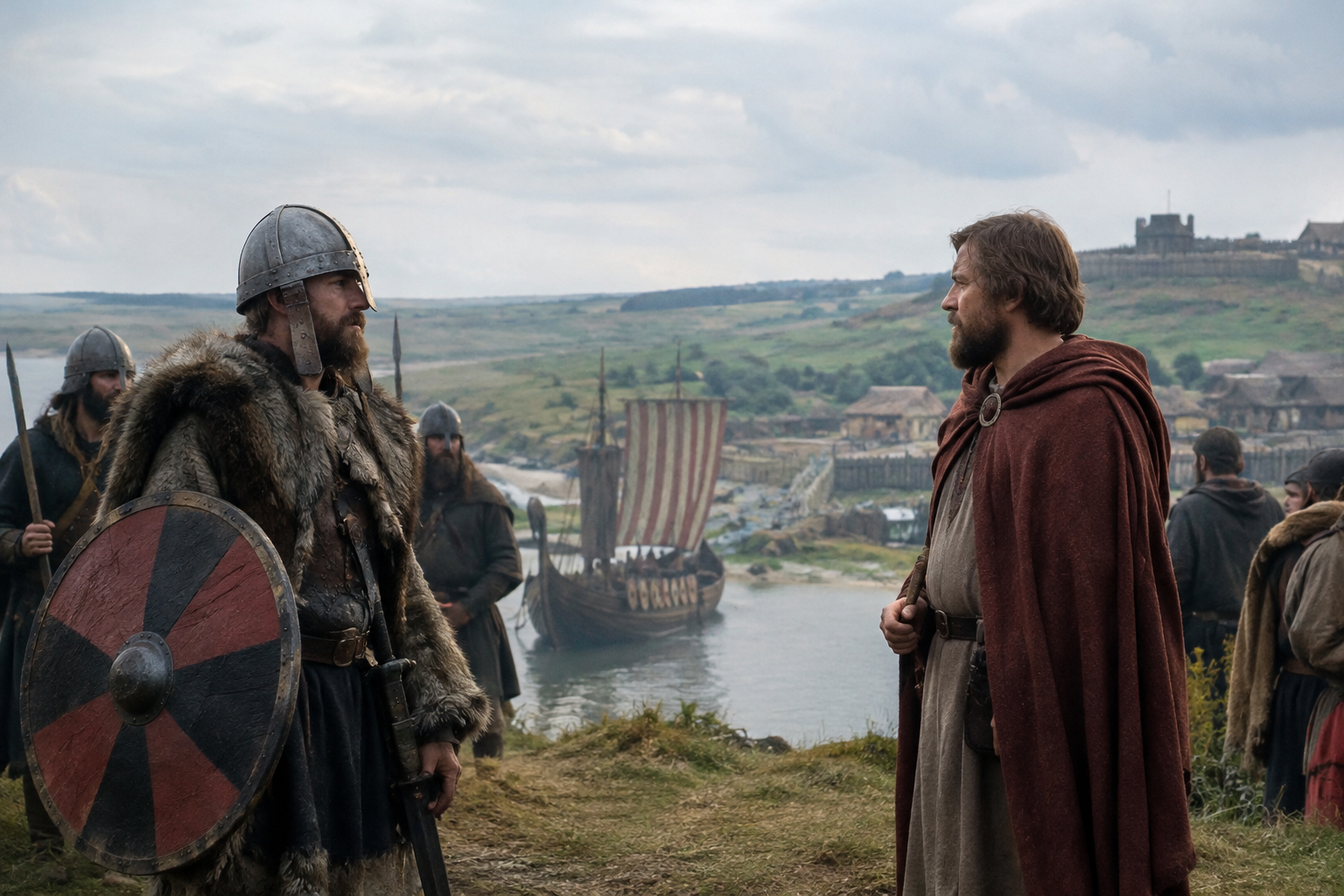
Some Y-DNA haplogroups come with loud historical labels attached to them. Others are more interesting precisely because they force us to slow down. I1a2a1a1a3a2 belongs to that second category. It sits inside the wider haplogroup I1, a paternal lineage most strongly associated in broad terms with northern Europe, especially Scandinavia, but this very specific branch is a reminder that the real story of paternal ancestry is never just "Viking" or "Germanic" written in block capitals across a map.
Y-DNA traces one narrow line only: the direct paternal line, father to son to son again across many generations. It does not describe a person's full ancestry, identity, or family history. But when a branch like I1a2a1a1a3a2 turns up in ancient remains from medieval Denmark and Viking Age England, it gives us a valuable way of thinking about how male lineages moved through the North Sea world, how they persisted, and how they later sat within the landscapes of noble estates and recorded family histories.
The broader haplogroup I1 is generally understood as a deeply rooted European paternal lineage whose later history became especially prominent in Scandinavia and surrounding regions. That is the large backdrop. But a downstream branch such as I1a2a1a1a3a2 should not simply be handed the entire history of all I1 men from prehistory onward. The closer we zoom in, the more careful we must be.
What can be said responsibly is that this branch belongs to a paternal framework strongly represented in the historical populations of the Scandinavian and North Sea zone. That matters because this was one of the great connected regions of medieval Europe: Denmark, Norway, the British Isles, coastal northern Germany, the Low Countries, and the Irish Sea world were linked by trade, raiding, migration, intermarriage, and settlement. Men carrying branches of I1 moved through this network not as abstract markers, but as farmers, sailors, warriors, clerics, craftsmen, and householders.
Ancient DNA has transformed how we see these movements. Instead of relying only on chronicles written by monks or later national histories, we can now recover tiny pieces of paternal history from graves themselves. That is often less tidy than legend, but far more revealing.
Explore Denmark's Deep Genetic Past
The most immediate evidence supplied for this haplogroup comes from two ancient individuals separated by sea but joined by a historical world that was anything but isolated.
The first is CGG100679, from Medieval Denmark Tjrby Randers Municipality, dated to 1325 AD. By that date Denmark was thoroughly medieval and Christian, yet still part of a region shaped by older Scandinavian patterns of kinship, lordship, and maritime connection. A male lineage found in medieval Jutland or eastern Denmark is not a fossil from the Viking Age, of course, but it can show continuity of paternal lines across the centuries after conversion, kingdom-building, and social change. That is often the quieter lesson of medieval DNA: not dramatic invasions every century, but persistence amid political transformation.
The second sample is VK262, identified as Viking Invader Ridgeway Hill England, dated to 998 AD. This is a more arresting archaeological label, and understandably so. Ridgeway Hill evokes the harsh realities behind the word "Viking": violence, conflict, and men crossing the sea into England in an age when armies and fleets were reshaping kingdoms. Yet even here caution is needed. A shared haplogroup branch between a man found in England and another from medieval Denmark is not proof that one descended from the other, nor that all such men belonged to one tightly bounded ethnic community. What it does show is that this paternal line belonged within the world of Scandinavian movement into Britain.
Put these two together and we glimpse something rather telling. By around 998 AD, a representative of this paternal branch appears in England in a Viking context. By 1325 AD, the lineage also appears in Denmark in an established medieval setting. That pattern fits well with what historians already know of the North Sea: movement outward, settlement abroad, and enduring homeland continuity all at once.
England was not simply "invaded by Vikings" and left unchanged. Different regions experienced raiding, settlement, political takeover, alliance, and assimilation in different ways. The paternal history of lineages like I1a2a1a1a3a2 belongs in that messier, more human picture. Some carriers may have arrived as part of war bands. Others likely came through settlement networks, trade routes, or later medieval migration between England and Scandinavia.
That matters especially in Britain, where medieval and early modern family histories often sit on top of much older demographic layers. A noble house recorded in Wales or England centuries later is not a genetic time capsule from one event or one people. But the landscapes those families occupied were shaped by many earlier movements, among them the Scandinavian presence in the British Isles.
Readers interested in the broader mixing of these populations may also enjoy work on later medieval and post-conquest England, where the categories "Viking," "Saxon," and "Norman" start to blur on the ground.
Read About Viking, Saxon, and Norman Mixing
The supplied noble connection here is the House of Yorke, associated with Erddig Hall near Wrexham in north Wales. This is not a medieval castle in the battlemented sense, and that is part of its charm. Erddig began as a grand country house built between 1684 and 1687 for Joshua Edisbury. It later passed to John Meller, who completed and improved it, before being acquired in 1721 by the Yorke family.
The Yorkes held the estate for more than two centuries, and what survives there is strikingly different from the usual noble fantasy of armorial glass and stern ancestral portraits alone. Erddig became one of the best preserved landed estates in Britain, noted not only for its interiors and gardens but for its archive of poems, portraits, and records that preserve the lives of servants as well as masters. In other words, it offers a rare social history from above and below stairs.
That makes Erddig especially apt in an article about Y-DNA. Paternal lineages can tempt us into thinking history is mainly the story of named men passing surnames and estates down tidy lines. Erddig reminds us that real historical worlds were households, not just pedigrees. A lineage such as I1a2a1a1a3a2 may survive through noble branches, modest tenant families, seafarers, craftsmen, and people who never entered a formal genealogy at all.
It would be irresponsible to claim that the Yorke family is proven to carry this exact haplogroup merely from the association supplied here. Historical association is not the same as confirmed genetic assignment. But placing the House of Yorke in this article is still valuable, because it anchors the discussion in a later British setting shaped by the long population history of the North Sea and western Britain. Erddig Hall stands in north Wales, a region where Welsh, English, and wider maritime influences have met for centuries.
By the twentieth century, the burden of maintaining the estate had become severe. After decline and damage from subsidence, the last private owners, Simon and Philip Yorke, gave Erddig to the National Trust in 1973. So the house survives not as a frozen relic of bloodline purity, but as a preserved record of social continuity, adaptation, and memory.
The value of I1a2a1a1a3a2 is not that it hands us a melodramatic origin myth. Its value is subtler and, in some ways, better. It places a direct paternal line within the Scandinavian and North Sea world. It appears in an individual from Viking Age England, VK262, and in a later medieval individual from Denmark, CGG100679. That combination suggests both movement and continuity: the kind of pattern historians would expect in a region tied together by sea-lanes, warfare, settlement, and dynastic politics.
It also shows why genetics and written history need one another. Written genealogies usually begin late and favor the wealthy. Ancient DNA begins earlier and often speaks for the unnamed. The two approaches are most useful when they are allowed to complement each other, not when one is made to pretend to prove more than it can.
So if your own Y-DNA falls on a branch like I1a2a1a1a3a2, the historical interest lies not in claiming automatic membership in a Viking army or a noble house. It lies in seeing your paternal line as part of a larger northern European story that ran through Scandinavian settlements, English burial grounds, Welsh estates, and centuries of ordinary family continuity.
MyTrueAncestry lets you explore those deeper connections by comparing your DNA with ancient individuals and historical populations. Those matches can open remarkable perspectives on where parts of your ancestry fit into the past, while still stopping short of claiming direct descent from any specific ancient sample or noble family.






Comments