Haplogroup I1a2a1a1a2b

– 6 min read


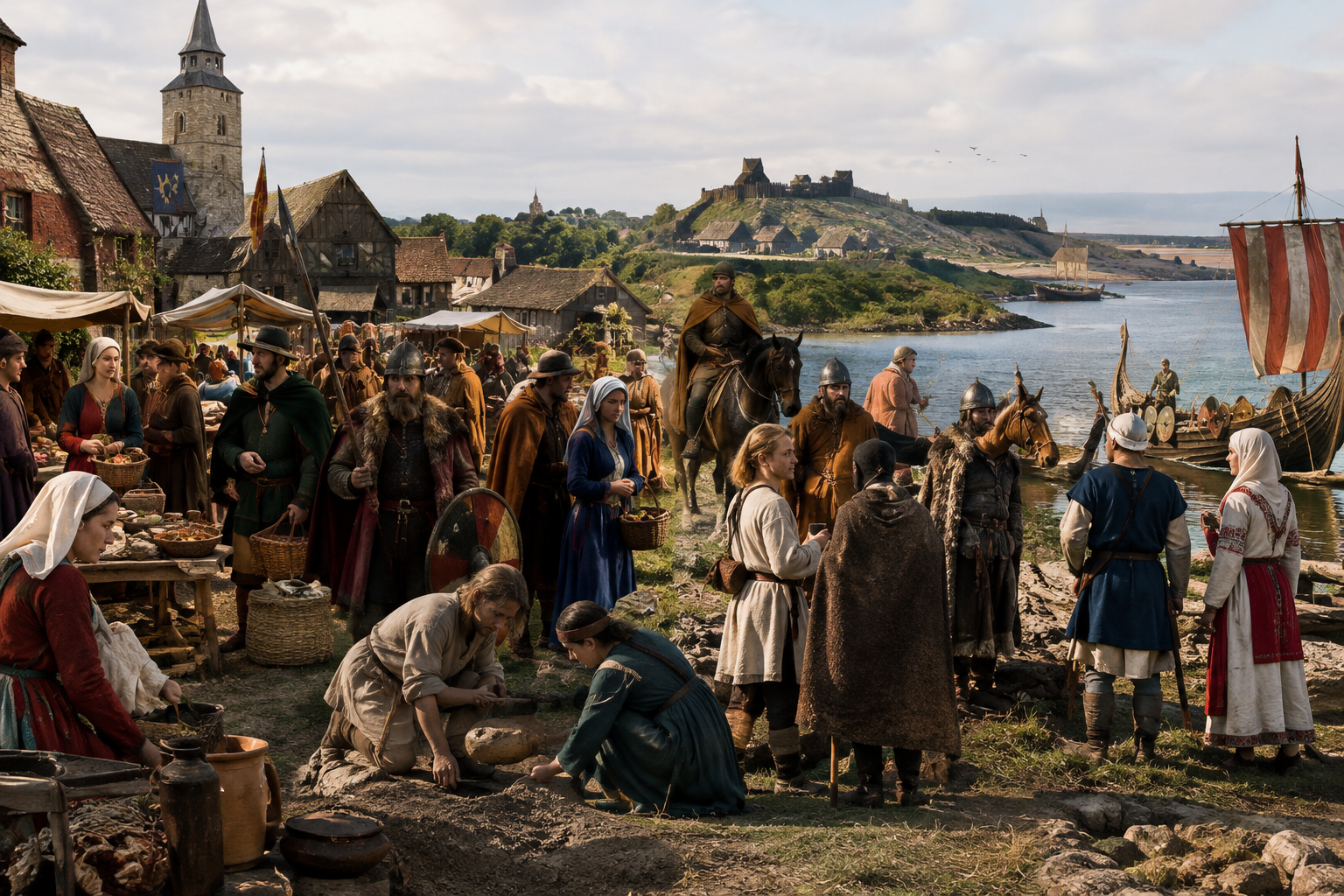
Some Y-chromosome lineages announce themselves with a grand imperial trail. Others are more interesting precisely because they do not. Haplogroup I1a2a1a1a2b belongs to that second category: a very specific paternal branch whose story emerges not from one famous king, but from a string of burials scattered across Denmark, Sweden, the Low Countries, England, Germany, Hungary, Serbia, Belgium, and Finland. Put those finds together and you begin to see a pattern - not a tidy ethnic label, but a northern and central European male line repeatedly turning up in the kinds of mobile societies that shaped late prehistory and the early Middle Ages.
That is the proper fascination of Y-DNA. It follows one direct paternal line only: father to son to son across many centuries. It does not describe a person's whole ancestry, culture, language, or identity. But in the hands of archaeology, it can illuminate the movement of male lines through real historical settings. In the case of I1a2a1a1a2b, the evidence points us toward a branch within the wider I1 family, a haplogroup long associated at broad scale with northern Europe, especially Scandinavia. For a narrow subclade like this one, though, caution matters. We should not simply pour the entire history of I1 into this more specific branch. What we can do is follow where the ancient evidence actually leads.
The broadest outline is suggestive enough. Among the oldest supplied individuals linked to this branch are men from Denmark: CGG106515 from Nordic Bronze Age Denmark at Strandlunden II, Gerlev, dated to 1265 BC, and CGG106734 from Iron Age Denmark at Sjaelland, Holbaek Fjord, Trundholm Mose, dated to 205 BC. That does not prove the exact birthplace of this subclade, but it does place its paternal trail in Scandinavia very early indeed.
This is the sort of evidence that makes archaeogenetics so useful. Written sources for the Nordic Bronze Age are, of course, nonexistent. Yet a male lineage can still be glimpsed moving through time. By the Iron Age, the same broader northern zone remained important. Rather than a single migration event, what the sample pattern hints at is persistence in Scandinavia followed by diffusion southward and eastward through the trading, raiding, colonising, and settlement networks of the first millennium AD.
Explore How Ancient DNA Reconstructs History
That would fit, in broad terms, with what we know about the role of Scandinavian and north Germanic populations in later prehistoric and early medieval Europe. But the key word is fit, not prove. Haplogroups do not speak languages, and they do not arrive carrying ethnic passports. What they do provide is a durable paternal marker that can be tracked across changing archaeological cultures.
Once we reach Late Antiquity, the trail becomes especially lively. Several samples sit in regions shaped by Gothic and post-Roman movement. In Serbia, I15549 from Gothic Period Timacum Kuline, Ravna Village, dated to 395 AD, and I15545 from the Gothic Era Timacum Slog Necropolis, dated to 480 AD, place this lineage in the Balkans during the unsettled centuries when imperial frontiers, federate groups, and local communities were being reshaped.
Hungary adds more pieces. A181016, from Gothic Kecskemet-Mindszenti Transtisza, dated to 450 AD, appears in the Carpathian Basin, while HMU069 from Longobard Period Pannonia Scarbantia Hegyko Barbaricum, dated to 525 AD, and SZL028 from Longobard Period Pannonia Savaria Szeleste Barbaricum, also dated to 525 AD, show the same paternal line present in communities associated with the Longobard age in Pannonia. Then comes RKO002 from Migration Period Hungary, Rakoczifalva, dated to 650 AD, and later AHS16 from Medieval Hungary, Carolingian Empire Zalavar Varsziget, dated to 850 AD.
This sequence is striking because it shows continuity of presence in the middle Danube world across several political regimes and archaeological labels. Gothic, Longobard, migration-period, Carolingian: these are not identical populations, nor should we imagine one unbroken family line marching neatly through every burial ground. But a northern-associated paternal branch appearing again and again in this corridor tells us something important about how male ancestry moved in the post-Roman centuries.
Discover Post-Roman DNA in Hungary
The westward side of the picture is just as revealing. CGG024694, a Saxon Settler from Frisii Netherlands Hogebeintum, dated to 413 AD, places this paternal line on the North Sea fringe. SED014, an Anglo-Saxon individual from Sedgeford in Norfolk dated to 600 AD, shows it in early medieval England. Btb71, from Merovingian Period Frankish Buettelborn in Germany dated to 585 AD, demonstrates its place within yet another post-Roman political landscape. By the High Middle Ages, ST2819 from Medieval Belgium Sint-Truiden Groenmarkt, dated to 1090 AD, shows the lineage embedded in an urbanising Low Countries setting.
None of these men was "the same people" in the crude sense. One lived in a Gothic context in Serbia, another in a Frankish one in Germany, another in Anglo-Saxon England. Yet their shared paternal branch reminds us that early medieval Europe was full of overlapping ancestries. Written labels can look fixed on the page; the DNA is rarely so obedient.
The northern connection does not disappear once the lineage enters the migration-period map. Viking Age samples keep Scandinavia firmly in the frame: VK337 from Viking Age Oland, Sweden, dated to 858 AD, VK357 from the same island dated to 1053 AD, and CGG105541 from Viking Age Denmark, Odense Norrebjerg, dated to 1000 AD. The pattern is rather persuasive: this branch was not simply a one-way export from Scandinavia long before history began. It remained present there while also appearing across the North Sea world and the middle Danube.
That makes I1a2a1a1a2b a fine example of how paternal history can be both local and mobile at once. A branch can retain a northern center of gravity while turning up in warrior burials, settler communities, frontier zones, and medieval towns far beyond its earlier heartlands.
The later Finnish sample, PKN013 from Post Medieval Finland Tavastia Paelkaene, dated to 1750 AD, should not be overread, but it does show the branch surviving into much later northern Europe. Again, survival is not the same as direct genealogical traceability. It simply means that this paternal line did not vanish with the end of the Viking Age or the migration period.
How does all this connect with a place like Locko Park near Spondon in Derbyshire, associated with the House Lowe? Not by magic, and not by assuming that one medieval or early modern family can be directly tied to Bronze Age Denmark because of a shared broad haplogroup. That would be poor history and worse genetics.
But there is a more intelligent connection. Locko Park stands in an English landscape shaped by exactly the kinds of long historical processes these samples illuminate. The estate grew around a medieval Augustinian priory founded in the twelfth century and dedicated to Saint Mary. After the Dissolution of the Monasteries under Henry VIII, the property passed into private hands, and the old religious house slowly gave way to a country seat. The present mansion was largely built in the eighteenth century for the Drury Lowe family, with work associated with William Smith and later nineteenth-century alterations. Its parkland and lake belong to the world of landscaped elite England.
What makes that interesting in this context is that Derbyshire, like Norfolk or the east Midlands more broadly, belongs to a country whose early medieval population was formed through repeated layers of continuity and migration. A lineage such as I1a2a1a1a2b, found in SED014 from Anglo-Saxon Norfolk, gives us a plausible historical backdrop for why northern-associated paternal lines may appear in later English family histories. Not proof of descent from any named ancient man, certainly not proof about every bearer of the Lowe surname, but a reminder that the fathers' lines of later landed families emerged from the same deep pool of medieval and pre-medieval ancestry that ancient DNA is now exposing.
Read More About the Lowe Family
Locko Park itself embodies that long afterlife beautifully. Monastic worship, Tudor confiscation, Georgian ambition, and family continuity all occupy the same ground. Genetics cannot read the stones, but it can deepen the human background against which those stones were laid.
The lesson of I1a2a1a1a2b is not that one narrow paternal branch "belongs" to Goths, Saxons, Vikings, Franks, English gentry, or anyone else in a simple sense. The lesson is subtler and more revealing. This branch appears across a long northern European arc, with early evidence in Denmark, continued presence in Viking Age Scandinavia, and striking appearances in the migration-period Balkans and Carpathian Basin, the North Sea world, Anglo-Saxon England, Merovingian Germany, medieval Belgium, and later Finland.
That is precisely why ancient DNA has changed historical study. Traditional genealogy starts late and usually follows the documented rich. Y-DNA, especially when paired with archaeology, reaches back into the undocumented majority. It shows how paternal lines can persist while identities, kingdoms, burial rites, and languages change around them.
If your own Y-DNA falls near a lineage like I1a2a1a1a2b, MyTrueAncestry can help place that result into a much larger human story - one that may include affinities to ancient Scandinavians, early medieval settlers, or the mobile communities of post-Roman Europe. Those comparisons are fascinating historical clues, though not proof that you descend from a particular excavated warrior or a later noble house.
Upload your DNA to explore whether your ancestry connects with the ancient individuals, regions, and historical populations behind discoveries like CGG106515, I15549, SED014, or VK337.






Comments