Haplogroup I1a2a1a1a1a2

– 6 min read


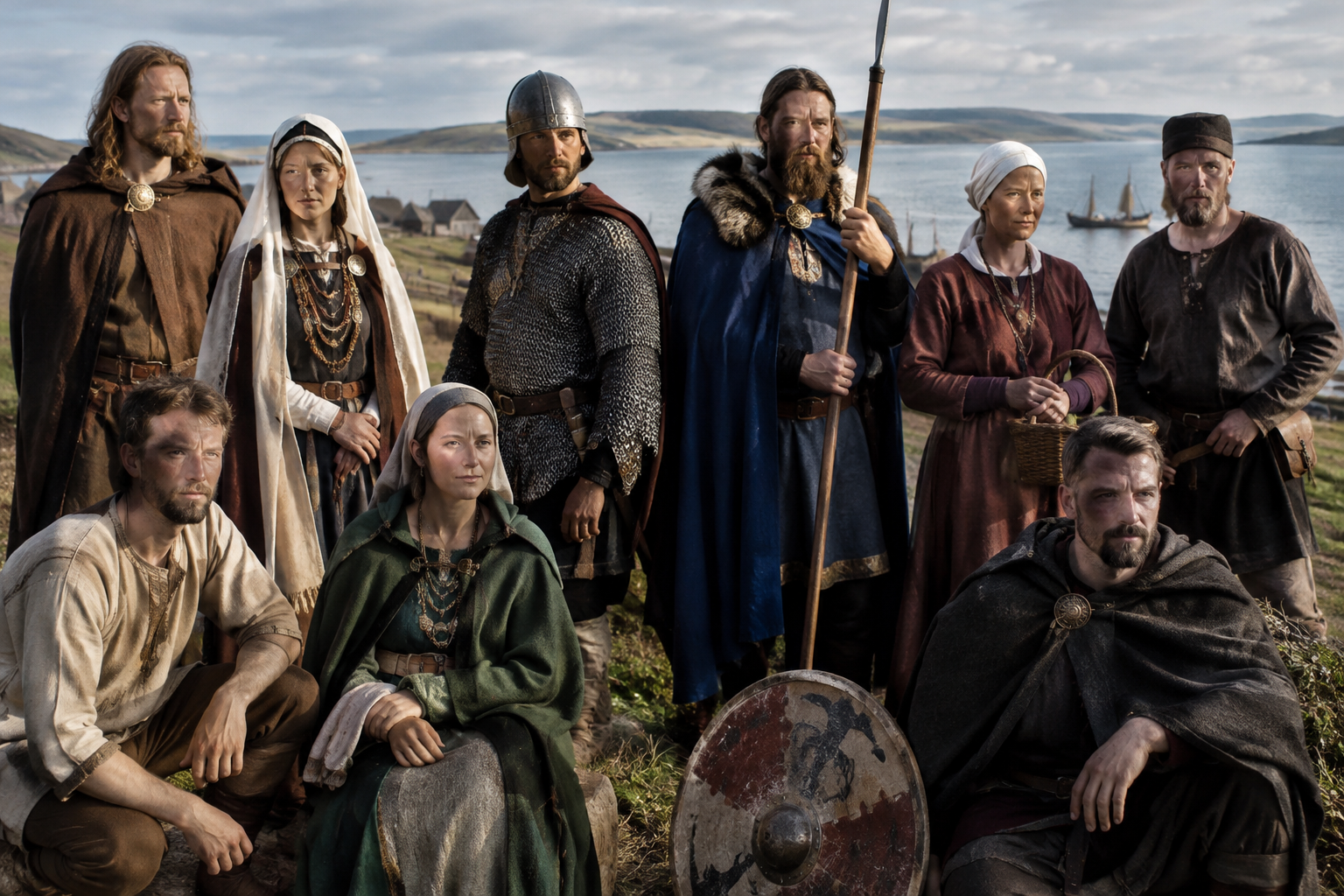
Some Y-chromosome lineages appear in the ancient record like recurring place names on an old map: Denmark, the North Sea coast, early medieval England, the Lombard world in Central Europe, and then later in towns and courts far to the south and west. Haplogroup I1a2a1a1a1a2 belongs to that kind of story. It sits inside the wider I1 branch, a lineage long associated in broad terms with northern Europe, especially Scandinavia and nearby regions. But the interesting part is not the old temptation to label a haplogroup as if it were a tribe. The interesting part is that ancient DNA lets us watch one paternal branch turn up in different historical settings, carried by real men buried in very different worlds.
That is worth stating plainly at the start: a Y-DNA haplogroup traces one direct paternal line only. It does not describe a person's full ancestry, culture, language, or identity. Still, paternal lineages can be historically revealing. They can show how male lines moved, persisted, and mingled across centuries. In the case of I1a2a1a1a1a2, the evidence supplied here points toward a northern European and especially Scandinavian-centered story, with later appearances in Anglo-Saxon England, the Migration Period Danube world, Viking Age Denmark, medieval Italy, and late medieval Belgium.
Within the Y-chromosome tree, I1a2a1a1a1a2 is a very specific downstream branch. That matters. We should be careful not to lazily pour the whole history of broad haplogroup I1 into this narrower subclade as if nothing changed along the way. What we can say more responsibly is that this branch belongs within a wider paternal family with deep roots in northern Europe, and the ancient samples supplied here place it repeatedly in settings tied to Scandinavian and northern European mobility.
The pattern is especially suggestive because the sample locations stretch across the great contact zone of the early medieval north: Jutland, Bornholm, Dover, the Vienna Basin, Hungary, and later urban Belgium. This is a landscape shaped by seafaring, migration, mercenary service, trade, dynastic politics, and the slow untidiness of post-Roman Europe. A lineage like this does not need a single dramatic conquest to explain its spread. Generations of smaller movements can do the work just as effectively.
Readers interested in the broader scientific background to this kind of work may enjoy MyTrueAncestry's overview of how the field developed in Ancient DNA and the Rise of Archaeogenetics.
The earliest supplied clue comes from Iron Age Denmark. CGG106748, described as a "Uralic Outlier Iron Age Denmark Bornholm Island Slusegard" and dated to 275 AD, is an arresting reminder that even before the Viking Age, the Baltic was no closed ethnic pond. Bornholm sat in a strategic maritime position, and the label "Uralic outlier" hints at a more complicated human background than neat textbook categories allow. Whatever the full details of that individual's ancestry, the presence of this paternal branch in Iron Age Denmark helps anchor it in the north before the great political transformations of the early Middle Ages.
Then comes BUK073 from Buckland Dover England, dated to 400 AD in the Early Anglo Saxon Period. Dover is exactly the sort of place where paternal line evidence becomes historically vivid: a doorway between the Continent and Britain, a frontier that was also a ferry crossing. This sample does not prove that the haplogroup was "Anglo-Saxon" in some simplistic sense, but it does place the lineage in the world of early post-Roman migration into England.
By the sixth and seventh centuries, the same broad paternal thread appears in striking continental contexts. MLE004, from a Longobard Grave Austria Moedling-Leinerinnen Vienna Basin dated to 550 AD, places the lineage in the orbit of the Lombard migration era. The Lombards are one of those peoples who loom large in written sources, but ancient DNA keeps reminding us that such groups were not genetically uniform marching columns. A paternal lineage turning up in a Longobard grave is valuable evidence for who was present in that social world, not proof of some eternal Lombard bloodline.
Similarly, RKF280 from Migration Period Hungary Rakoczifalva dated to 650 AD shows the branch in the Carpathian Basin, another classic meeting ground of peoples after Rome. This is the kind of evidence that makes the early medieval map look less like blocks of color and more like overlapping networks of movement, alliance, and settlement.
For more on this turbulent era, one especially relevant community article is Ancient DNA Sheds Light on Post-Roman Society in the Little Hungarian Plain, which helps frame the Hungarian evidence in a wider regional setting.
If the earlier evidence suggests a northern and north-central European pattern, the Viking Age samples sharpen it. CGG106777 from Viking Age Denmark Bogovej, dated to 975 AD, and VK327 from Viking Age Ribe Jutland, dated to 1005 AD, place this paternal line in two evocative Danish settings. Ribe in particular was one of the great trading towns of early medieval Scandinavia, a place where merchants, craftspeople, sailors, and travelers rubbed shoulders. If a haplogroup appears there, it belongs not only to a genealogy but to a world of ships, exchange, and coastal power.
That Viking and North Sea context makes another related article worth pursuing: Exploring Viking Age Genetics: Insights from Population Genomics and Ancient DNA. It offers a broader look at the sorts of movements that help explain why a northern paternal lineage might later be found far beyond Scandinavia.
Yet the story does not stop in the north. TAQ009 from Medieval Tarquinia Lazio Italy, dated to 960 AD, places the lineage in central Italy. That is a useful corrective to the habit of mentally trapping I1-related branches in Scandinavia alone. Medieval Italy was full of long-distance connections: Lombard legacies, Carolingian politics, mercenaries, clerics, merchants, and the movements of smaller families over generations. A northern-associated paternal branch found in Lazio is not an anomaly so much as a clue to the mixed and mobile character of medieval Europe.
Finally, there are the three Late Medieval Belgium St. Rombouts samples, STR045, STR045b, and STR045c, each dated to 1553 AD. Their clustering is intriguing. Whether these represent closely related men, repeat tests, or multiple individuals associated with the same context, they place this paternal line in the Low Countries during the late medieval or early modern period. Belgium, like the North Sea coast generally, was a place where older northern European lineages could persist within urban and ecclesiastical populations shaped by centuries of trade and political integration.
This is where readers are often tempted to leap too fast: from an ancient sample to a noble surname, from a Y-branch to an aristocratic pedigree. Better to proceed like a sensible historian. The supplied noble context is House Darbie and Knowsley Hall in Merseyside, the historic seat of the Earls of Derby, associated with the Stanley family from the late fourteenth century onward. That is a powerful historical setting, but it is not, by itself, proof that every Stanley or Derby line carried haplogroup I1a2a1a1a1a2.
What Knowsley Hall does offer is a way to think about how ancient paternal lineages survive into later recorded history. The estate passed into Stanley hands in the 1380s, and over centuries it grew from a fortified manor into a grand country house, reshaped in the eighteenth and nineteenth centuries, with figures such as Robert Adam contributing to its later form. Under the 13th Earl of Derby it became famous not merely as an aristocratic seat but as a place of science, collecting, and natural history. There is something nicely fitting about that. A house associated with collecting and inquiry becomes, in this article, a backdrop for thinking about genetic evidence and the long memory of lineages.
If you want to continue with the historical family itself, the natural companion piece here is The Stanley Family, which places Knowsley and the Earls of Derby in their fuller genealogical and political setting.
The strength of haplogroup I1a2a1a1a1a2 is not that it hands us a fairy-tale pedigree. Its strength is that it lets us see continuity and movement together. In the supplied evidence, the lineage appears in Iron Age Denmark, early Anglo-Saxon England, Migration Period Central Europe, Viking Age Denmark, medieval Italy, and late medieval Belgium. That is not a single people on parade. It is a paternal branch moving through different societies over a very long stretch of time.
Seen that way, Knowsley Hall and the Stanley world belong not at the end of an unbroken genetic proof, but in the same broad European historical landscape shaped by the North Sea, by medieval settlement, and by the persistence of old lineages within new political orders. Castles, halls, and noble estates preserve names and documents. Ancient DNA preserves something different: the biological traces of male-line descent that written history often cannot see at all.
For readers interested in that larger North Sea setting, another strong follow-up is North Sea Migrations to Britain: From Vikings to Industrial Revolution, which helps place lineages like this one in a much wider British and northern European story.
If your own Y-DNA belongs somewhere near this branch, that does not make you a Viking, a Lombard, or an Earl of Derby. But it may place one direct paternal line of your ancestry within the same long historical currents that carried men between Denmark, England, the Danube, Italy, and the Low Countries. That is quite enough to be fascinating.
Upload your DNA to MyTrueAncestry to explore whether your results show links to ancient individuals, archaeological cultures, and historical populations like those discussed here. Such matches can open remarkable perspectives on your past, even when they do not prove direct descent from any particular ancient person or noble house.






Comments