Haplogroup I1a1b1d

– 9 min read


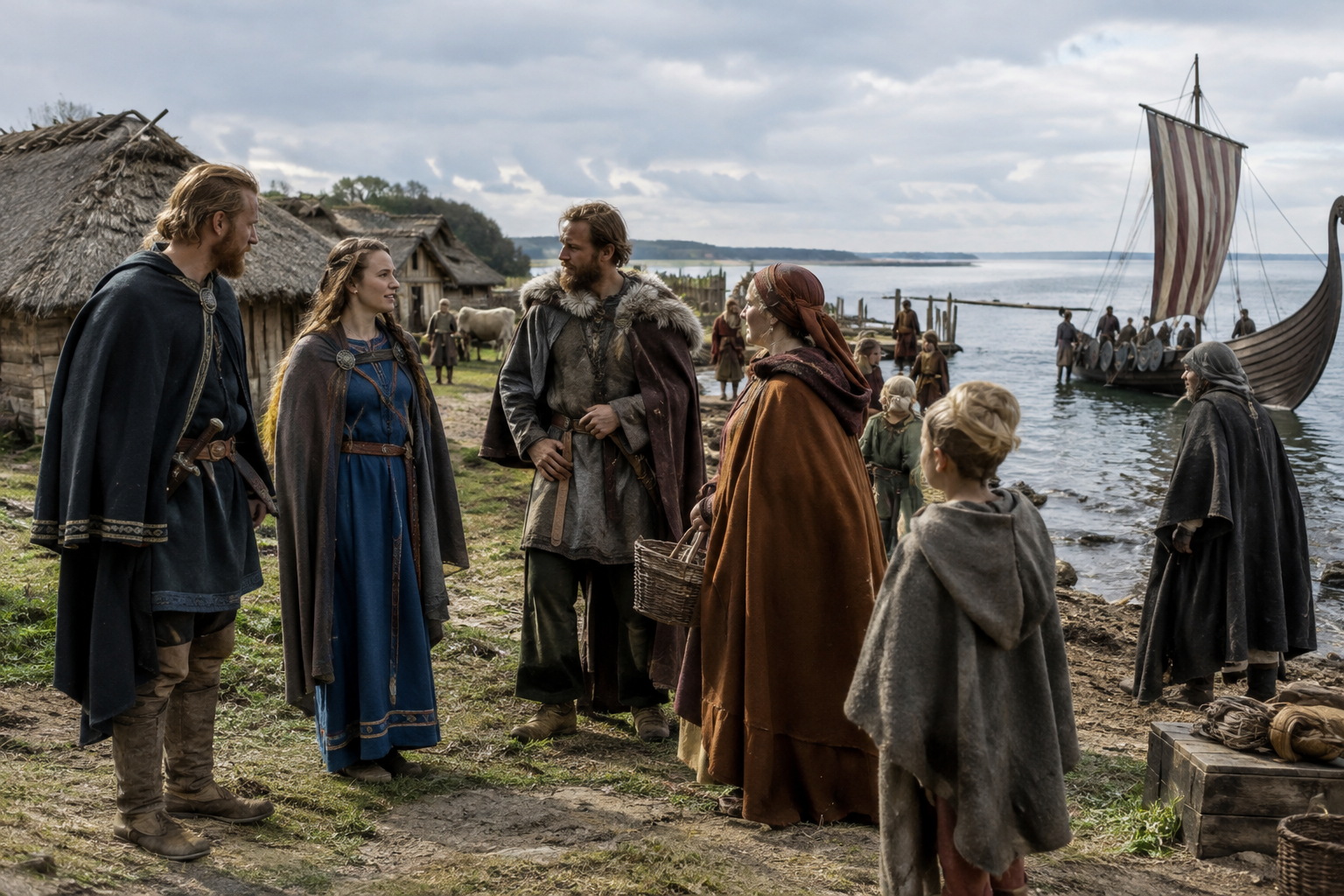
Some Y-chromosome lineages announce themselves with a bang: a royal tomb, a famous battle, a named dynasty. Haplogroup I1a1b1d is more interesting for the way it appears across a long northern and north-central European arc, in burials that belong not to one single people or kingdom, but to a world of movement: Iron Age Denmark, Viking Age Sweden, early medieval Germany, post-Roman Pannonia, Anglo-Saxon England, and beyond. That is exactly why it matters. It reminds us that paternal lineages do not travel with neat ethnic labels attached.
As always with Y-DNA, a caution first. A haplogroup traces one direct paternal line only: your father's father's father, and so on. It is not the whole of anyone's ancestry, and it does not by itself prove identity, language, status, or descent from a noble house. But when a lineage like I1a1b1d turns up in a chain of ancient burials across centuries, it gives us a remarkably concrete way of watching men, families, and communities move through history.
I1a1b1d belongs within the wider Y-DNA haplogroup I1, a branch strongly associated in broad terms with northern Europe, especially Scandinavia in both ancient and modern discussions of paternal ancestry. For a narrow subclade such as I1a1b1d, however, we must be careful not to simply hand it the entire history of I1 as if nothing changed along the way. The real question is not what all I1 men did, but where this branch appears in the evidence we actually have.
The supplied ancient DNA points toward a distribution centered above all on Scandinavia and the North Sea world, with extensions into the Continent during the Migration Period and early Middle Ages. That is historically plausible. These were centuries when seaways, river corridors, military service, trade, and migration linked Denmark, Sweden, Saxony, Frisia, Britain, Pannonia, Bavaria, and the Baltic. In that setting, paternal lines could spread widely without implying one simple mass migration or one tidy tribal narrative.
An especially intriguing early marker is CGG105926 from Neolithic Sweden Albacksbacken Maglarp, dated 1800 BC. One sample cannot do all the work, and a specific subclade's deeper prehistory always needs caution. Still, its presence suggests that lines related to this branch were already in Scandinavia long before Viking ships or medieval kingdoms entered the picture. That makes later appearances in Denmark and Sweden look less like sudden arrivals and more like parts of a longer northern continuity, even if the exact branching history remains to be refined.
By the Roman Iron Age, the evidence becomes more geographically revealing. CGG107443, from the Danii Tribe Denmark Northwest Sjaelland Asnaes and dated 175 AD, places this paternal line in a Danish setting before the Viking Age proper. That matters because it gives the story a foothold in a real Iron Age northern landscape: not saga, not legend, but a datable burial from the Danish world.
Another early outpost is CGG107762 from the Iron Age Netherlands Outlier Valkenburg Marktveld, also dated 175 AD. The word "outlier" is almost the whole fascination here. It hints that this lineage, though strongly at home in the north, was already present on the Lower Rhine fringe. In other words, the North Sea was not a barrier. It was a highway.
Then comes the disorienting, splendid mess of the Migration Period. In Post Roman Empire Pannonia Hungary Balatonszemes, we find Bal_111, Bal_111m, and Bal_111x, each dated 475 AD. Nearby in the Longobard Period Pannonia Savaria Szeleste Barbaricum Hungary stands SZL026, dated 525 AD, and at Migration Period Hungary Rakoczifalva there is RKF183, dated 650 AD. Here the lineage appears far from Scandinavia, in that great post-Roman corridor where Gothic, Longobard, local provincial, steppe, and other communities overlapped and re-formed.
None of this proves a simple Scandinavian-to-Hungary story for every one of these men. But taken together, the pattern fits a historical world in which northern and central European paternal lines moved south and east through military retinues, federate settlements, marriage networks, and the collapse of Roman frontiers.
Bavaria adds another important stop. Alh_236 and Alh_141, both from Merovingian Period Bavaria Altheim Germany and dated 600 AD, place the branch in a kingdom shaped by post-Roman realignments. So does To_Lav_T2US16 from Dark Ages Italy Torino Lavazza, dated 550 AD. This is the kind of evidence that makes the early medieval world feel less like separate national histories and more like a connected zone of movement.
By the seventh and eighth centuries, I1a1b1d is visible in Britain as well as on the Continent. I16509 from the Kingdom of Mercia England Wolverton Buckinghamshire, dated 635 AD, and I16383 from the Kingdom of Dumnonia Britain Cornwall Widemouth Bay, dated 700 AD, show the lineage in two very different British settings: one in Anglo-Saxon Mercia, the other in the southwest, where post-Roman British traditions remained strong. That alone is a useful warning against simplistic ethnic equations. The same paternal branch could appear in regions shaped by very different political cultures.
There is also VEM057 from Early Medieval Croatia Velim-Velistak, dated 775 AD, reminding us that these paternal lines were not confined to the northern fringe. The early medieval map was full of overlapping routes, and men moved with war bands, churches, markets, and courts.
The Scandinavian evidence then grows denser. VK315 from Viking Age Rantzausminde Grav Funen Denmark, dated 875 AD; als007 from Viking Age Sweden Uppland Alsike, dated 975 AD; fjk534 from Viking Age Fjalkinge Sweden, also 975 AD; VK404 from Viking Age Skara Varnhem Sweden, dated 1050 AD; and VK507 from Vendel Age Saaremaa Salme I, dated 725 AD, all point to a strong presence around the Baltic and Scandinavian heartlands.
That continuity does not stop with the Viking Age. mbs072 from Medieval Sigtuna Sweden, dated 1100 AD, and CGG100498 from Medieval Jutland Denmark Vor Frue Kirkegard Aalborg, dated 1400 AD, show the same paternal story persisting into established Christian towns and medieval societies. Even kro016 from the Stora Kronan Shipwreck Battle of Oland Sweden, dated 1676 AD, carries the line into the early modern naval world. That is one of the pleasures of Y-DNA: occasionally a branch can be followed from prehistoric Scandinavia to a warship in the age of gunpowder.
The story of a haplogroup does not end in burial archaeology. Sometimes it also brushes up against the documentary world of surnames, estates, and later noble families, though always with the same caution: shared haplogroup associations do not prove that every bearer of a name belonged to one unbroken paternal line.
The supplied later historical association here is the House of Liles, also appearing in older forms such as de Lisle. That matters less as a claim of blanket descent than as a reminder of how medieval family identity took shape in the centuries after the migrations and settlements traced in the ancient DNA. By the later Middle Ages, paternal lines that had once moved through the North Sea world as anonymous individuals in cemeteries and ship burials had become attached to surnames, arms, landed rights, and legal memory.
In the case of the House of Liles, the historical setting is clearly English and aristocratic, rooted in the world of gentry and noble landholding rather than in the earlier Scandinavian and continental burial record itself. That is precisely the point. A haplogroup like I1a1b1d belongs to a much older biological history, while houses such as Liles belong to the later documentary history in which lineages became socially visible. The two should not be collapsed into one another, but they can still be read alongside each other in useful ways.
For readers exploring this haplogroup, the Liles connection offers a glimpse of how a paternal lineage might eventually surface in the records of medieval and early modern society. Families like this were shaped by inheritance, marriage strategy, local influence, and proximity to royal government. They lived in a world where lineage mattered intensely, not in the genetic sense modern people mean, but in the legal and social sense of who could hold land, claim office, and maintain status across generations.
So the interest of the House of Liles is not that it solves the origin of I1a1b1d. It does not. Rather, it gives this ancient paternal story a later historical setting in England, showing how one branch of the broad northern European population history traced above eventually intersects with named families preserved in written record.
The clearest surviving place linked with this family is Shirburn Castle in Oxfordshire. It began in the 1370s as a moated fortified house built by the de Lisle family under a licence to crenellate. That phrase sounds slightly theatrical to modern ears, but it mattered very much in medieval England. It signaled not just defense, but status: the right to present a residence as fortified, lordly, and publicly important.
Shirburn is especially interesting because it sits on the boundary between castle and country house. Its origins were martial enough, with moat and fortified character, yet it was also a residence meant to display settled power in the landscape of late medieval Oxfordshire. In other words, it was the kind of place where family identity, local authority, and ancestral memory became fixed in stone.
In the early eighteenth century, the building was extensively remodelled for the Earls of Macclesfield, and it remained their family seat for centuries. Over time, Shirburn became known not only as an inherited noble residence but also for its important historic library. That later history is worth noting because it shows how aristocratic seats often outlived the military circumstances that first produced them. A fortified house of the fourteenth century could become, in a quieter age, a center of estate management, scholarship, and family prestige.
For anyone interested in the haplogroup, Shirburn offers something tangible: not proof of genetic descent, certainly, but a real historical setting connected with a family associated with this lineage in later tradition. Ancient DNA gives us men in motion across Denmark, Sweden, Britain, and the Continent; a place like Shirburn shows what the far later world of hereditary family identity looked like once those long population histories had hardened into names, properties, and ancestral seats.
How does this connect to later noble history? Carefully. Not by pretending an ancient burial in Pannonia proves descent from an English aristocratic family, but by recognizing that medieval lineages emerged from populations already shaped by centuries of mobility across northern Europe.
The supplied noble connection here is the House of Liles and Shirburn Castle in Oxfordshire. Shirburn began in the 1370s as a moated fortified manor built for the de Lisle family after receiving a licence to crenellate from Edward III. That phrase is wonderfully medieval: permission to make your house look properly martial. Yet Shirburn was never only a fortress. It was a high-status residence, a carefully staged expression of rank, security, and landed identity.
In the early 1700s the estate passed to the Earls of Macclesfield, who altered parts of it while preserving much of the medieval plan. Over time it became better known not as a bastion under siege but as a country house of collections, libraries, and estate life. More recently, inheritance disputes and legal battles have added a rather modern layer to its history. Through all that, it remains one of the best preserved small medieval fortified houses in England.
The genetic point is not that Shirburn Castle proves a Y-haplogroup. Castles do not do that. But places like Shirburn preserve the historical landscape in which paternal lines became surnames, estates, legal claims, and family memory. A lineage such as I1a1b1d, visible in early medieval England at Wolverton and Cornwall, belongs to the same broad historical world from which later English houses emerged: a world already shaped by Anglo-Saxon settlement, North Sea links, and centuries of population mixture.
The real lesson of I1a1b1d is that paternal ancestry can be both specific and maddeningly broad at the same time. Specific, because these sample IDs - CGG107443, SZL026, I16509, VK315, mbs072, kro016 - belong to real men from real places. Broad, because sharing a haplogroup does not make them close kin in any genealogical sense, still less ancestors of a named modern family.
Yet the pattern is unmistakable. This branch appears repeatedly in Scandinavia, around the North Sea, in early medieval Germanic zones, in Britain, and in the post-Roman Carpathian world. That is not the fingerprint of a single event. It is the mark of long northern continuity combined with migration, service, settlement, and adaptation across changing kingdoms.
If you want to understand how written history and DNA can illuminate one another, that is the place to start: not with fantasy pedigrees, but with the stubborn survival of paternal lines across landscapes that changed from tribal territories to kingdoms, from burial grounds to churches, and from fortified manors to castles like Shirburn.
If your own Y-DNA falls near haplogroup I1a1b1d, MyTrueAncestry can help place that result in a deeper archaeological setting, comparing your DNA with ancient individuals from sites like Sigtuna, Funen, Bavaria, Pannonia, and early medieval England. Those matches do not prove direct descent from a particular ancient person or noble family, but they can offer a remarkably vivid view of the populations and historical worlds your paternal line once moved through.






Comments