Haplogroup I1a1b1a4a2a

– 6 min read


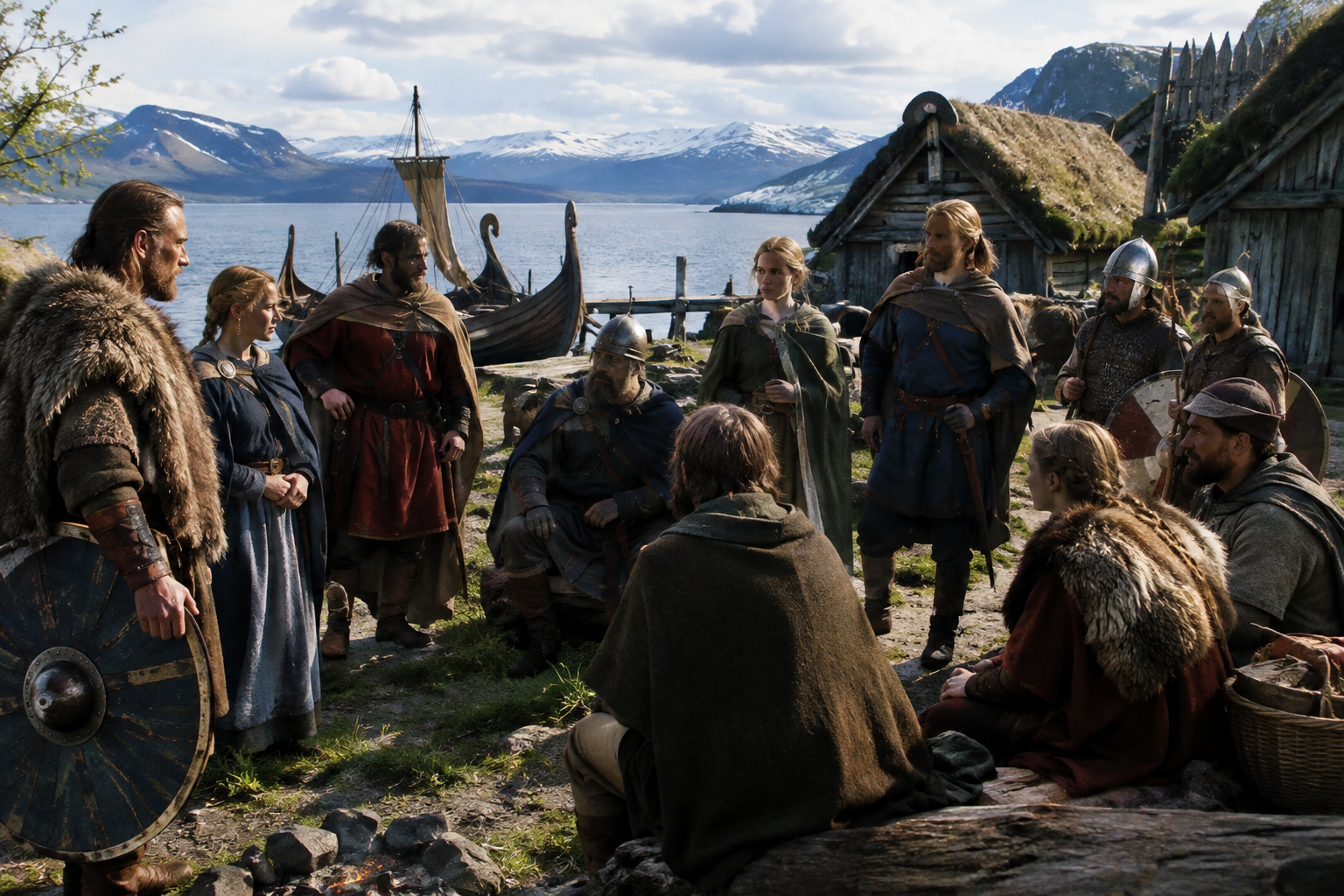
Some Y-chromosome lineages turn up in the ancient DNA record like recurring place names on an old map: not everywhere, not always, but often enough to tell us that something enduring was moving through the landscape. Haplogroup I1a1b1a4a2a belongs to that sort of story. It is a very narrow paternal branch, and like many such branches it is most useful when set against the broader history of its parent lineage rather than treated as if it alone explains whole peoples or kingdoms.
In plain terms, Y-DNA haplogroups trace one direct paternal line: father to father to father. They do not represent a person's full ancestry, culture, or identity. Still, they are extraordinarily useful. When a subclade like I1a1b1a4a2a appears in ancient burials across Scandinavia, the Baltic, Iceland, the western Slavic world, and even early medieval Croatia, it gives us a glimpse of male-line continuity and movement that written sources alone could never provide.
The wider haplogroup I1 is strongly associated in genetic studies with northern Europe, especially Scandinavia, and it appears frequently in discussions of later Iron Age and medieval populations in that region. For a specific downstream branch such as I1a1b1a4a2a, caution matters. We should not simply pour the whole history of broad I1 into this one twig of the tree. But the supplied ancient samples do suggest that this branch, or a very close lineage within that part of I1, was present in the Scandinavian world before and during the Viking Age, and later appears in regions connected by trade, migration, raiding, settlement, and dynastic links.
That pattern is historically plausible. The late first millennium was a period when the Baltic and North Sea were not barriers but roads. Men from Norway, Sweden, Denmark, the Baltic islands, and the North Atlantic moved through a connected zone of ships, war bands, farms, tribute networks, and royal ambitions. If one wants to understand how a paternal lineage could turn up in Norway, Sweden, Saaremaa, Iceland, and medieval Poland, this is the right historical setting to start with.
For readers interested in the bigger methodological picture of how these discoveries are made, MyTrueAncestry's overview of archaeogenetics is a useful companion.
The earliest supplied evidence comes from rtp001 and rtp004, both from Pre-Vendel Age Sweden Vaesternorrland Romback, dated to 475 AD. These are especially valuable because they place this paternal line in Sweden before the Viking Age proper. That matters. It suggests that the lineage was already part of the population of northern Scandinavia in the centuries before the famous expansion of Scandinavian seafaring.
By the Vendel Age, the picture broadens. VK382 from Oland Sweden, dated to 700 AD, places the lineage on one of the key Baltic islands of the Swedish world. Oland was no backwater. It sat at the intersection of maritime routes, elite display, and military organization. Then there is VK488 from Vendel Age Saaremaa Salme II-VIII, dated to 725 AD. Saaremaa, in present-day Estonia, is famous in early medieval archaeology for dramatic evidence of armed seaborne groups. A lineage found there fits neatly into that eastern Baltic zone where Scandinavian movement and local Baltic societies met, traded, and fought.
Norway is represented too. CGG107010 from Viking Age Norway Lund, dated to 775 AD, as well as VK529 from a Viking Age Warrior Nordland Norway dated to 800 AD, and VK547 from Viking Age Tjeldsund Nordland Norway dated to 900 AD, help anchor this paternal branch in western Scandinavian settings closely tied to the Viking world. Nordland and Tjeldsund were part of the long coastal highway of Norway, where local chieftains, fish economies, ship traffic, and royal authority all mattered.
And then the Atlantic opens up. SSJ-A2 from Viking Norse Iceland, dated to 935 AD, and HSJ-A1B from Norwegian Viking Iceland, dated to 950 AD, show the same paternal signature in the settlement world of Iceland. These men are not "proof" of direct descent for any living person with the haplogroup, but they are a vivid demonstration of how far north Atlantic colonization carried some Scandinavian male lines.
If you want to go further into this wider context of seafaring expansion and settlement, one especially relevant read is MyTrueAncestry's piece on Viking genetic history.
What makes this lineage especially interesting is that it does not remain tidily boxed inside Scandinavia. The sample VEM008 from Early Medieval Croatia Velim-Velistak, dated to 750 AD, places it in the eastern Adriatic world. That does not mean a simple label such as "Scandinavian migrant," still less does it assign ethnicity by chromosome. But it does remind us how mobile early medieval Europe could be. Armies, mercenaries, traders, marriage networks, and frontier societies all moved people in ways the old national histories often flatten.
The medieval Slavic world is represented by PCA0389, listed as Piast Dynasty Lubusz-Greater Poland Border Santok Lad and dated to 1100 AD. This is a particularly striking sample because it appears in the orbit of the Piast realm. Santok lay in a frontier zone of great strategic value, a place of rivers, routes, and political competition. A paternal lineage with apparent earlier roots in the Scandinavian and Baltic sphere appearing here is exactly the sort of thing that reminds us how entangled northern and central Europe had become by the High Middle Ages.
It is worth stressing the limits of the evidence. A shared haplogroup does not prove that the men from Iceland, Saaremaa, Norway, Croatia, and Santok were closely related in any genealogical sense. What it does show is that one paternal branch had spread across a large historical zone shaped by the Baltic, the North Sea, and the political transformations of the early medieval world.
Readers interested in the Polish dynastic angle may want to follow the Piast connection further.
That broader northern story offers an intriguing backdrop for the supplied association with Clan Smith and Methven Castle near Perth. Here one must be careful and honest. The historical association does not prove that every Smith, Smythe, or person connected to Methven carried haplogroup I1a1b1a4a2a. Nor does the presence of an ancient Scandinavian-leaning paternal branch elsewhere amount to evidence for a specific medieval Scottish pedigree. But the comparison is still historically illuminating.
Methven is the sort of place that archaeologists adore because it refuses to belong to only one century. The site reaches back to prehistoric burial remains and an early medieval church before a royal castle was established there in the 13th century. That sequence alone tells us something important: elite medieval landscapes often sit atop much older sacred and political ground.
The castle entered national history in 1306, when Robert the Bruce was defeated nearby by Aymer de Valence during the Wars of Scottish Independence. Later the medieval stronghold declined and passed through several noble owners. In the 17th century a new house was built on or near the old site, and in the later 18th century it was transformed into the Palladian mansion associated with the Smythe family. Prehistoric dead, medieval kingship, civil-war rebuilding, Enlightenment taste: Methven manages the lot.
Why does that matter in an article about Y-DNA? Because places like Methven preserve regional memory in stone, while ancient DNA preserves a different sort of memory in bone. They are not the same kind of evidence, and neither should be made to do the other's job. But together they show how landscapes can hold continuity across enormous spans of time even as families, buildings, and political loyalties change.
For more on the historical clan context, MyTrueAncestry has a dedicated article on Clan Smith.
The story of I1a1b1a4a2a is not the story of a single people marching intact across history. It is more interesting than that. The samples suggest a paternal line present in pre-Vendel and Vendel Sweden, visible in Viking Age Norway, carried into Iceland, and turning up in wider early medieval Europe from Croatia to the Piast frontier. That is a pattern of persistence and movement, not a tidy ethnic label.
It also shows why ancient DNA has changed historical enquiry. Written genealogies usually begin late, favour elites, and say little about the deeper background of paternal lines. Ancient DNA, by contrast, lets us see ordinary and extraordinary men alike: a warrior in Nordland, a burial in Romback, a Norse settler in Iceland, a man in the Piast sphere at Santok. Shared haplogroups do not make them one family in the everyday sense. But they do place them on connected branches of a much older human story.
If your own Y-DNA falls within I1 or one of its branches, MyTrueAncestry can help place that result in a richer archaeological setting. You may discover connections to ancient populations and historical regions discussed here, while remembering that such matches illuminate the past without automatically proving direct descent from any particular ancient individual, clan, or noble house.
Upload your DNA to MyTrueAncestry and explore whether your results show links to ancient Scandinavians, Viking Age settlers, or other archaeological individuals from Europe's medieval past.






Comments