Haplogroup I1a1b1a1e2f2

– 6 min read


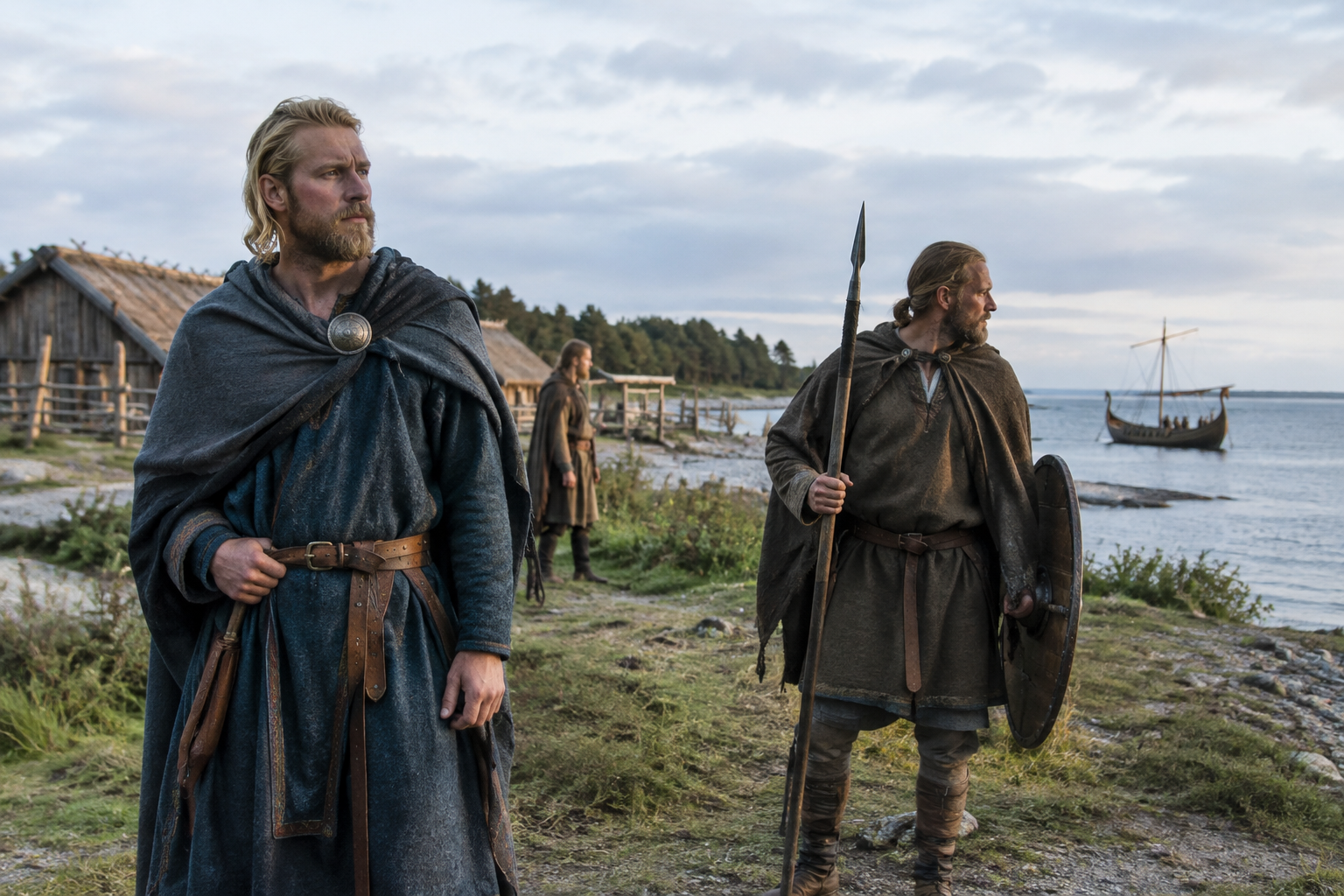
Some Y-chromosome lineages are famous because they are broad and easy to spot on the map. Others are interesting precisely because they are narrow, late-forming, and visible only when ancient DNA and careful phylogenetic work bring them into focus. Haplogroup I1a1b1a1e2f2 belongs to that second category. It sits deep within the wider I1 branch, a paternal lineage strongly associated with northern Europe, especially Scandinavia, and it offers a useful reminder that the closer we look, the more history stops being a blur of "Vikings" and becomes a mosaic of distinct male lines, local communities, and particular families.
That matters because Y-DNA traces only one line of ancestry: the direct paternal line, from father to son to son. It does not describe a person's whole ancestry, culture, or identity. Still, when a specific branch appears in ancient burials from Viking Age Sweden and then turns up in the historical orbit of a long-rooted Scottish family such as the Edmondsons of Duntreath, it gives us something wonderfully concrete to think with. Not proof of a neat genealogical chain from Uppsala to Stirlingshire, certainly not, but a historically grounded way to connect archaeology, migration, and memory.
The broader haplogroup I1 is one of the classic northern European Y-chromosome lineages, most strongly associated with Scandinavia in both modern and ancient DNA studies. That much is well established. What is more delicate, and more interesting, is how a narrow branch such as I1a1b1a1e2f2 fits into that larger story. We should not simply pour the whole history of I1 into this single subclade as if every Scandinavian episode belonged equally to it. Instead, the safer conclusion is that this branch forms part of the later internal diversification of a northern European paternal lineage that became especially visible in the first millennium CE.
In historical terms, that places the haplogroup in a landscape shaped by regional Scandinavian societies, maritime mobility across the Baltic and North Sea, and the social rearrangements of the Viking Age. This was a world in which male lineages could expand locally through inheritance and status, but also move surprisingly far through trade, raiding, military service, settlement, and marriage networks. Such movements do not automatically correspond to ethnicity in any simple sense. They do, however, help explain why a paternal line rooted in Scandinavian history might later have relevance in places far beyond Sweden.
Readers interested in the deeper archaeological background to Scandinavian population formation may also enjoy this broader look at ancient DNA and the region's early transitions:
Explore Early Scandinavian DNA
The most valuable anchors here are two ancient individuals from late 10th-century Sweden. They do not "prove origins" in some absolute sense, but they do place this paternal branch firmly in the lived world of Viking Age Scandinavia.
The first is enb200, from Viking Age Sweden Uppsala Enbacken, dated 969 AD. Uppsala is no minor backdrop. In the Viking Age and early medieval imagination, it was one of the great centers of Swedish power, cult, and kingship. A burial from that region carrying this paternal line tells us that the branch was present in one of the most historically charged districts in Scandinavia during a time when old religious traditions, royal authority, and Christian influence were all colliding and recombining.
The second is VK473, from Viking Age Gotland Kopparsvik Sweden, dated 975 AD. Gotland was a different sort of place from inland royal centers such as Uppsala. It was a Baltic crossroads, famous for trade, movement, and far-flung contacts. A paternal lineage appearing there in the same broad period suggests not a single static homeland but a branch participating in the wider social geography of late Viking Age Scandinavia: one foot in regional communities, the other in maritime networks.
That is the real excitement of ancient DNA when handled properly. It does not hand us a saga hero with a name and a family tree. It gives us real men, buried in real places, and shows that this paternal line was present in both central Sweden and on a Baltic island deeply tied to exchange and mobility.
If you want to widen that Scandinavian frame still further, this article offers an excellent companion piece:
Once we have late Viking Age Sweden in view, the larger historical setting becomes clearer. Scandinavia in the 9th to 11th centuries was not isolated. Men from Swedish, Danish, and Norwegian zones moved around the Baltic, across the North Sea, into the British Isles, and beyond. Some came as traders, some as raiders, some as settlers, and many probably as all three at different moments in family history. A paternal line like I1a1b1a1e2f2 could therefore have remained local in some branches while spreading outward in others.
This is where caution is essential. We do not have evidence that the two Swedish individuals were ancestors of any later Scottish family. Nor should we imagine that every bearer of an I1 branch in Britain must have arrived in a dramatic Viking ship. Some lines may have moved in the Viking Age, others in later medieval traffic across the North Sea, and still others through the tangled population history of Britain itself. What ancient DNA does show is that Scandinavian-linked paternal lines were part of the demographic background from which later North Atlantic and British histories emerged.
For readers curious about those longer movements between Scandinavia and Britain, this related article is especially relevant:
The later historical setting supplied with this haplogroup brings us to Clan Edmondson and Duntreath Castle, near Blanefield in Stirlingshire. Here the mood shifts from burial grounds and Y-chromosome branches to stone, lordship, and the long memory of place. Duntreath is described as one of Scotland's oldest continuously inhabited houses, with roots reaching back to the 14th century when it was the seat of the Edmonstone family, linked by marriage to the royal Stewart line.
That is already enough to make the site compelling. Medieval and early modern Scotland was not a tidy world of fixed loyalties but a landscape of feuds, alliances, civil conflict, and stubborn local power. Duntreath grew from a fortified tower into a lairdly home, surviving precisely because families such as the Edmonstones knew how to endure political weather that would have swept away lesser houses. The association with Rob Roy MacGregor and the surrounding Lennox country only thickens the atmosphere. One can feel how such a place stood at the edge of Highlands and Lowlands, in a zone where family history and regional legend constantly overlap.
Still, the genetic point must be made plainly. A historical association between this haplogroup and Clan Edmondson does not prove that every Edmondson or every Edmonstone male carried I1a1b1a1e2f2, nor that the family descends directly from the Viking Age men from Sweden. What it does provide is a historically meaningful context in which a northern European paternal lineage may be considered alongside a Scottish noble house whose story is bound up with continuity, territory, and inheritance.
Readers who want to explore the family context more directly may enjoy the community article devoted to it:
The value of haplogroup I1a1b1a1e2f2 lies not in grandiose claims but in scale. At the broad level, it belongs to a paternal tradition with deep roots in northern Europe and strong historical visibility in Scandinavia. At the narrower level, the ancient samples enb200 from Uppsala Enbacken in 969 AD and VK473 from Kopparsvik, Gotland in 975 AD place this branch in the late Viking Age with unusual clarity. And at the historical end of the story, Duntreath Castle reminds us that male-line continuity mattered intensely in medieval and early modern society, whether or not we can bridge every gap between genetics and genealogy.
In other words, this haplogroup helps us think about how paternal lines persist through very different kinds of history. First they appear as bones in a Swedish burial ground. Later, comparable paternal patterns may survive in populations shaped by the North Sea world. Much later still, family identity is preserved not in DNA alone but in charters, marriages, towers, and estates. Genetics and archives are not rivals here. They are different kinds of evidence, each illuminating what the other cannot fully capture.
If your own Y-DNA points toward a lineage like I1a1b1a1e2f2, MyTrueAncestry can help place that result into a wider human story. You may discover genetic affinities with ancient individuals such as enb200 or VK473, or with broader historical populations connected to Scandinavia and the North Sea world. That does not prove direct descent from a named Viking or membership in a noble Scottish family. But it can offer a fascinating, evidence-based perspective on where one paternal line fits into the deep and complicated history of Europe.






Comments