Haplogroup I1a1b1a1e2e

– 6 min read


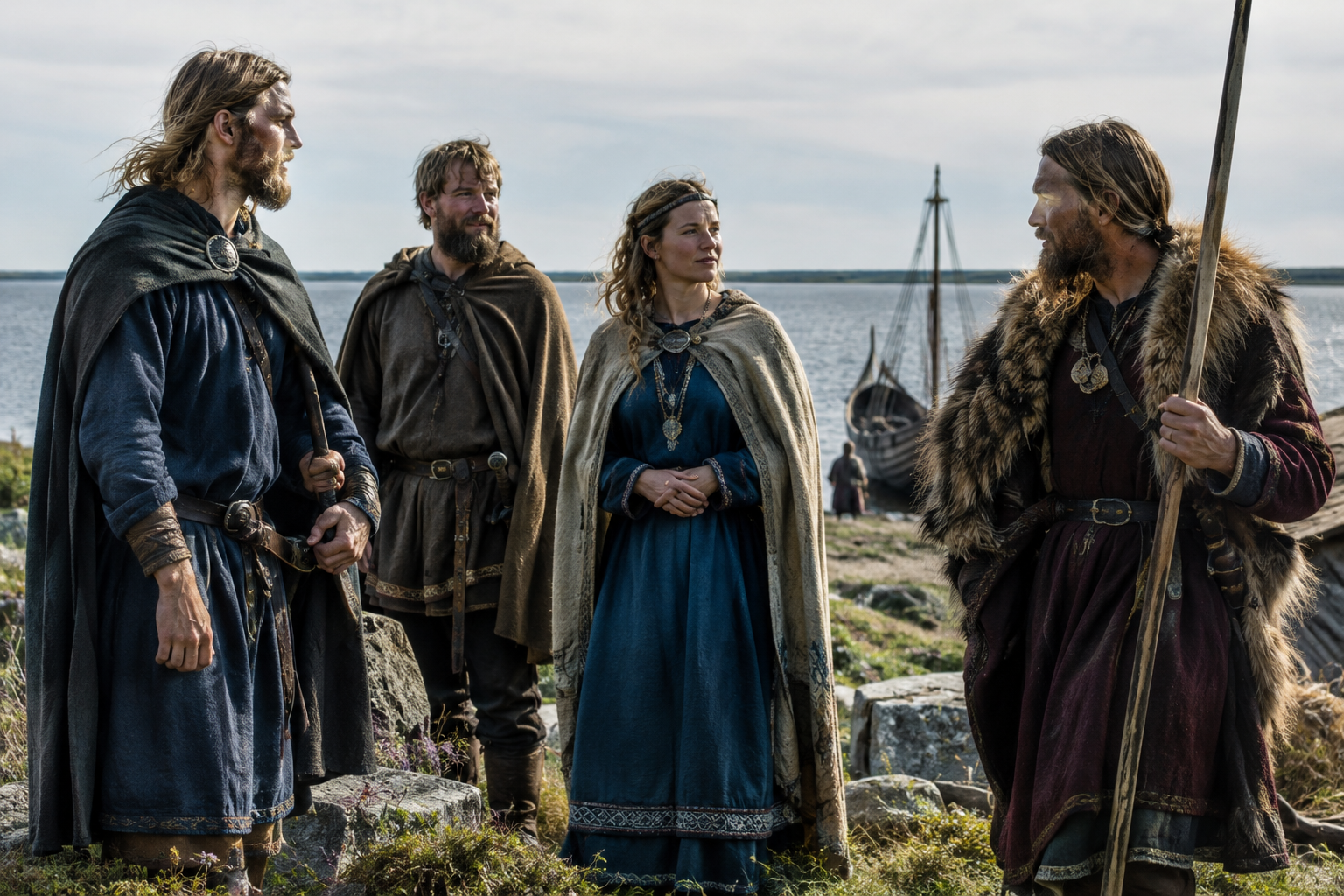
Some Y-chromosome lineages are easy to tell broad stories about. Others are more elusive, and that is part of their fascination. Haplogroup I1a1b1a1e2e belongs to a paternal line within the wider I1 family, a branch long associated with northern Europe, especially Scandinavia. What makes this particular subclade interesting is not that it explains everything, but that it gives us a narrow thread to follow through Viking Age burials, seaways of the Baltic and North Sea, and eventually into the later historical landscapes of Scotland.
It is worth pausing on what a Y-DNA haplogroup can and cannot do. Y-DNA traces one direct paternal line only: father to son to son across the centuries. It does not describe a person's whole ancestry, and it certainly does not assign someone neatly to a people, kingdom, or clan. But in the right context, especially when combined with archaeology and written history, it can illuminate how particular male lines moved, endured, and appeared in very different settings over time.
The broader haplogroup I1 is most strongly tied, in general terms, to northern Europe and especially to Scandinavia. That much is well established. What is harder, and more responsible, is to avoid lazily projecting the full history of I1 onto every narrow downstream branch. A subclade such as I1a1b1a1e2e represents a much more specific twig on that tree. Its story has to be built from actual evidence, not from wishful thinking.
The evidence supplied here points firmly toward a Scandinavian and Baltic world in the centuries around the Viking Age. That does not mean the branch began in the Viking Age, only that this is where it becomes archaeologically visible in the samples at hand. The pattern is suggestive: Sweden, Denmark, and Saaremaa in present-day Estonia. In other words, not an isolated valley lineage, but one at home in the maritime zone of the northern seas.
That wider setting matters. The late Iron Age and Viking Age were not periods of static, sealed ethnic blocks. They were times of travel, raiding, trade, fosterage, marriage alliances, and settlement. Paternal lines could be carried across very short distances in one generation and across whole seas in a few more.
The most vivid evidence for this haplogroup comes not from a medieval pedigree roll but from excavated graves. One of the clearest anchors is enb200, from Viking Age Sweden Uppsala Enbacken, dated to 969 AD. Uppsala hardly needs romantic embellishment. It was one of the great centers of early Scandinavian power and belief, and a burial from that world places this paternal line squarely in a core Swedish setting at the end of the 10th century.
Then there is VK295, from Viking Age Hessum Funen Denmark, dated to 950 AD, and VK296, from Early Viking Age Hundstrup Sealand Denmark, dated to 680 AD. Taken together, these Danish samples are particularly useful because they hint at continuity across time as well as geography. Sealand and Funen were central islands in the Danish world, tied into the arteries of movement that linked the Baltic, the North Sea, and the British Isles.
The earliest of the listed individuals, VK511, comes from Vendel Age Saaremaa Salme II XXVIII, dated to 725 AD. Salme is one of those discoveries that reminds us how misleading tidy national histories can be. Saaremaa sits in the eastern Baltic, and the famous Salme finds have often been discussed in connection with warrior mobility across the sea. A paternal lineage appearing there belongs to that restless northern world in which Scandinavian contacts stretched beyond modern borders.
None of these men can be treated as direct ancestors of later named families. That would be absurdly overconfident. But they do show that this paternal branch, or a very close related line within its neighborhood on the tree, was present in precisely the regions most associated with Scandinavian expansion and interaction in the early medieval period.
Once one sees this cluster of Sweden, Denmark, and Saaremaa, the larger historical framework becomes easier to grasp. The story is not merely "Vikings went raiding." It is that the northern seas created a corridor of repeated human movement. Men of related paternal ancestry could turn up in elite war bands, rural settlements, trading ports, and mixed communities from the Baltic to the North Atlantic.
This is where Y-DNA is helpful in a modest way. It does not identify language spoken at home, loyalties in battle, or how any one individual saw himself. But it can reveal that certain paternal lines were circulating in the same world that later connected Denmark, Sweden, the Isles, and parts of Britain. In that sense, a haplogroup like I1a1b1a1e2e belongs to the human background of the North Sea zone.
Readers interested in how such movement shaped Britain more generally may want to compare this with broader work on migration across the sea lanes linking Scandinavia and the British Isles.
How does this connect, cautiously, to later Scotland? Not by pretending that an excavated man from Uppsala is somehow the documented forefather of a Highland chief. Rather, the connection lies in regional history. Northern and western Britain, including Scotland, were deeply affected by centuries of Scandinavian contact, settlement, and political entanglement. Some paternal lines with Scandinavian roots or Scandinavian medieval distribution would naturally have become part of later Scottish populations.
That is the historical backdrop for considering Clan Chisholm. The clan's long association with Erchless Castle in the Highlands of Scotland places us in a very different world from Salme or Hundstrup, but not in an unrelated one. Erchless Castle, in Strathglass in Inverness-shire, was the long-time seat of the Chisholms. Its story begins in the later Middle Ages, with a tower house probably first built on the site in the 15th century, then altered and enlarged in the 16th century.
Like so many Highland strongholds, Erchless was not simply a military structure. It was a residence, a statement of status, and a symbol of local authority. Over centuries it passed through Chisholm hands as both home and emblem of power, shaped by feud, politics, and changing taste as much as by warfare. By the modern period it had become more country house than fortress, reflecting the transformation and eventual decline of traditional clan society. Yet it survived as a reminder of the old Highland order and of the Chisholm presence in the region.
What genetics can offer here is context, not proof. If a Y-DNA association is reported in relation to a clan tradition or surname project, that still does not mean every historical Chisholm male belonged to the same paternal branch, nor that a specific castle "belongs" to a haplogroup. Families are genealogically complex. Adoptions, non-paternal events, cadet lines, and multiple male founders all complicate the picture. Still, when a lineage with Scandinavian-era visibility appears in later Scottish contexts, it fits a broader pattern of how northern European paternal lines were carried into medieval and post-medieval Britain.
The real value of I1a1b1a1e2e is that it encourages us to think historically at several scales at once. At the widest scale, it belongs to a northern European paternal framework. At a more focused scale, the ancient samples place it in the Scandinavian and Baltic world of the Vendel and Viking Ages. At a later scale, its historical interest extends into regions touched by those northern migrations, including Scotland.
And that, in truth, is what ancient DNA does best. It does not replace archives, archaeology, or family history. It unsettles them, sharpens them, and occasionally rescues them from fantasy. A burial such as VK511 from Saaremaa, or enb200 from Uppsala, gives us something no medieval chronicler could: a directly observed paternal lineage from a named place and date. A castle such as Erchless, by contrast, gives us the social and political architecture of a much later world. Put the two together and you do not get a fairytale of direct descent. You get something better: a more grounded sense of how deep paternal lines can persist through changing cultures, kingdoms, and identities.
If you enjoy seeing how genetics meets noble history, clan tradition, and the hard evidence of excavated lives, there is plenty more nearby in the MyTrueAncestry community.
Upload your DNA to MyTrueAncestry to explore whether your results show similarities to ancient individuals such as enb200, VK295, VK296, or VK511, and to place your paternal line within the wider history of northern Europe. Those matches do not by themselves prove direct descent or membership in a noble family, but they can open a remarkably concrete window onto the ancient world behind your ancestry.






Comments