Haplogroup I1a1b1a1e2c4a

– 6 min read


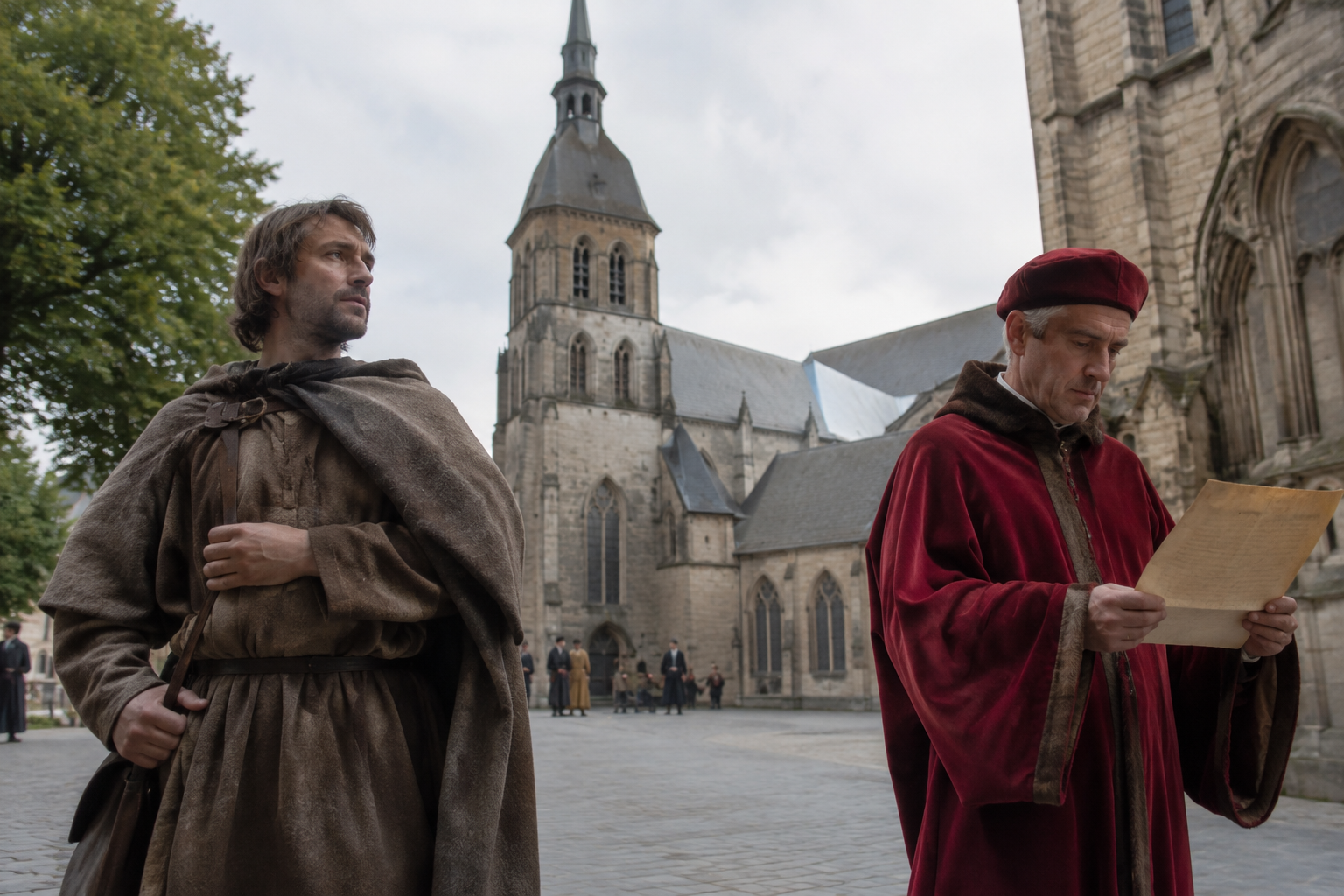
Some Y-chromosome lineages are so broad that they sweep across whole chapters of European prehistory. Others, like I1a1b1a1e2c4a, are much narrower and more intimate. They do not tell us the whole story of a person's ancestry, of course. Y-DNA follows only one line: father to son, back through grandfathers, great-grandfathers, and beyond. But precisely because it is so narrow, it can sometimes act like a stubborn thread surviving political collapse, migration, war, conversion, and the rise and fall of noble houses.
This particular branch sits within the wider world of haplogroup I1, a paternal lineage most strongly associated in broad terms with northern Europe and especially with later populations around the Scandinavian and North Sea zone. That does not mean every downstream branch has the same exact history, nor that a specific subclade can simply be declared "Viking," "Germanic," or "Scottish" by fiat. What ancient DNA does allow us to do is something far more interesting: to watch pieces of that paternal landscape appear in real burials, in real churches, and in real historical communities.
Haplogroup I is one of the old European Y-chromosome families, and I1 is one of its best known surviving branches. In modern population genetics, I1 is often discussed in connection with northern Europe, but that broad pattern should be handled carefully when we are talking about a very specific lineage such as I1a1b1a1e2c4a. A downstream branch may have a much more local history than its parent clade. It may also appear in places that remind us how mobile medieval and post-Roman Europe really was.
That is the first useful lesson here. A haplogroup is not an ethnicity. It is not a surname. It is not a coat of arms. It is a marker of direct paternal ancestry. The men who carried branches of I1 could have spoken different languages, served different rulers, worshipped in different churches, and thought of themselves in entirely different ways depending on where and when they lived.
Still, the broader backdrop matters. Northern and northwestern Europe saw repeated episodes of movement and mixture: late prehistoric population change, Roman frontier mobility, early medieval settlement, North Sea exchange, and the long commercial and ecclesiastical networks that tied the Low Countries, Britain, and the Continent together. A lineage like this one makes most sense when placed inside that busy, restless map.
Discover How Ancient DNA Rewrites History
The most vivid evidence supplied for this haplogroup comes not from legend but from two named individuals: ST1199 from Medieval Belgium Outsider Sint-Truiden Onze-Lieve-Vrouwekerk, dated 900 AD, and R1286 from the Late Medieval Cancelleria Basilica, dated 1429 AD.
Let us start with ST1199. The label itself is arresting. A man buried at Sint-Truiden, in what is now Belgium, and identified in the archaeological context as an "outsider." That single word opens a window onto the early medieval world. Churches were not only places of worship; they were anchors of community, memory, and status. To be marked as outside the local norm hints at mobility, arrival, or a life lived across regional boundaries. We should not invent more than the evidence allows, but the combination of a paternal lineage from the I1 world and a burial in a major ecclesiastical setting in medieval Belgium fits neatly with what we know of the Low Countries as a zone of exchange, pilgrimage, lordship, and movement.
Then there is R1286 from the Late Medieval Cancelleria Basilica, dated 1429 AD. Here the setting is unmistakably different: a late medieval basilica, part of a more urban, more formally Christian, and more institutionally layered society. By the fifteenth century Europe was not a patchwork of tribal frontiers but a continent of courts, clergy, merchants, and legal cultures. To find a related paternal signal in that world is a reminder that lineages do not belong neatly to one era. A branch that may once have circulated through northern populations can later turn up in an Italian ecclesiastical context, carried by men whose identities were shaped by late medieval society rather than by any prehistoric origin story.
Taken together, ST1199 and R1286 do not prove a direct genealogical connection. They do something better: they show that this paternal thread was present across different parts of medieval Europe, in different centuries, and in different social settings.
Explore Medieval Sint-Truiden DNA
If the Belgian and basilica burials suggest mobility, the Scottish connection brings us into a landscape where geography itself feels historical. The supplied family association points to Clan Urquhart and to Castlecraig in Dumfries and Galloway, near the Solway coast in southwest Scotland.
This is not the Scotland of tourist shorthand. It is the borderland world: farms, tracks, estates, market centres, churches, tower houses, and old territorial habits that long outlived the Middle Ages. Castlecraig is described as a small settlement, quiet today, yet firmly tied to a countryside that was never truly isolated. That matters. Dumfries and Galloway sat within networks linking the Irish Sea, the Solway, northern England, and lowland Scotland. Medieval lordships, later lairds, and improving landowners all left their mark there.
The place-name itself preserves the memory of a crag or rocky site associated with fortification or a strong house. Even where the great structure is gone, or survives only in name and local memory, the landscape keeps the argument going. That is often how aristocratic history works in Britain: not only through intact castles, but through field boundaries, parish alignments, estate names, and the faint grammar of control impressed onto the land.
In that sense, the association with Clan Urquhart is historically evocative even if it is not, by itself, proof that every Urquhart male carried this exact haplogroup. That distinction matters. A clan is a social and historical formation, not a laboratory result. Surnames branch, adoptions happen, illegitimacy happens, cadet lines diverge, and documented pedigrees rarely map perfectly onto Y-DNA expectations. Still, regional clan history can provide a meaningful setting for thinking about where certain paternal lines may have persisted.
What links a medieval burial in Belgium, a late medieval basilica, and a quiet settlement near the Solway? Not a single family tree that we can draw with confidence. Rather, a pattern of continuity and relocation across the social institutions that preserved memory: churches for burial, estates for power, and fortified places for local authority.
Castlecraig belongs to that world of remembered strongholds. Nearby tower houses, churches, and market centres speak of a region shaped over centuries by contested authority. Southwest Scotland was never a sealed ethnic box. It was part frontier, part corridor, part maritime edge. That makes it entirely plausible, in a broad historical sense, that paternal lines with deeper roots in the North Sea and northwestern European world could become embedded in local landed society there.
The value of ancient DNA is that it lets us compare these historical landscapes against real biological evidence. Written genealogy usually starts late and favors the powerful. Archaeology often sees the ordinary but not the names. Genetics adds a third perspective. It cannot tell us that a man from Sint-Truiden founded a Scottish clan, because that would be fantasy. But it can show that particular paternal branches were present across the same broad European zones later tied together by trade, warfare, lordship, and church networks.
For readers interested in the wider British and North Sea setting, it is worth exploring how medieval and post-Roman population history has been reconstructed through ancient genomes. These larger studies help explain why seemingly local family histories so often sit on top of much older patterns of movement.
Explore North Sea Migrations to Britain
The fascination of I1a1b1a1e2c4a lies in its scale. It is not the history of "a people." It is the history of one thin paternal stream inside the much larger river of European ancestry. Its parent lineage points us toward northern Europe, but the supplied medieval evidence reminds us that such lines traveled, settled, and reappeared in varied contexts.
ST1199 at Sint-Truiden shows this lineage in a tenth-century ecclesiastical landscape of the Low Countries. R1286 in the Late Medieval Cancelleria Basilica places it within a very different world of late medieval Christian burial. The Clan Urquhart and Castlecraig association then pulls our attention to southwest Scotland, where family memory, territorial identity, and the remains of fortified places carried older lineages into the age of lairds and estates.
That is the proper way to read a haplogroup like this one: not as a magic key to nobility, ethnicity, or destiny, but as a disciplined historical clue. It may connect your paternal line to broad regions and long-term movements. It may place you in the same deep branch as men buried in medieval churches. It may even align with the historical geography of a clan country or noble district. But none of that, by itself, proves direct descent from a named ancient individual or membership in a specific noble house.
What it does offer is something arguably more compelling: a chance to see your paternal ancestry against the real backdrop of European history, from church burials and borderlands to estates, crags, and remembered strongholds.
If you want to explore how archaeology, genetics, and family history intersect across Britain and beyond, another useful next step is the broader picture of post-Roman and medieval population change.
Discover Ancient DNA in Post-Roman Britain
MyTrueAncestry lets you compare your DNA with ancient individuals, archaeological cultures, and historical populations from across the past. If your paternal line belongs somewhere within the I1 family, discoveries like ST1199 and R1286 offer a glimpse of the kinds of historical worlds your deeper ancestry may once have moved through. Those matches do not automatically prove direct descent or noble status, but they can provide a remarkably vivid new perspective on where your story fits in the long human past.






Comments