Haplogroup I1a1b1a1e2a

– 6 min read


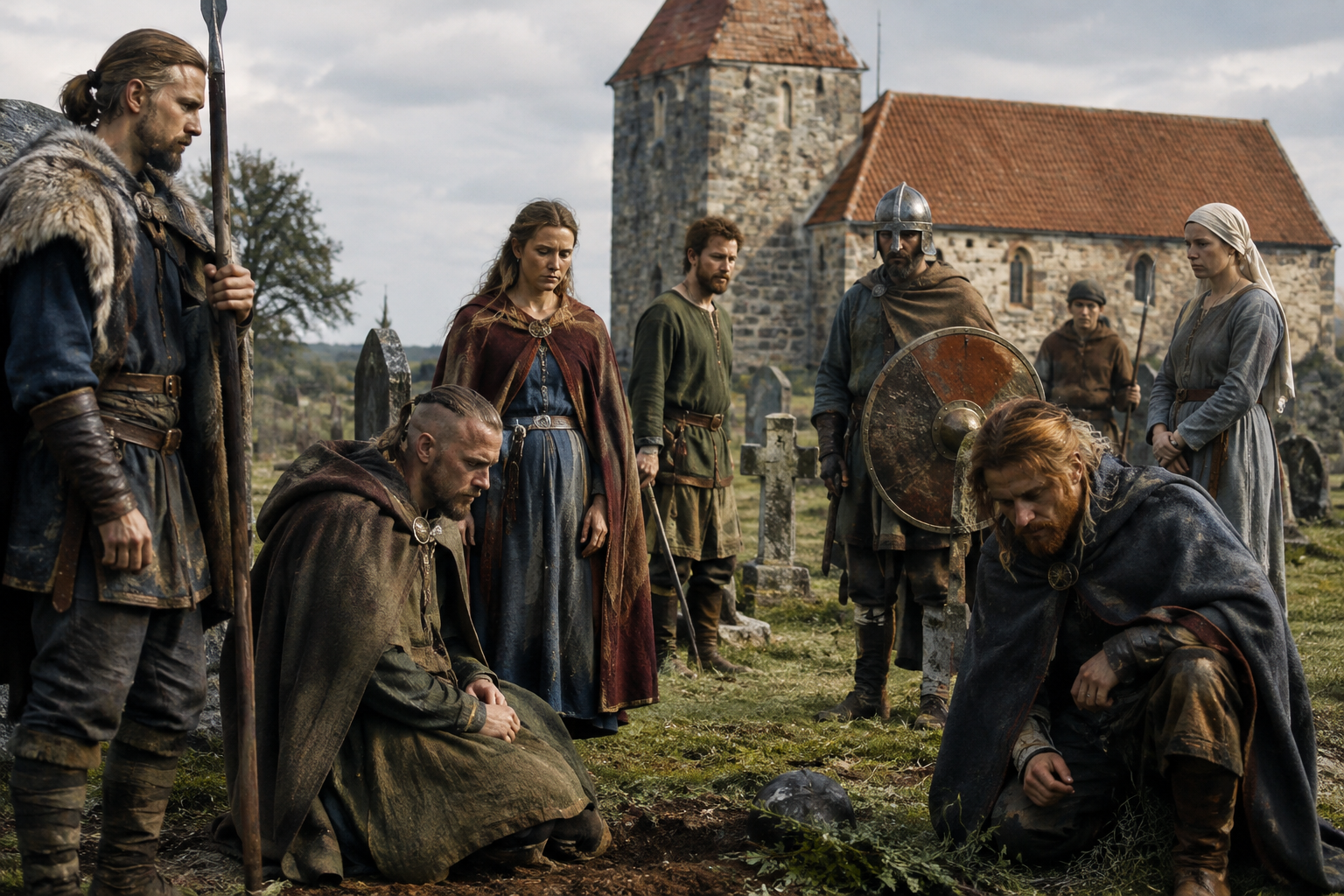
Some Y-chromosome lineages announce themselves with grand sweeps across continents. Others are more interesting precisely because they are narrower, more local, and more revealing of how real paternal lines survived through particular regions and periods. Haplogroup I1a1b1a1e2a belongs to that second category. It sits within the wider I1 branch of the Y-chromosome tree, a lineage long associated in broad terms with northern Europe, especially Scandinavia. But this very specific subclade is not the whole story of I1 in miniature. It is a smaller twig on that older northern tree, and its value lies in how ancient DNA lets us glimpse where one such paternal branch appeared in the historical record.
That matters because Y-DNA traces one direct paternal line only: father to son to son across generations. It does not describe a person's total ancestry, still less their culture, language, or identity. Yet when a rare or specific lineage turns up in Viking Age Denmark, Sweden, the eastern Baltic, and even among Scandinavian dead in England, it offers something wonderfully concrete. Not a myth of pure peoples, but a map of movement, kinship, and survival.
The broader haplogroup I1 is generally understood as one of the characteristic paternal lineages of northern Europe, with especially strong historical relevance in Scandinavia. For a subclade as specific as I1a1b1a1e2a, caution is essential. We should not simply pour the full deep history of I1 into this downstream branch and pretend the problem is solved. What we can say, responsibly, is that the evidence supplied here places this lineage within a distinctly Scandinavian and North Sea world during the first and early second millennia AD.
That is already historically rich terrain: the late Iron Age, the Vendel period, the Viking Age, and the medieval societies that followed. These were not isolated worlds. They were linked by sea lanes, raiding, trade, migration, dynastic ambition, conversion, and settlement. A paternal lineage found in Denmark and Sweden, then in Oxford among victims of the St. Brice's Day massacre, is not a genetic fairy tale. It is a reminder that men, and often family lines, moved with the traffic of the North Sea.
For readers interested in the longer population background behind Scandinavian history, Denmark's deeper story before the Viking Age is well worth exploring.
The most striking thing about the sample set is its geographical coherence. We are not looking at an isolated outlier from some unexpected corner of Europe. We are looking at a cluster centered on Scandinavia and its maritime orbit.
One early marker comes from VK296, an Early Viking Age individual from Hundstrup, Sealand, Denmark, dated to 680 AD. That date places him at the threshold of the Viking world, when Scandinavian society was already dynamic, connected, and regionally varied before the classic age of longships burst into written history. Then there is VK511 from Salme II XXVIII, Saaremaa, dated to 725 AD, in the Vendel Age. Salme is one of those sites that has transformed how we imagine the Baltic: not a backwater, but a corridor of organized martial movement across the sea.
By the 10th century the pattern continues. VK320 from Langeland Bogovej, Denmark, dated to 950 AD, and enb200 from Uppsala Enbacken, Sweden, dated to 969 AD, place this paternal line in two of the most historically resonant zones of Viking Age Scandinavia: the Danish islands and the Swedish heartland. Uppsala, of course, was not merely a settlement but a political and sacred center in early Swedish history. A Y-line appearing there does not prove royal or elite status by itself, but it anchors the lineage in one of the major arenas of northern state formation.
And then the sea crossing becomes literal. Two individuals from the Viking St. Brice Massacre, Oxford, VK176 and VK165, both dated to 1002 AD, show the same broad paternal connection in England. The historical context is chillingly specific: these were people caught in the anti-Danish violence ordered under King Aethelred. Here ancient DNA does not give us a saga hero. It gives us dead men in a crisis of Anglo-Scandinavian history.
Readers fascinated by that wider picture of mobility, mixture, and Viking expansion may enjoy this deeper look at the genomic evidence.
Taken together, these samples suggest that I1a1b1a1e2a belonged to the lived paternal landscape of southern and eastern Scandinavia and the Baltic-connected world around it. That is not the same as saying it was exclusive to Vikings, nor that every bearer was ethnically or culturally identical. Ancient DNA has repeatedly shown that Viking Age communities were not genetically uniform. What the samples do show is repeated presence in places central to Scandinavian expansion.
The Oxford individuals are especially useful because they show how a paternal lineage can move from homeland context into a historically documented event abroad. This is exactly where Y-DNA is at its most illuminating. Written sources tell us of Danes in England. Archaeology uncovers violent death. Genetics adds another layer, showing that some of those men carried paternal lines also seen back in Denmark and Sweden.
The chronology extends further into the Middle Ages with CGG100442, from Vor Frue Kirkegard, Aalborg, Jutland, Denmark, dated to 1350 AD. By then the Viking Age was centuries past. Scandinavia was Christian, feudal patterns were more developed, and kingdoms were long established. Yet the paternal line persists. That continuity does not prove unbroken local descent from any named earlier individual, but it does show that this branch remained part of the population of medieval Denmark.
For a broader look at how such lineages fit into Britain after the Viking and Anglo-Saxon centuries, this article offers valuable context.
This brings us, carefully, to the later historical world of noble families. The supplied family association is the House of Eure, linked with Witton Castle in County Durham. Here we must be precise. A historical association between a family and a haplogroup is not proof that every male Eure carried I1a1b1a1e2a, nor do the Scandinavian ancient samples prove direct descent from any Viking individual to the Eure line. That would require much more specific documentary and genetic evidence.
What we can say is that the Eure story belongs to a region deeply shaped by the same North Sea and northern British history in which Scandinavian paternal lineages played a part. County Durham was never a remote edge in medieval history. It sat within a frontier world of lordship, ecclesiastical power, cross-border tension, and long memories of earlier Scandinavian settlement in northern and eastern England.
Witton Castle itself began as a 15th-century fortified manor house built for the powerful Eure family. That phrase alone tells us something important. This was not merely a comfortable residence. It was architecture shaped by status, defense, and control. Over later centuries it was enlarged and softened into a grand country house, and in the Victorian period it was restored in the romantic Gothic manner so beloved of those who preferred the Middle Ages at a safe aesthetic distance. Its later link to local coal wealth and its modern afterlife as a caravan park and leisure site give it an oddly fitting English career: from fortress to estate to heritage curiosity.
A castle like Witton does not preserve DNA in any symbolic sense, but it does preserve regional memory. It fixes a family in place on the landscape. And when that landscape is northern England, where Scandinavian movement and settlement once mattered so much, the comparison with the ancient DNA record becomes historically suggestive, even when not genealogically proven.
Readers who want the family story itself in more detail can continue with the dedicated community article.
Haplogroup I1a1b1a1e2a is interesting not because it lets us make extravagant claims, but because it ties together several kinds of evidence with admirable restraint. Ancient DNA places this paternal branch in Denmark, Sweden, Saaremaa, and Viking Age England. Archaeology places those men in burial grounds, martial contexts, and moments of migration and violence. Later history places associated families such as the Eures in a northern English world that had long been shaped by those earlier movements across the North Sea.
That is how genetics is most useful to historians: not as a magic key to noble descent, but as another source for reconstructing the human past. It reminds us that paternal lineages can persist across centuries, spread across maritime zones, and appear in both famous centers and ordinary cemeteries. It also reminds us that a shared haplogroup is not the same thing as a family tree. Broad lineage similarity can show deep or regional connections without proving that one man was the ancestor of another.
If your own DNA includes an I1-related paternal line, or if you are simply curious about the ancient people who carried lineages found in the Viking and medieval North, MyTrueAncestry can help you explore those connections. Ancient DNA matches can offer remarkable historical perspective, even when they do not prove direct descent from a named Viking, a medieval lord, or the builders of a castle in County Durham.






Comments