Haplogroup I1a1b1a1e2

– 6 min read


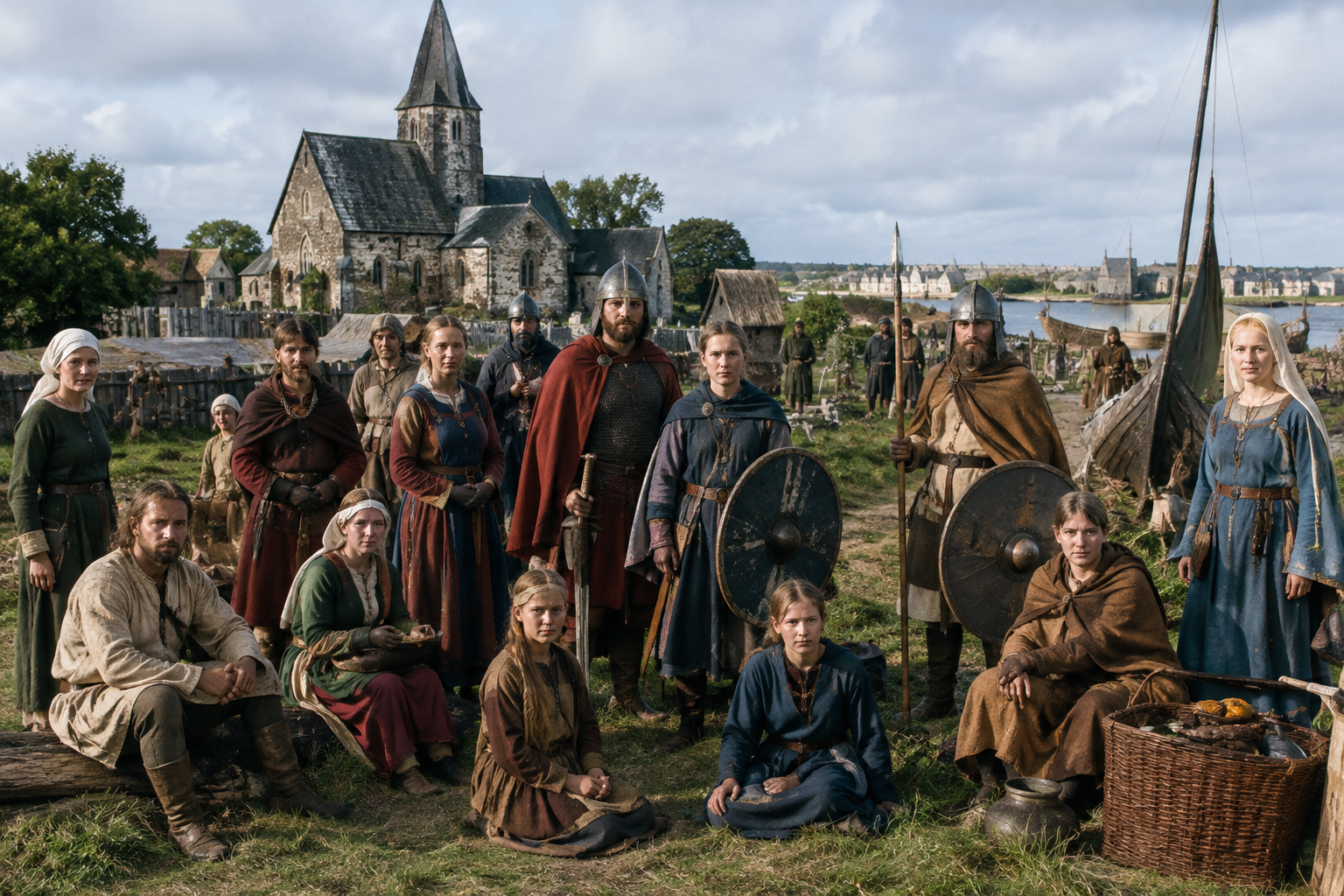
Some Y-chromosome lineages announce themselves with a thunderclap. Others emerge more quietly, by turning up again and again in places that matter. Haplogroup I1a1b1a1e2 belongs to that second category. It is a very specific branch within the wider I1 paternal family, and what makes it historically interesting is not that it can be made to explain everything, but that the ancient DNA record places related paternal lines in a distinctly northern European world: Iron Age Pomerania, Vendel Age Baltic raiding grounds, Viking Age Denmark and Sweden, medieval Jutland, and even among the dead of Oxford's St. Brice's Day massacre.
That is precisely why Y-DNA can be so compelling. It tracks one direct paternal line only: father to son to son across centuries. It does not describe a person's whole ancestry, and it certainly does not assign someone a full ethnic identity, language, or noble pedigree. But in the right archaeological settings, it can help us follow the long career of male lineages through migration, warfare, settlement, and dynastic history. With I1a1b1a1e2, the story is one of northern connections that later brush against the wider medieval and Mediterranean world.
I1 is generally associated with northern Europe, especially Scandinavia, and that broad background matters here. Still, caution is essential: a narrow branch such as I1a1b1a1e2 should not simply be handed the entire history of all I1 men. What we can say, from the evidence supplied, is that this lineage sits within a paternal cluster that appears repeatedly in regions tied to the Baltic and Scandinavian sphere.
The sample pattern is striking. We find one early anchor in PCA0480, from Iron Age Pommerania Gdansk Wielbark, dated 200 AD. That places a related paternal line in a region long discussed by archaeologists in connection with mobility around the southern Baltic. Then, several centuries later, the trail becomes much denser in Scandinavia itself: Zealand, Funen, Langeland, Jutland, Oland, Gotland, Uppsala, and Saaremaa. This is less a random scatter than a map of the Viking Age world and its immediate prelude.
That does not prove a single tribe, people, or dynasty. But it does suggest that this branch, or closely related paternal lines, belonged to the sort of population networks that linked the Baltic coast to the Danish islands, central Sweden, and the overseas expeditions of the Vendel and Viking Ages.
The most revealing thing about this haplogroup is not one glamorous burial, but a chain of finds across time.
Start with PCA0480 from Iron Age Pommerania Gdansk Wielbark, dated 200 AD. Pomerania was no backwater. It stood on the southern Baltic shore, where exchange, migration, and cultural contact tied communities into a broader northern world. A paternal lineage related to I1a1b1a1e2 in this setting hints that the later Scandinavian concentration was part of a wider Baltic zone, not an isolated island story.
Then the evidence tightens in Scandinavia. In Denmark alone we have VK296 from Early Viking Age Hundstrup Sealand dated 680 AD, CGG107518 from Viking Age Denmark Hundstrup Mose dated 779 AD, VK295 from Viking Age Hessum Funen Denmark dated 950 AD, and VK320 from Viking Age Langeland Bogovej Denmark dated 950 AD. That is a useful spread across the Danish islands and across centuries, suggesting continuity or repeated presence of the paternal line in the heartland of Viking Age maritime society.
Sweden offers a similar picture. VK379 from Vendel Age Oland Sweden dated 700 AD, enb200 from Viking Age Sweden Uppsala Enbacken dated 969 AD, and VK473 from Viking Age Gotland Kopparsvik Sweden dated 975 AD place related lines in some of the most historically resonant landscapes of early medieval Scandinavia. Oland and Gotland sat in the middle of Baltic traffic; Uppsala needs no introduction as one of the great centres of pre-Christian and early royal Sweden.
Perhaps the most dramatic finds are from Saaremaa and Oxford. The Vendel Age Salme burials in Saaremaa, Estonia, have transformed our understanding of early Scandinavian raiding and warfare in the eastern Baltic. Here we have VK549 from Vendel Age Saaremaa Salme II-J, VK553 from Vendel Age Saaremaa Salme II-M, VK511 from Vendel Age Saaremaa Salme II XXVIII, and VK509 from Vendel Age Saaremaa Salme I, all dated 725 AD. Their presence places this paternal branch in the company of warrior groups moving across the Baltic before the classic Viking Age was fully underway.
And then there is England. VK176 and VK165, both from the Viking St. Brice Massacre Oxford and dated 1002 AD, show that related paternal lines were among Scandinavian-associated men caught up in one of the most chilling episodes of Anglo-Scandinavian history. A haplogroup does not tell us their names, loyalties, or biographies. But it does place one paternal thread from the Scandinavian world in the brutal politics of late Anglo-Saxon England.
See North Sea Migrations to Britain
What happens after the Viking Age? The supplied record does not vanish, which is itself informative. CGG100442 from Medieval Jutland Denmark Vor Frue Kirkegard Aalborg dated 1350 AD shows a related paternal line still present in medieval Denmark. By this point we are in a Christian, urban, and politically transformed Scandinavia, far removed from ship burials and raiding bands. Yet the paternal line remains in the historical landscape.
There is also R1286 from Late Medieval Cancelleria Basilica dated 1429 AD. The great interest here is geographical contrast. A lineage with such a strong northern and Baltic ancient profile also appears in a late medieval ecclesiastical context further south in Europe. That need not imply a neat migration tale for one family. Medieval Europe was full of clerics, merchants, soldiers, pilgrims, and diplomats on the move. But it does remind us that paternal lines which may have been concentrated in one region could, by the later Middle Ages, surface in much more cosmopolitan settings.
This is one of the pleasures of ancient DNA. Written records tend to privilege elites and institutions; genetics catches ordinary men as well as noble ones, and catches them before surnames, heraldry, or court chroniclers did the filing.
The later historical association supplied for this haplogroup brings us to a very different stage: Monaco. The House of Grimaldi is one of those dynasties whose story seems almost too theatrical to be true, though in this case the legend is embedded in a hard political reality. The Princes Palace of Monaco began as a Genoese fortress built in 1191 on the Rock of Monaco, guarding a strategic stretch of coast. In 1297, Francois Grimaldi seized it in the exploit that became the founding legend of the dynasty.
Over time, the palace was enlarged from a military stronghold into a princely residence with Renaissance galleries, state rooms, and ceremonial courts. The building itself reflects the history of Monaco: precarious, adaptive, always negotiating survival between larger powers such as Genoa, France, and Spain. Damaged in conflict and altered repeatedly, it nonetheless remained the symbolic centre of the state and the home of its rulers. In the modern era it continued that role under figures including Prince Rainier III and Prince Albert II.
Now, one must be very careful here. A historical association between a haplogroup and a noble house is not proof that every Grimaldi male carried I1a1b1a1e2, nor that ancient Scandinavian or Baltic samples are direct ancestors of the Grimaldis. That would be absurdly overconfident. What can be said is something subtler and more interesting: by the later Middle Ages, paternal lineages with deep northern European archaeological visibility could appear in elite and Mediterranean settings too. Castles and palaces preserve political memory; DNA preserves biological lineages. Sometimes those stories overlap, but not always in the simple way people hope.
The Grimaldi connection is therefore best understood as a historical lens, not a proof of dynastic descent from Viking raiders. It invites us to think about how lineages move far beyond their earliest visible homelands, passing from the Baltic world of ship burials and massacre pits into the documentary world of fortresses, courts, and princely houses.
Discover the House of Grimaldi
So what does haplogroup I1a1b1a1e2 reveal? First, it points toward a paternal history strongly tied, in the available ancient record, to the Baltic and Scandinavian sphere. Second, it shows how a direct male line can persist through very different historical worlds: Iron Age coastal societies, Vendel Age warrior groups, Viking Age settlements and expeditions, medieval Danish towns, and later elite Mediterranean contexts.
Third, it is a useful reminder of what Y-DNA can and cannot do. It can illuminate one paternal thread with remarkable precision. It cannot by itself tell the whole story of a person, a people, or a dynasty. Shared haplogroups do not equal close kinship, and archaeological proximity does not automatically mean direct descent. But when genetics is combined with archaeology and history, it allows us to see continuity and movement in a way no single source ever could.
If your own paternal line falls within a branch like this, the excitement lies not in claiming a crown or a castle, but in seeing your lineage set against real historical landscapes: Pomerania in the Roman Iron Age, Saaremaa in the age of Baltic war bands, Oxford in a moment of political terror, and Monaco on its fortress rock.
Upload your DNA to MyTrueAncestry to explore whether your results show connections to ancient individuals, archaeological cultures, and historical populations like those discussed here. Those matches may not prove direct descent from a particular warrior or noble family, but they can offer a vivid new way to understand where one small part of your ancestry fits into the human past.






Comments