Haplogroup I1a1b1a1d2b

– 6 min read


Some Y-chromosome lineages announce themselves with a bang: a royal tomb, a famous conquest, a named dynasty. Others are more interesting precisely because they do not. Haplogroup I1a1b1a1d2b belongs to that second category. It sits within the wider I1 branch, a paternal lineage long associated in broad terms with northern Europe, especially Scandinavia, yet this very specific subclade reminds us of an important truth: the deeper we go down the Y-DNA tree, the less useful sweeping labels become, and the more valuable ancient DNA becomes.
That is why this branch is historically intriguing. Rather than standing for an entire people or nation, I1a1b1a1d2b appears here through a small but suggestive cluster of medieval and Viking Age evidence stretching from Denmark to Iceland and into the Carolingian world in Hungary. Y-DNA traces one direct paternal line only. It does not represent a person's total ancestry, and it certainly does not turn a genetic signature into proof of membership in a famous family. But it can help us follow male-line continuities and movements across centuries in a way written sources rarely can.
Broadly speaking, I1 is one of the best-known Y-chromosome lineages in northern Europe, with a particularly strong historical association with Scandinavian populations. That does not mean every branch of I1 has the same story, nor that every I1 man in the past belonged to a single language group or ethnic identity. A narrow subclade such as I1a1b1a1d2b represents a much later twig on that older tree, and its own history must be reconstructed from direct evidence rather than inherited assumptions.
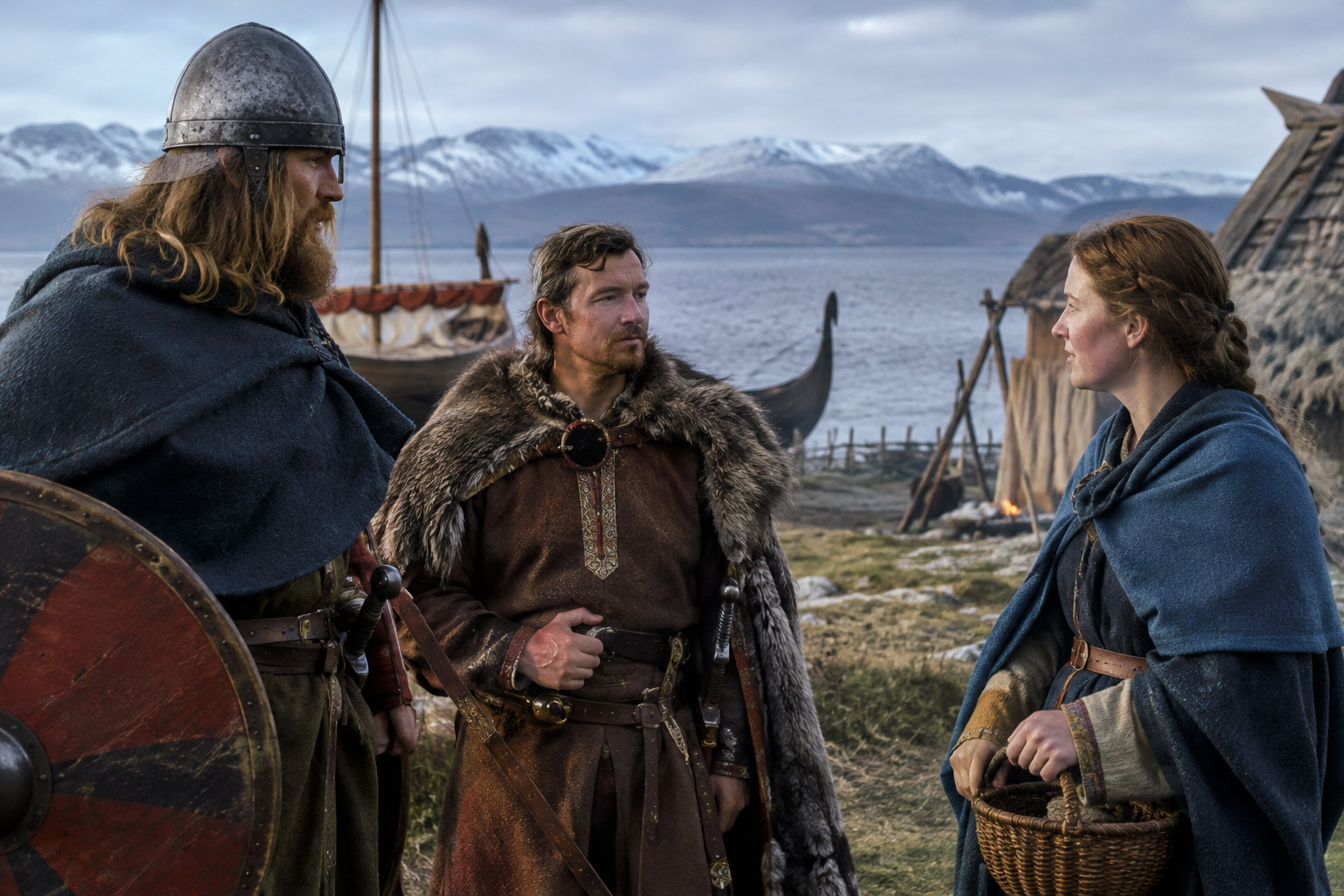
What the supplied evidence does suggest is a line at home in the North Sea and Baltic-connected world of the early medieval centuries. That is already enough to make it fascinating. The Viking Age was not just a story of raids and longships. It was also a period of settlement, intermarriage, local power-building, and the movement of families across remarkable distances. A paternal lineage found in Denmark, Iceland, and the Carolingian frontier in Hungary belongs naturally in that story of mobility.
The most vivid way into this haplogroup is through the men whose remains preserve it.
One of them is CGG106825, from Viking Age Denmark Bakkendrup Sealand, dated to 975 AD. Sealand was no backwater. It was part of the political and maritime core of late Viking Age Denmark, in an age when kingship, Christianity, trade, and older local loyalties were all jostling for space. A paternal lineage found there belongs in one of the central arenas of Scandinavian history. This does not make CGG106825 an ancestor of later named families. But it does place the lineage in the very landscape from which many northern movements into the British Isles, the North Atlantic, and continental Europe emerged.
Then there is DAV-A9, from Viking Norse Iceland, dated to 935 AD. Iceland is often imagined as remote, but in the Viking Age it was better understood as connected: a new society built from seaborne migration, with ties back to Norway, the Norse settlements of the Atlantic, and the wider Scandinavian world. A matching paternal branch in Iceland is exactly the sort of evidence that helps archaeogenetics move beyond saga stereotype. It shows not a generic "Viking gene," but one male line participating in the settlement network of the North Atlantic.
The third sample, AHS29, comes from Medieval Hungary Carolingian Empire Zalavar Varsziget, dated to 850 AD. This is perhaps the most arresting of the three because it shifts the setting so dramatically. Zalavar sat within a frontier zone where Carolingian power, local populations, and wider east-central European developments met. A northern-associated paternal line appearing in that world may reflect the complicated mobility of the period: military service, trade, migration, elite retinues, or other forms of contact. We should be careful here. One sample cannot explain an entire migration route. But it does show that the paternal history of this branch was not confined neatly to Scandinavia.
These three men are useful precisely because they do not come with grand genealogies attached. No chronicler tells us that CGG106825 sailed west, or that DAV-A9 founded a dynasty, or that AHS29 was a mercenary from the north. Ancient DNA forces a more disciplined sort of imagination. It lets us say: here is a paternal line present in late first-millennium Scandinavia; here it is again in Norse Iceland; here it appears in a Carolingian-era setting in Hungary. That pattern fits a world of movement across sea routes, river systems, and political frontiers.
It also reminds us that medieval Europe was full of men whose names are lost but whose descendants, lineages, and local impacts were real. Traditional genealogy begins with records, often among the elite. Y-DNA and ancient burial evidence begin elsewhere: in cemeteries, settlements, ruined churches, and excavated bone. The two approaches ask different questions and sometimes meet in productive ways.
Readers interested in how archaeogenetics has transformed this whole field may enjoy a broader look at Ancient DNA and the Rise of Archaeogenetics, which shows just how much the discipline has changed our picture of the past.
That brings us to the House de Courcy and the Chateau de Courcy in Normandy. The castle began as a medieval stronghold linked to the powerful de Courcy family and became an important local seat in the feudal age, when castles were instruments of lordship, war, and control over the countryside. Over time it was damaged in conflict, altered by later owners, and partly rebuilt, so that its ruins preserve traces of several periods rather than one frozen medieval moment.
This matters because Normandy was one of the great meeting grounds of northern and continental history. Its aristocratic culture was French-speaking and feudal, yet its ducal past was inseparable from Scandinavian settlement. A family like the de Courcys belongs to that world shaped by conquest, adaptation, and the making of new regional identities. That does not allow us to declare that the de Courcy paternal line was I1a1b1a1d2b. The evidence provided does not justify that. But historically, the association is still meaningful: a northern European paternal lineage found in Viking Age Scandinavia sits in a plausible wider context for the emergence of Norman aristocratic society.
Read About the House de Courcy
The ruins of Chateau de Courcy also illustrate something genetics cannot do on its own. A haplogroup can show continuity or movement in male lines, but a castle shows how power was grounded in land, defense, and memory. Stones preserve ambition. DNA preserves descent in one narrow line. Put together, they help us understand how populations become polities, and how mobile lineages become local lordships.
If one were to sketch the most cautious historical backdrop for I1a1b1a1d2b from the evidence at hand, it would be this: a paternal branch rooted somewhere within the wider northern European and especially Scandinavian history of I1; clearly present in the Viking Age world of Denmark; carried into the Norse Atlantic sphere of Iceland; and also visible in a Carolingian-era setting in Hungary, where long-distance movement was hardly unusual. From there, the broader history of northern-descended male lines in medieval Europe intersects naturally with places like Normandy, where Scandinavian settlement and Frankish political culture fused into something new.
For readers interested in that fusion, the Norman case is especially revealing. The transformation from Viking settlers to Norman lords is one of the classic examples of how lineages move across cultural boundaries without carrying a single fixed identity with them. A man can be genetically connected to the Scandinavian world and historically part of a French-speaking feudal aristocracy a few generations later.
Haplogroup I1a1b1a1d2b is a good example of why the finer branches of the Y-tree are so rewarding. They move us away from overblown claims about whole peoples and toward something more historically honest: male lines travelled, settled, persisted, and sometimes reappeared in unexpected places. The evidence here points to a branch active in the Viking and early medieval centuries across a connected northern and central European world.
It also shows the limits of the evidence, and those limits are worth respecting. Shared haplogroups do not prove direct descent. Ancient samples are not automatically ancestors of modern families. A noble house associated with a region does not become genetically proven simply because a broad historical setting seems compatible. But when archaeology, geography, and Y-DNA line up carefully, they can illuminate one another in ways neither could manage alone.
If your own paternal ancestry falls on a rare or highly specific branch, that is often where the real historical interest begins. Not with a fantasy of instant royal descent, but with the slower, more interesting question: in what worlds did this line travel, endure, and leave its mark?
Upload your DNA to MyTrueAncestry to explore how your results compare with ancient individuals like CGG106825, AHS29, and DAV-A9, and to discover the archaeological populations and historical regions connected with your deep ancestry. Those matches may not prove a direct genealogical line to a Viking settler or a Norman noble house, but they can open a remarkable window onto the past your DNA still carries.






Comments