Haplogroup I1a1b1a1d

– 6 min read


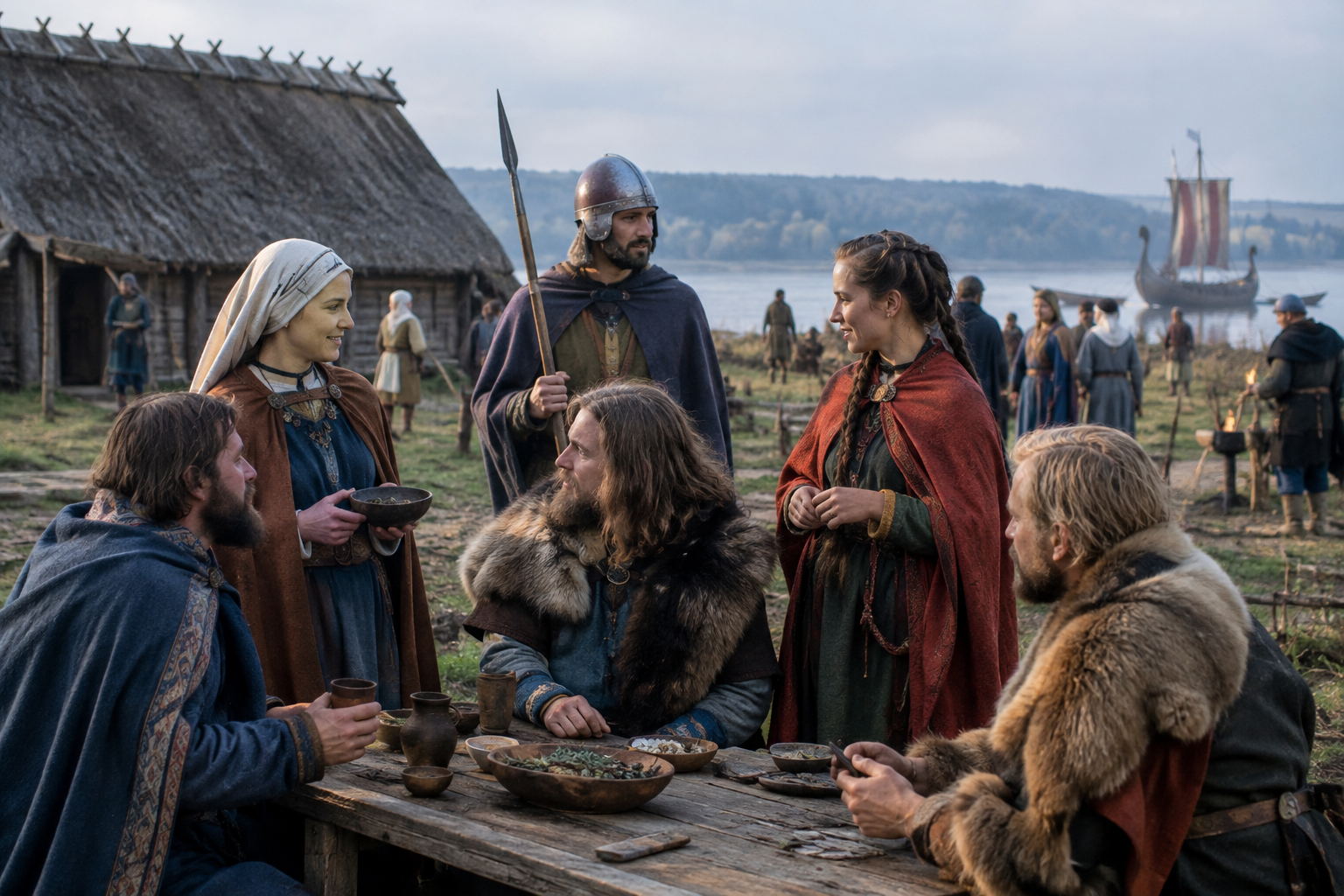
Some Y-DNA haplogroups arrive in the historical record with a bang: a royal tomb, a famous dynasty, a dramatic migration. Others emerge more intriguingly, by appearing again and again in different places where the North Sea, the Baltic, and the wider world of early medieval Europe kept colliding. I1a1b1a1d belongs to that second category. It is a very specific branch within the wider I1 paternal tree, and that matters, because the narrower the branch, the more carefully we must speak about it.
Y-DNA traces one direct paternal line only: father to father to father across the centuries. It does not describe a person's whole ancestry, culture, language, or identity. Still, these paternal branches can be remarkably useful. They let us watch one thread of human history move through burials, settlements, trading worlds, and later noble landscapes. In the case of I1a1b1a1d, the supplied ancient DNA points strongly toward northern and northeastern Europe, with appearances in Iron Age Central Europe, the Baltic zone, Viking Age Scandinavia, Rus-connected sites, Iceland, medieval England, and the Carolingian frontier in Hungary.
The broader haplogroup I1 is widely associated with northern Europe in both modern and ancient DNA studies, especially Scandinavia and regions connected to later Germanic-speaking and Viking Age movements. But it is important not to dump the entire history of I1 onto one small downstream subclade. I1a1b1a1d is a much narrower branch, and the safest way to understand it is through the actual ancient individuals in which it appears.
Those individuals suggest a paternal lineage that was at home in the Baltic-Scandinavian world and mobile across it. That does not mean every man in Viking Scandinavia belonged to this branch, nor that every carrier was ethnically the same. What it does suggest is that this line took part in the networks that linked Denmark, the Baltic islands, the southern Baltic coast, eastern river routes, the British Isles, and North Atlantic settlement.
If you want a wider introduction to how ancient DNA lets us reconstruct such paternal histories, MyTrueAncestry has a useful overview in Ancient DNA and the Rise of Archaeogenetics.
The earliest supplied signs of this lineage are already telling. One sample, 2338b, comes from Iron Age Czech Prague, dated 100 BC. Another, PCA0480, comes from Iron Age Pommerania Gdansk Wielbark, dated 200 AD. Even before we reach the Viking Age, then, the branch appears in two very different but connected historical zones: inland Central Europe and the southern Baltic coast.
That southern Baltic context is especially suggestive. The Wielbark area near Gdansk is one of those archaeological landscapes that historians keep returning to because it sits at a crossroads: Baltic shorelines, exchange routes, and the shifting interaction of local communities and larger cultural horizons. A Y-line appearing there in the Roman era and then turning up later around Scandinavia and the Viking world does not prove a single migration path. But it does fit a broader pattern of movement around the Baltic basin rather well.
For readers interested in how ancient DNA has reshaped debates about Iron Age movements and language spread in this region, see Ancient DNA Reveals Central European Origins and Spread of Celtic Languages. It is not about this branch specifically, but it helps place Central Europe in a wider prehistoric and Iron Age framework.
Explore Iron Age Central Europe
By the early medieval period, the evidence becomes even more vivid. VK549 from Vendel Age Saaremaa Salme II-J, dated 725 AD, places the lineage in the eastern Baltic just before the classic Viking Age. Saaremaa, in present-day Estonia, was no backwater. It was part of a maritime zone where raiding, trade, and elite display all mattered. A paternal line here is a reminder that the Viking world was never only about Norway, Denmark, and Sweden as neat modern boxes; it was an interconnected seascape.
Then comes CGG106825 from Viking Age Denmark Bakkendrup Sealand, dated 975 AD. Sealand was one of the political and strategic cores of late Viking Denmark. A lineage found there and also in Saaremaa hints at circulation across the Baltic rather than isolation within a single kingdom.
Even more striking is VK223 from Viking Age Gnezdovo Russia, dated 950 AD. Gnezdovo was tied to the great riverine routes of the early Rus world, where Scandinavians, Slavs, Finnic peoples, and others met in trade and power. Here the same paternal branch appears not at the end of Europe, but deep within one of its busiest exchange corridors.
And then there is DAV-A9 from Viking Norse Iceland, dated 935 AD. That pushes the line out into the North Atlantic colonizing frontier. One can almost map the geography from sample to sample: Baltic island, Danish heartland, Rus-connected emporium, Icelandic settlement zone. Not a neat family tree, of course, but a clear historical world.
Readers who want more on the North Atlantic side of this story may enjoy Erik the Red and the First Viking Settlers of Greenland, which captures the same expansionary Norse horizon in archaeological terms.
Discover Norse Atlantic Settlement
The medieval samples show that this paternal line did not vanish when the age of longships gave way to kingdoms, churches, and hospitals. AHS29 from Medieval Hungary Carolingian Empire Zalavar Varsziget, dated 850 AD, places it on the Carolingian frontier in the Carpathian Basin. That is a very different political world from Viking Sealand or Saaremaa, yet still one linked by mobility, warfare, and frontier settlement.
Then there is ATP_PSN_326 from Medieval England Cambridge St Johns Hospital, dated 1250 AD. By then we are a long way from the Iron Age and well into the institutional world of medieval English towns. A Y-line that appears in Iron Age Prague, Roman-era Pommerania, Viking Denmark and Iceland, and then medieval Cambridge speaks not of one people replacing another, but of continuity and mixture within northern Europe over many centuries.
For a broader look at how such movements played out in Britain, North Sea Migrations to Britain: From Vikings to Industrial Revolution is a particularly apt companion piece.
How does all this connect to later noble history? Carefully. Genetics and genealogy are not the same thing, and a shared haplogroup is not proof that an ancient man from Sealand or Gnezdovo was an ancestor of a medieval Scottish lord. But geography, memory, and paternal continuity do sometimes illuminate the same historical landscapes.
The supplied noble association here is Clan Lyon and Glamis Castle in Angus, Scotland. Glamis began as a royal hunting lodge and by the 14th century was tied to the Scottish crown through Sir John Lyon, whose family received the thaneage of Glamis after his marriage to a daughter of King Robert II. Over time the Lyons rebuilt and enlarged it into the striking towered castle known today, with major 17th-century work shaping much of its present form.
And what a building it is in historical imagination. Glamis stands where medieval lordship, royal favor, and later legend meet. It became linked in folklore and literature with Shakespeare's Macbeth, and in modern royal history it is remembered as the childhood home of Queen Elizabeth The Queen Mother and the birthplace of Princess Margaret in 1930. Still associated with the Earls of Strathmore and Kinghorne, it preserves a long social memory of rank, landholding, and dynastic presence in eastern Scotland.
That eastern Scottish setting matters. The North Sea world that carried lineages like I1a1b1a1d into Britain also shaped the wider historical background of Angus and the Scottish east coast. That is not proof about the Lyon paternal line. It is, rather, the sort of context in which ancient DNA and medieval records begin to speak to one another without pretending to say the same thing.
Readers wanting to follow that family history more directly can turn to Clan Lyon, which explores the clan itself in greater detail.
I1a1b1a1d is historically interesting because it appears across a chain of places that genuinely mattered: Prague in the Iron Age, the southern Baltic in the Roman era, Saaremaa in the Vendel Age, Denmark and Gnezdovo in the Viking Age, Iceland in the era of Norse expansion, and medieval England and Hungary in later settled political worlds. That distribution makes it a useful paternal marker for studying movement across northern Europe.
But restraint is essential. A haplogroup is not a surname, not a coat of arms, and not a nationality. It cannot by itself prove descent from Clan Lyon, from a Viking warrior, or from any named medieval house. What it can do is place a direct paternal line inside the broad historical processes that created the Europe we know: Baltic exchange, Scandinavian mobility, frontier settlement, and the layering of ancient populations beneath later kingdoms and castles.
If your own Y-DNA belongs somewhere near this branch, that is an invitation to investigate, not a permission slip for fantasy. The real excitement is better than fantasy anyway: ancient burials, real places, real men, and a paternal line that can be tracked across more than a millennium of European history.
If you want to see whether your DNA shows links to ancient individuals like ATP_PSN_326, CGG106825, VK223, VK549, or DAV-A9, MyTrueAncestry can help you explore those comparisons. Such matches can offer remarkable insight into the deep history around your ancestry, even though they do not by themselves prove direct descent from a specific ancient person or noble family.






Comments