Haplogroup I1a1b1a1a

– 6 min read


Some Y-chromosome lineages arrive in history with trumpets and banners. Others appear more quietly: in an Iron Age burial in central Europe, in a grave on the Baltic coast, in a boat burial, in a trading town, in Iceland at the edge of the North Atlantic. Haplogroup I1a1b1a1a belongs to that second kind of story. It is not a complete history of a people, still less a badge of ethnicity, but a direct paternal line that can be followed through time by ancient DNA.
That is the first thing to keep firmly in mind. A Y-DNA haplogroup traces one narrow line of descent: father to son to son. It does not describe a person's whole ancestry, culture, language, or identity. Yet precisely because it is so narrow, it can be remarkably revealing. In the case of I1a1b1a1a, the ancient samples supplied here place this paternal branch in a striking arc from Iron Age central Europe to the Baltic and into the Viking world. What emerges is not a fairy tale of pure bloodlines, but a more interesting reality: continuity, movement, and the untidy spread of men, families, and communities across northern Europe.
Haplogroup I1a1b1a1a is a downstream branch within the wider haplogroup I1 tree, a major Y-chromosome lineage long associated in broad terms with parts of northern Europe. For a specific subclade like this one, caution matters. We should not simply pour the entire history of I1 into this narrower branch as if nothing changed along the way. Subclades have their own histories, their own expansions, and often their own regional patterns that only become clear when ancient and modern DNA are studied together.
The supplied evidence suggests that this lineage, or closely related paternal branches, was present across a corridor running through central Europe, the southern Baltic, and into Scandinavian-linked maritime settings by the early medieval period. That is historically interesting because it cuts across several worlds we often keep too neatly separate: late Iron Age communities, Baltic-zone populations, warrior and merchant networks of the Vendel and Viking ages, and later medieval regions that preserved memories of noble lineages in stone and record.
Explore Ancient DNA and Archaeogenetics
The earliest anchor in this set is 2338b, listed as Iron Age Czech Prague Year:100 BC. Even with only a concise label, the significance is plain enough. By 100 BC, we are in a central European landscape shaped by exchange, mobility, and overlapping cultural zones. Prague was no isolated backwater. It sat within routes connecting the Elbe basin, the Danube world, and regions further north. A paternal lineage related to I1a1b1a1a appearing here reminds us that lineages later seen in more northerly contexts were not confined to one tidy homeland in the historical imagination.
Then we move north to PCA0480, Iron Age Pommerania Gdansk Wielbark Year:200 AD. This is an especially evocative data point. The Wielbark cultural horizon has long attracted attention because of its place in debates about mobility around the Baltic, including discussions of communities connected with the Goths and with wider movements between Scandinavia and the southern Baltic. Ancient DNA does not solve every old argument, but it does complicate them in useful ways. A paternal line of this sort in the Gdansk region fits a world where the Baltic was less a barrier than a highway.
What matters here is not to force an ethnic label onto the sample, but to note the geography. Central Europe and the southern Baltic are both represented before the Viking Age. That suggests that by late prehistory and the Roman Iron Age, this paternal branch or its close relatives were already part of a broader northern European pattern.
Read About Central European Ancient DNA
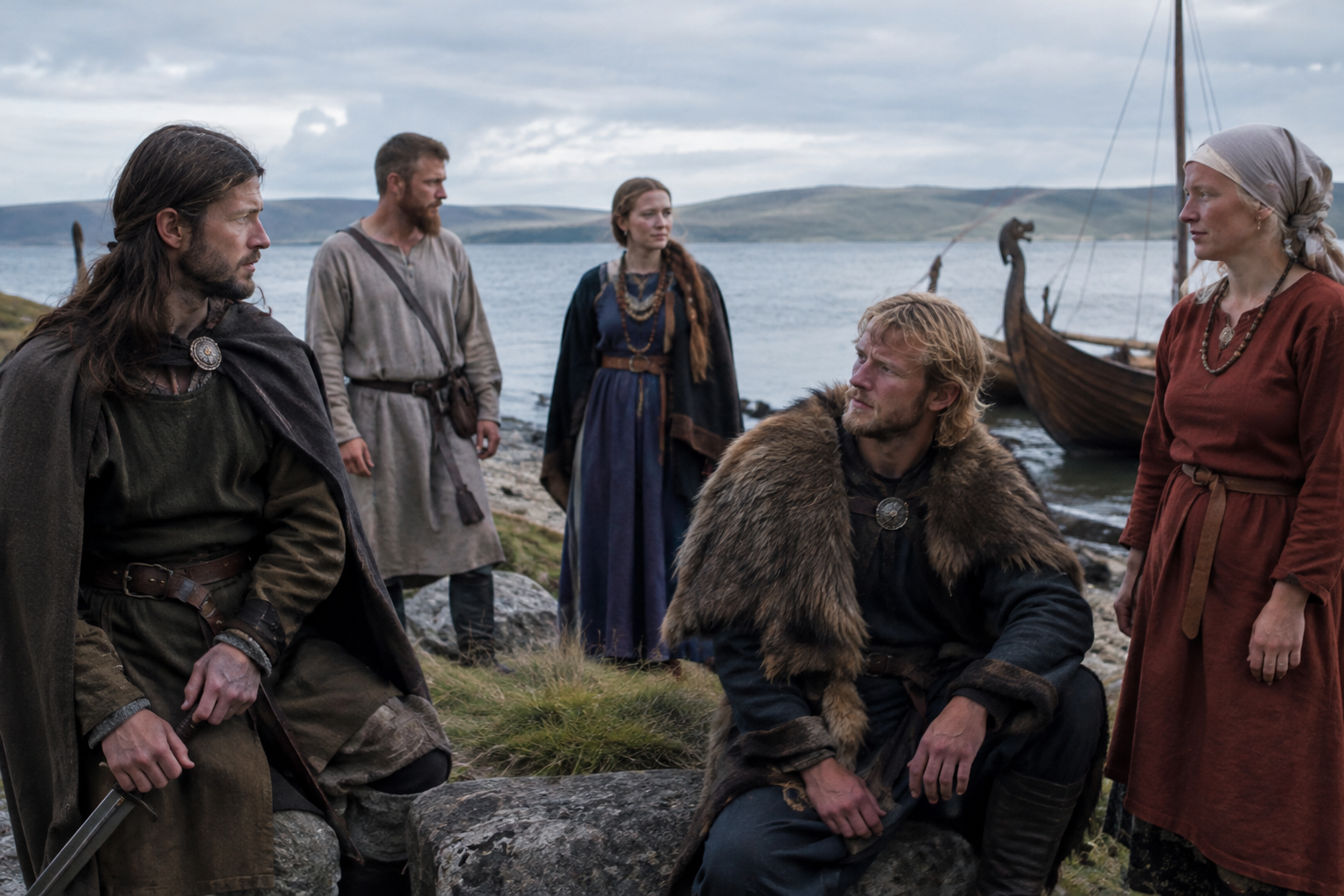
If the Iron Age samples establish depth, the early medieval ones provide drama. VK549, listed as Vendel Age Saaremaa Salme II-J Year:725 AD, belongs to one of the most arresting archaeological settings in northern Europe. Salme on Saaremaa, in present-day Estonia, is famous for its ship burials and for what they reveal about martial expeditions across the Baltic before the classic Viking Age was fully underway. Here the paternal story is no abstraction. We are looking at men caught up in real seaborne violence and long-distance movement.
By the time we reach VK223, Viking Age Gnezdovo Russia Year:950 AD, the map has widened further east. Gnezdovo was one of the great nodal points of the Viking Age, tied to river routes linking the Baltic to the lands of Rus and beyond to Byzantium and the Islamic world. A lineage like I1a1b1a1a appearing there fits what archaeology has shown again and again: Viking Age mobility was not merely raiding from Scandinavia outward, but settlement, commerce, service, and cultural mixture across enormous distances.
Finally there is VDP-A5, Viking Boat Burial Iceland Year:925 AD. Iceland has a special place in the popular imagination, but the genetic point is sober and important. By the early 10th century, paternal lines connected to the Scandinavian world had reached the far North Atlantic. That does not make every matching modern tester a Viking in any simplistic sense. It does show that this branch participated in the same broad sphere of migration and colonization that carried people, livestock, law, poetry, and feuds across the ocean.
Put these samples side by side and a pattern emerges. Not a straight line, certainly, and not proof of direct descent from any one burial. But a pattern: central Europe in the late Iron Age, the southern Baltic in the Roman era, Baltic maritime conflict in the Vendel Age, riverine eastern networks in the Viking Age, and Atlantic settlement in Iceland. That is a remarkable historical spread for one paternal branch.
This is where ancient DNA is so useful. Written sources are patchy, partisan, and late. Archaeology gives us objects, graves, and landscapes. Y-DNA adds another kind of evidence: a way of tracking paternal continuity and dispersal across time. Yet it must be read modestly. Shared haplogroups do not prove close kinship. Men separated by many centuries can belong to the same branch without being traceable ancestors and descendants in any practical genealogical sense.
Still, the broad lesson is clear enough. Lineages like I1a1b1a1a help show how northern Europe was knitted together by repeated movements long before modern nations existed. The Baltic, the North Sea, and the river routes into eastern Europe were zones of connection, not margins.
At first glance, the leap from Baltic ship burials to House Ramirez de Arellano in La Rioja may seem improbable. But this is precisely where historical storytelling becomes interesting, provided we keep our footing. A noble family associated with a haplogroup is not thereby genetically proven in all its branches, and a haplogroup match does not make a medieval lord the descendant of any particular ancient sample. What we do have is a later historical setting in which paternal identity, inheritance, landholding, and memory mattered enormously.
The family's associated stronghold, The Castle of Nalda in La Rioja, began as a medieval fortress linked to the Kingdom of Navarre and was first recorded in the eleventh century, guarding routes through the Iregua valley. That detail alone tells us much. Castles were not simply houses with better walls. They were instruments of control over roads, valleys, tolls, loyalties, and fear. Nalda stood in a frontier region where crowns shifted, rivalries sharpened, and noble ambition had to be made visible in masonry.
Over time the castle became the seat of the powerful Manrique de Lara family, who rebuilt and expanded it into a lordly stronghold during the later Middle Ages. Later still, as so often in Europe, military importance faded. Neglect, ruin, and alteration followed. Yet the surviving walls and tower still dominate Nalda, preserving not genetic proof, of course, but historical memory: the stubborn afterlife of lineage, status, and regional power in medieval Spain.
Explore the House Ramirez de Arellano
Haplogroup I1a1b1a1a is best understood not as a tribal label but as a thread through a long and complicated human record. In the samples here, that thread appears in Iron Age Prague, in Pommerania near Gdansk, in the maritime violence of Salme, in the cosmopolitan Viking Age world of Gnezdovo, and in Iceland's boat-burial horizon. Later, in a very different register, the world of castles and noble houses reminds us how paternal descent became embedded in law, inheritance, and prestige.
For family historians, that is the fascination. Genetics and history do different jobs. Documents may tell you who held a castle; DNA may show that a paternal branch had been moving through Europe for centuries before the castle was ever built. Neither replaces the other. Together they make the past larger, stranger, and more human.
If you want to place your own paternal story against that deeper background, MyTrueAncestry can help you explore ancient DNA matches and historical populations connected to the worlds discussed here. Those comparisons can offer powerful clues and context, even though they do not by themselves prove direct descent from any ancient individual or noble family.






Comments