Haplogroup I1a1a4a1a1b1

– 5 min read


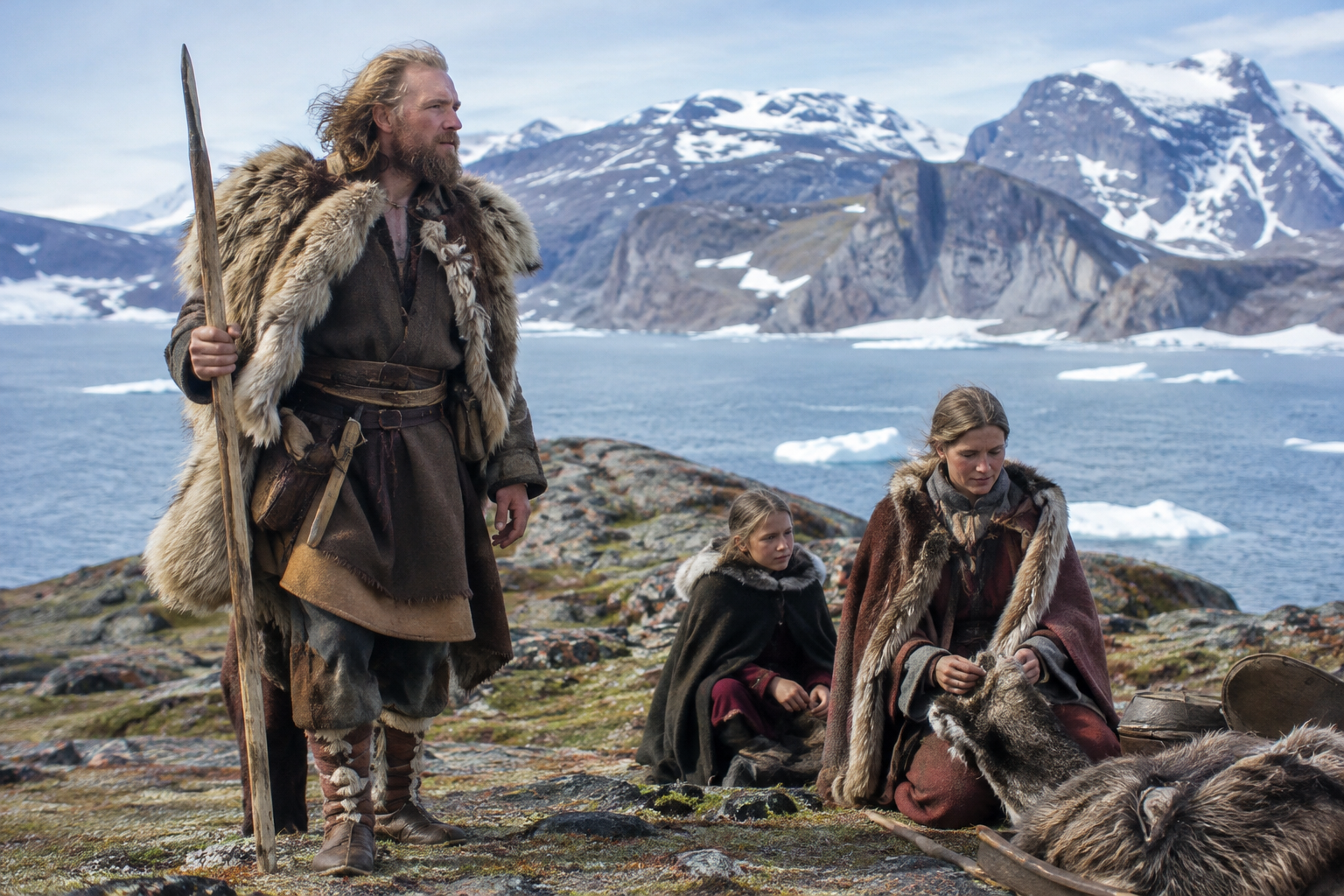
At Igaliku Fjord in southern Greenland, archaeologists and geneticists have been able to put a Y-chromosome label on at least one man from the Viking Age settlement world: sample VK186, dated to around AD 1000. That date matters. It places him in the era when Norse communities had established themselves on the edge of the North Atlantic, farming, trading, worshipping, and burying their dead in a landscape that was both newly colonised and stubbornly difficult.
The haplogroup associated here is I1a1a4a1a1b1, a very narrow branch within the broader Y-DNA haplogroup I1. Y-DNA follows one direct paternal line only, so it does not describe the whole ancestry of a person like VK186. But as a historical clue it is still valuable, because I1 is one of the paternal lineages most often discussed in connection with later Scandinavian populations, and a Viking Age Greenlander carrying a downstream branch of that lineage helps anchor the story in a real, named archaeological setting rather than in modern surname lore.
Igaliku Fjord lies in the heartland of the old Eastern Settlement, the largest concentration of Norse farms in medieval Greenland. This was not a temporary raiding camp or a saga fantasy. It was a farming colony, tied to Iceland and Norway, with churches, seasonal movement, animal husbandry, and long-distance exchange across some of the harshest sea routes in the medieval world.
That is what makes VK186 so interesting. A paternal lineage such as I1a1a4a1a1b1 appears here not in Scandinavia itself, but at the far western edge of the Norse expansion. In other words, this branch was being carried by men who were part of the colonising population of Greenland, or descended very closely from it, by around AD 1000.
The Greenland evidence has featured in population-genetic research on Viking Age mobility and settlement, including an ancient DNA study of Viking world populations that helped frame Greenland not as an isolated curiosity but as one node in a much larger North Atlantic network. Even without overselling one sample, that wider context matters: Greenland was settled by people with real family histories behind them, not by abstract "Vikings" dropped onto a map.
There is always a temptation to treat a long haplogroup label as if it were a tribal badge. It is not. I1a1a4a1a1b1 is a very specific twig on a much larger paternal tree, and the wider tree has a long history in northern Europe. But the presence of this exact branch in a Viking Age Greenlander does not automatically tell us where that branch first formed, which language its earliest carriers spoke, or whether every man in the settlement shared the same ancestry.
What it does suggest is more modest and more useful. By the time Norse settlement reached Greenland, this paternal line was already part of the male population moving through the Scandinavian and North Atlantic world. That makes the branch historically legible in a way many modern testers appreciate: it is tied to a documented medieval frontier community rather than to a vague regional average.
This is also a good point to distinguish between the broad and the narrow. The parent haplogroup I1 is widely discussed in northern European genetic history. The article haplogroup, I1a1a4a1a1b1, is much narrower. One should not simply pour every claim ever made about I1 into this smaller branch. Ancient DNA works best when the scale of the claim matches the scale of the evidence.
Greenland can look peripheral on a modern map, yet in the Viking and early medieval centuries it was part of an active maritime corridor. Ships linked Norway, the British Isles, Iceland, Greenland, and, for a time, lands even farther west. A man buried in Greenland was therefore living in a society shaped by movement, kinship, and repeated crossings of sea-lanes that stitched the North Atlantic together.
That is why a haplogroup from Igaliku Fjord is not just a local footnote. It contributes to the broader picture of how paternal lines associated with Scandinavian populations spread during the Viking Age. Genetic evidence has become increasingly important here because it helps separate literary imagination from biological history. The sagas tell us that Norse settlers went west; ancient DNA helps show the human substance of that movement.
Greenland also sharpens another historical point. Colonisation was not just conquest or adventure. It involved the transplantation of households and lineages into a new landscape. When we identify a paternal lineage like I1a1a4a1a1b1 in this setting, we are looking at the biological trace of that transplantation. However fragmentary the evidence, it is a reminder that settlement history was made by particular families, not just by fleets and famous names.
Because I1 is often discussed alongside Scandinavia and later Germanic-speaking populations, readers naturally ask whether a lineage like I1a1a4a1a1b1 can be linked directly to language. The sensible answer is that language and Y-DNA are connected only indirectly. A paternal line can persist through cultural change, and languages can spread without one single male lineage taking over.
Still, Viking Age Greenland sits within a well-known Norse-speaking world. So while the haplogroup alone does not prove language, the archaeological and historical setting of VK186 places this branch inside a Norse colonial community operating in Old Norse. That is a strong contextual fact, and it is far better than pretending the chromosome itself "spoke" a language. For the bigger picture, recent work on Germanic-language spread and ancient genomics offers a useful companion to the Greenland evidence.
VK186 is only one individual, and one must be careful with single-sample storytelling. Yet single individuals can be illuminating when they stand at the right place in history. Greenland around AD 1000 was one of those places: a colony connected to Icelandic and Norwegian settlement streams, dependent on transoceanic contact, and living at the edge of what medieval Europeans could sustain.
That means the branch I1a1a4a1a1b1 is not merely "Scandinavian" in a loose modern sense. In this case it is directly associated with the Norse expansion into the North Atlantic. That gives the haplogroup a concrete historical setting: not just the homeland, but the frontier.
It is worth setting this beside other island and maritime studies from the North Atlantic world. Genetic work on later island populations has shown again and again that these seas were corridors as much as barriers. Greenland belongs in that same story, though at a colder and more precarious limit.
If your paternal line falls under I1a1a4a1a1b1, the most responsible historical takeaway is not that you descend from a famous chieftain or a saga hero. It is that your direct male line belongs to a very specific offshoot of a broader northern European haplogroup that is now documented in at least one man from Viking Age Greenland, sample VK186. That places the branch within the real human history of Norse settlement in the North Atlantic.
For family historians, that is already quite a lot. It ties a modern paternal signature to a world of fjords, farms, sea-crossings, and frontier communities at the western edge of medieval Europe.






Comments