Haplogroup I1a1a3

– 4 min read


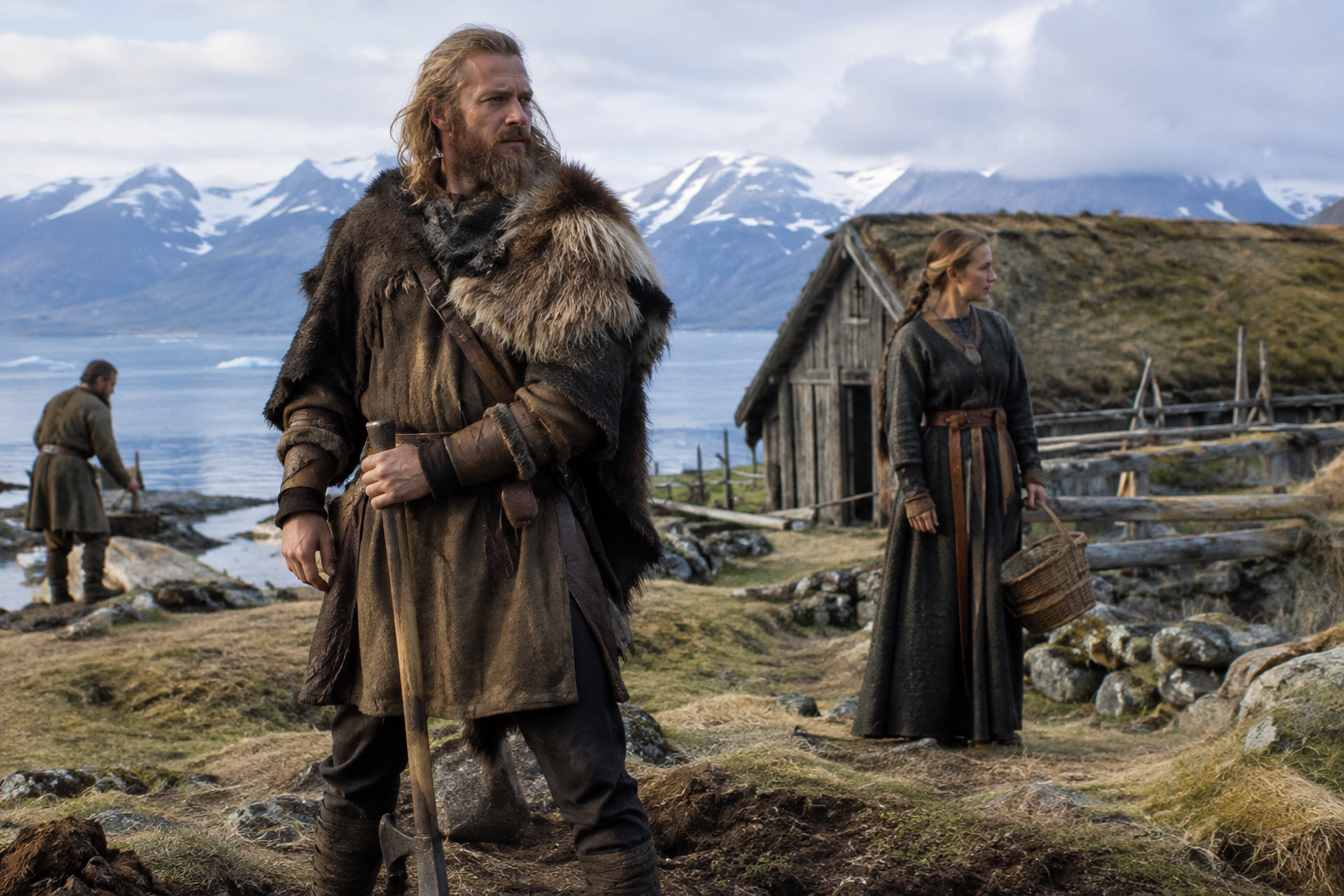
At Brattahlid in Greenland, one Viking-age male sample stands out for anyone interested in Y-DNA I1a1a3: VK183, dated to around AD 990. That date places him in the first generation of Norse settlement in Greenland, in the world created by Erik the Red and the farming communities that tried to make a life at the very edge of the medieval European world.
This is a useful place to begin because Greenland was never a vague Viking backdrop. It was a real colony, dependent on ships, livestock, trade, and stubborn human organisation. A direct paternal lineage such as Y-DNA traces only one narrow ancestral line, not a person's whole ancestry or identity, but when a branch like I1a1a3 appears in an early Greenland settler, it places that paternal line inside one of the most remarkable expansion zones of the North Atlantic Norse.
Brattahlid, in the Eastern Settlement of Greenland, is one of the best-known places in the Norse Atlantic story. It is associated in the written tradition with Erik the Red's household, but archaeology matters here more than saga glamour. This was a functioning settlement landscape of farms, church sites, animal husbandry, and imported connections to Iceland, Norway, and beyond.
Sample VK183 belongs to that frontier moment. Even with sparse sample-level detail, the combination of site, date, and Y-lineage matters. An I1-associated paternal line in an early Greenland settler fits what ancient DNA and later population history both suggest about the strong role of Scandinavian male lines in Viking-age westward expansion.
A preprint study examining Viking-age population history is linked with this Greenland material here: https://www.biorxiv.org/content/10.1101/703405v1. Without overclaiming details not stated in the sample note, the broader relevance is clear enough: Greenland was part of the Norse diaspora, and VK183 helps anchor I1a1a3 in that colonial setting.
The haplogroup in this article is I1a1a3, a downstream branch within the wider Y-DNA haplogroup I1. That wider I1 lineage is strongly associated with northern Europe, especially Scandinavia, in both modern distributions and ancient DNA discussions. But it is important not to blur the levels: the broad history of I1 is not automatically the precise history of every one of its later branches.
So the cautious reading is this. VK183 provides evidence that a man associated with I1a1a3 was present in Viking-age Greenland around AD 990. That does not mean the whole branch originated in Greenland, nor that every medieval Norse settler carried it, nor that one sample can stand for all Norse men. What it does do is place this paternal line inside a very specific historical world: Scandinavian expansion across the North Atlantic.
Greenland was not settled in isolation. It was part of a chain linking Norway, the Norse colonies in the North Atlantic, and the western seaways of the Viking Age. In historical terms, that means movement was not simply raiding. It involved households, ships' crews, clergy, traders, and farming families establishing durable communities in places that were demanding and often precarious.
Y-DNA can be particularly revealing in these settings because colonising movements are often sex-biased in complicated ways. A paternal lineage found in an early Norse colonial site may reflect the migration of male-founded lines, but that must be placed alongside the fuller genetic picture, which often shows mixed ancestry within Viking communities. In other words, a Y-line can tell us something precise about one paternal descent line while leaving the rest of the family story open.
There is something especially valuable about finding a lineage in Greenland rather than in the Scandinavian mainland alone. Mainland Scandinavia contains many local histories layered over millennia. Greenland, by contrast, represents a narrower historical episode: the export of Norse society to a distant colony in the late 10th century and after. That gives the sample a sharper historical frame.
VK183 therefore sits at a point where archaeology and family-history curiosity meet rather neatly. If your paternal line belongs to I1a1a3, this sample does not prove descent from a famous settler, still less from a saga hero. But it does show that men linked to this branch were present in one of the most iconic Norse settlement zones at the time that colony was being established.
It also reminds us that Viking expansion was not just a matter of Scandinavians appearing in Britain or along the rivers of eastern Europe. Some of these lineages travelled into an Arctic Atlantic colony, where survival depended on social resilience as much as seamanship.
The wider I1 story is often discussed alongside the spread and development of Germanic-speaking populations in northern Europe. That should be handled carefully. Haplogroups do not speak languages. Still, in broad population terms, northern European paternal lineages, archaeology, and later linguistic zones do sometimes overlap in historically meaningful ways.
That is why a Greenland sample like VK183 matters beyond one burial or one farm. It belongs to a Norse-speaking colonial world that carried Scandinavian law, religion in transition, farming practice, and social institutions across the sea. A paternal lineage attached to that world becomes part of a real historical process, not an abstract map of percentages.
Germanic Languages and Genomics
It is easy to imagine Greenland as a lonely outpost, cut off at the end of the earth. Medieval reality was more connected. The colony relied on exchange with Iceland and Norway, and its people were part of wider Christian and commercial networks even while living at a geographical extreme.
That wider connectedness matters when thinking about I1a1a3. A paternal branch found at Brattahlid belongs not just to a frozen margin but to a moving network of people across the Norse world. The same broad northern background that helped shape settlement in Greenland also fed into Iceland, the Faroe Islands, and Scandinavian-linked communities elsewhere in the North Atlantic.
For I1a1a3, the most distinctive insight from the evidence here is not a grand claim about all of Europe. It is much more concrete, and more interesting for that reason. Sample VK183 places this lineage in the early Norse settlement world of Greenland around AD 990, showing that this paternal branch was part of the Scandinavian expansion that carried farming communities into the North Atlantic.
For someone researching a modern I1a1a3 paternal line, that is a meaningful historical anchor. It points toward a branch with a credible place in the Norse and wider Scandinavian sphere, and it shows how even a single well-placed ancient sample can connect a lineage to one of the boldest settlement experiments of the medieval North.






Comments