Haplogroup I1a1a1a1a

– 5 min read


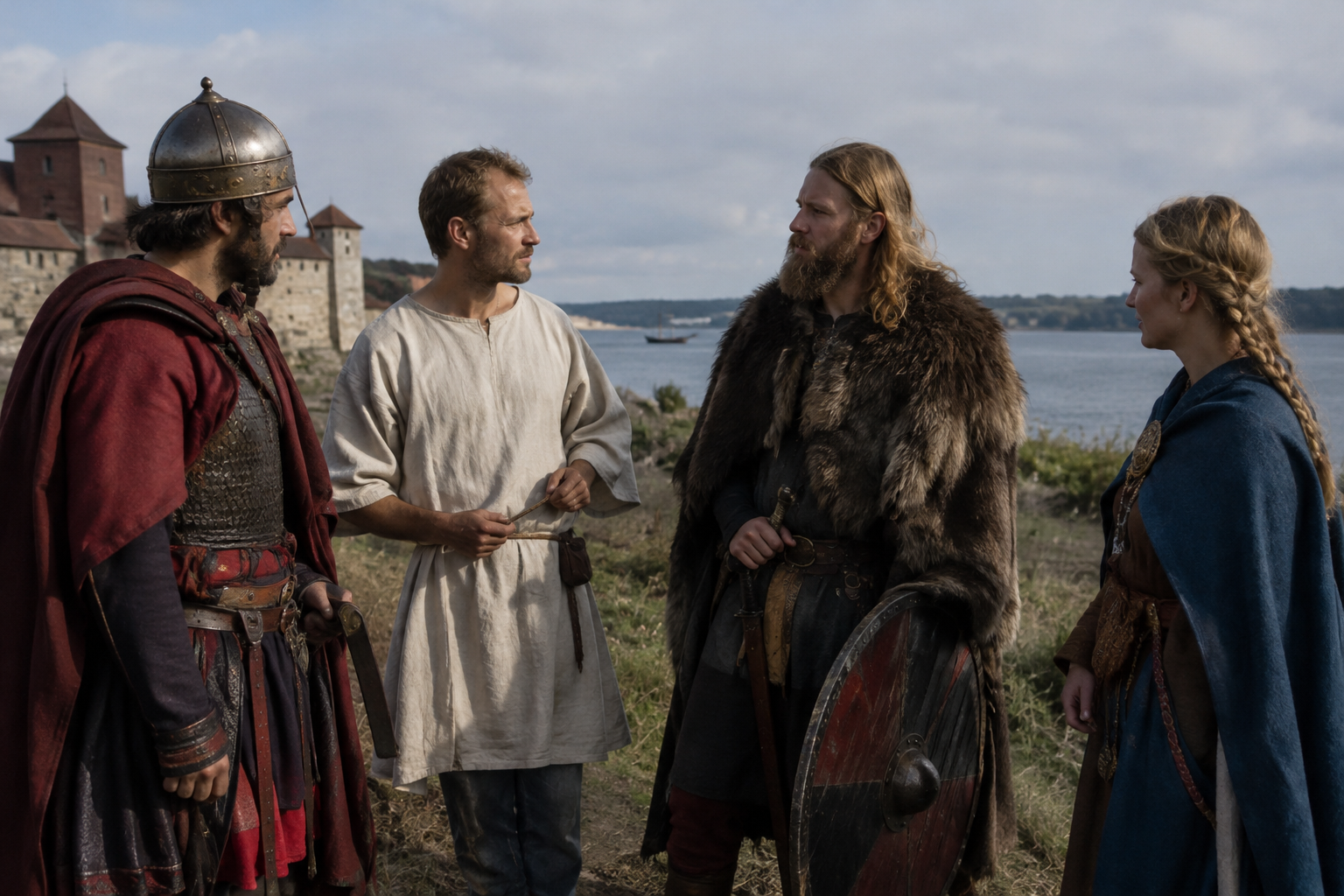
Some Y-chromosome lineages seem to sit quietly in the background of European history until ancient DNA gives them away. Haplogroup I1a1a1a1a is one of those cases: a very specific branch inside the wider I1 paternal family, showing up in finds from Viking Age Sweden, Roman-era Poland, and even late medieval Serbia. That spread is historically interesting not because it proves one neat migration story, but because it refuses to be confined to one.
As always with Y-DNA, a caution is essential. A haplogroup traces only one direct paternal line - father to father to father - and not a person's whole ancestry. A man with I1a1a1a1a could have had ancestors from many different regions and populations through all his other lines. Even so, these paternal markers are remarkably useful for tracking how male lineages moved, survived, and sometimes reappeared in very different historical settings.
The broader haplogroup I1 is most strongly associated in ancient and modern discussions with northern Europe, especially Scandinavia. That does not mean every downstream branch has exactly the same story, nor that every ancient carrier belonged to a recognisable "Scandinavian people" in the way modern readers might imagine. But it does give us a sensible starting point: I1a1a1a1a belongs within a paternal family with deep importance in the history of northern Europe.
What makes this narrower branch so interesting is the way ancient samples place it in several different historical worlds. Instead of a single frozen ethnic label, we see movement around the Baltic, appearance in Roman-period frontier zones, and survival into the later medieval Balkans. In other words, this is not just a "Viking" marker, even if Viking Age finds are among the clearest clues we have.
For readers interested in the bigger archaeological picture of how ancient DNA changed this field, MyTrueAncestry's article on archaeogenetics is a useful companion.
The most immediately suggestive evidence for I1a1a1a1a comes from Viking Age Sweden. Two supplied individuals stand out: VK380, from Viking Age Oland Sweden dated to 1000 AD, and VK50, from Viking Age Gotland Kopparsvik Sweden dated to 975 AD. These are not abstract data points. They come from islands that were central to Baltic travel, trade, and cultural contact.
Gotland in particular was no backwater. It was a nodal point in the Viking Age world, tied into exchange networks stretching across the Baltic and far beyond. Oland too sat in a strategic maritime position. A paternal lineage found in both places suggests that this branch was present in communities deeply involved in seafaring northern Europe.
But here one must be careful. Finding I1a1a1a1a in Viking Age Sweden does not prove that the branch originated there, nor that all later carriers descend from Viking raiders, merchants, or settlers. What it does show is that by the late 10th and early 11th centuries, this paternal line was part of the social world of Baltic Scandinavia.
If you want to follow that Scandinavian setting further, the community article on Viking Age genetics opens up the wider context.
Then the story becomes more complicated - which is to say, more interesting. The sample R10636, from Roman Era Weklice Poland dated to 300 AD, places this haplogroup in a very different setting. Roman-era Poland was outside the empire proper, yet hardly isolated from it. This was a world of frontier contact, local communities, shifting alliances, and long-distance mobility through the Baltic and central European corridors.
A paternal line related to I1a1a1a1a appearing there fits well with what archaeologists and geneticists increasingly see in northern and central Europe: movement without neat borders. Trade, marriage, military service, migration, and community formation all carried lineages across zones that Roman authors tried to sort into tidy categories but real life kept scrambling.
The later appearance of R3906 from Late Medieval Sirmium Serbia, dated 1556 AD, extends that geographical range into the Balkans. Sirmium, with its long Roman and post-Roman history, had been a major urban centre for centuries. By the 16th century it stood in a region shaped by medieval kingdoms, imperial contest, and population change. This sample does not prove an unbroken paternal chain from Viking Sweden to Serbia, of course. But it does show that the lineage, or a closely related paternal branch, was present far south of its usual northern associations.
That Balkan dimension is worth setting beside broader regional studies of deep continuity and later admixture.
Taken together, R10636, VK380, VK50, and R3906 do not give us a simple arrow on a map. They suggest something subtler: a paternal branch with clear visibility in the north, but with mobility into the Baltic world, central European contact zones, and later southeastern Europe.
This is precisely where ancient DNA is so useful. Traditional genealogy usually runs out long before the Viking Age, and written history often notices elites more than ordinary men. Y-DNA, especially when matched with excavated individuals, gives us another way into the problem. It shows that paternal lines can persist through radical political change: Roman frontiers fall, Viking trade systems rise, medieval lordships form, and yet certain male lines continue, sometimes in unexpected places.
Readers interested in the Polish and wider east-central European side of this world may also enjoy the article on the turbulent cemeteries of southwest Poland, where Huns, Goths, and local communities complicate every easy label.
The supplied noble connection brings us to medieval England and the House of Malet, associated here with Eye Castle in Suffolk. Eye Castle began as a Norman motte and bailey soon after 1066, probably built by William Malet. Its purpose was practical and political at once: to control the surrounding district and guard routes through the Waveney valley. That is what Norman conquest looked like on the ground - earth, timber, command, and visibility.
Later the site was strengthened, and in the 13th century a stone shell keep was added to the mound. Across the Middle Ages it served as the centre of the Honour of Eye. Not a vast royal fortress, then, but something in many ways more revealing: a local statement of lordship, administration, and entrenched authority. In later centuries the castle declined, with parts adapted as a courthouse and prison while the medieval defences decayed into ruin.
Why place a Norman castle in an article about I1a1a1a1a? Not because the castle proves the haplogroup, and not because one should lazily assume a Norman family carried a particular Y-line simply from association. Rather, Eye Castle gives us a later historical landscape in which paternal ancestry, lordship, and memory intersect. The Norman elite who seized and reorganised England entered a land already shaped by earlier waves of migration from the North Sea world, including populations among whom broader I1 lineages are historically relevant. Genetics and castles do different jobs, but together they remind us that medieval society was built on layer after layer of older population history.
For more on this family itself, the MyTrueAncestry community has a dedicated piece on the Malets.
What makes haplogroup I1a1a1a1a compelling is not a fantasy of tracing one heroic bloodline unchanged from a Viking ship to a Norman castle. History is far messier than that, and genetics is more interesting for it. This branch appears in Viking Age Swedish island communities, in Roman-era Poland, and in late medieval Serbia. That pattern points to endurance, movement, and the stubborn refusal of real populations to stay in the categories later ages invent for them.
So if this haplogroup appears in your own Y-DNA results, the right conclusion is not "I am descended from a Viking chieftain" or "I belong to a noble house." The better conclusion is that your direct paternal line may connect to a strand of European history visible in ancient burials from the Baltic to the Balkans. Ancient DNA offers context, not a fairy tale. But it is very good context indeed.
Upload your DNA to MyTrueAncestry and explore whether your paternal ancestry shows connections to ancient individuals like VK380, VK50, R10636, or R3906. These matches do not prove direct descent from any one excavated person or noble family, but they can place your lineage inside the real human history uncovered by archaeology.






Comments