Haplogroup I1

– 6 min read


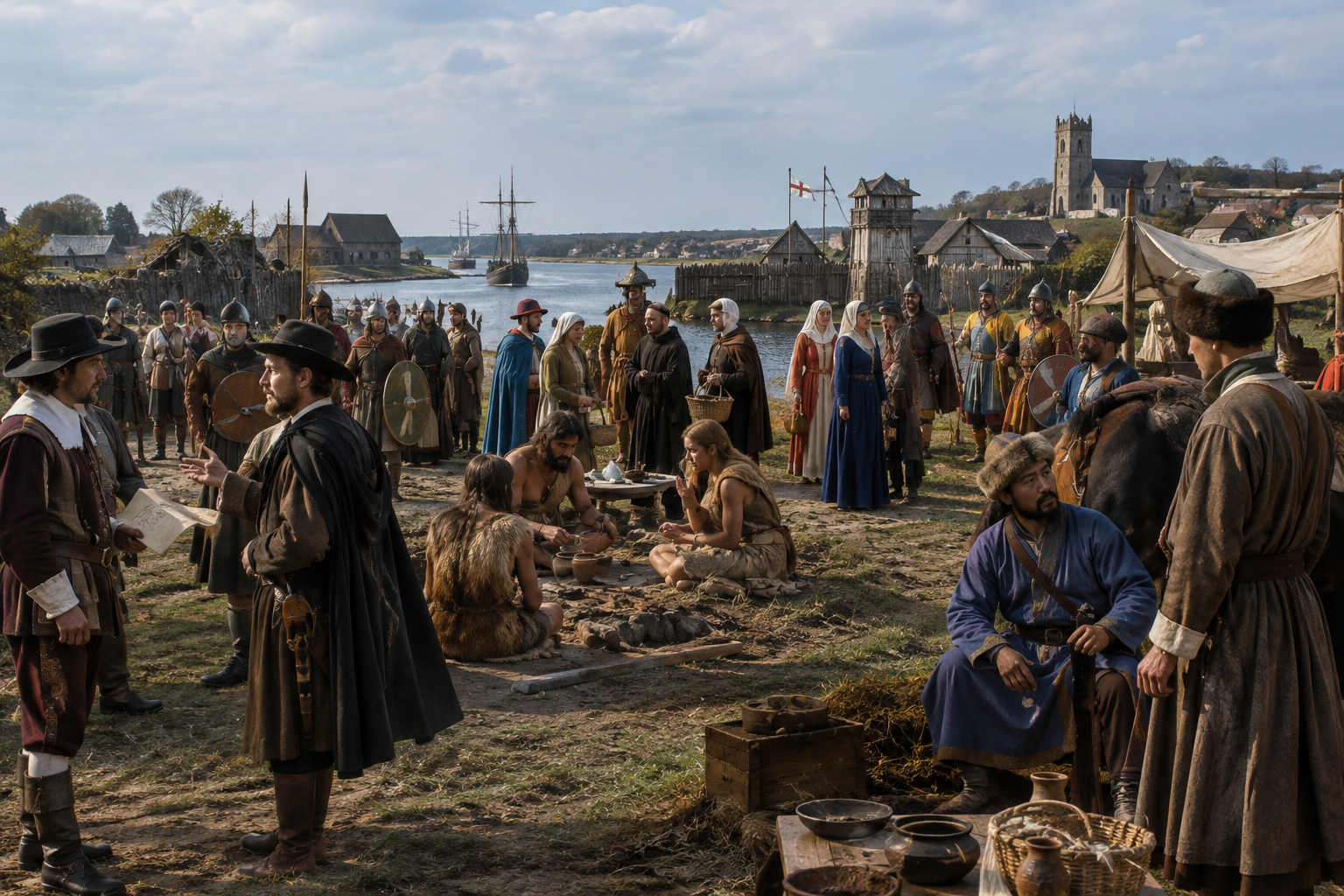
Haplogroup I1 has one of those histories that makes ancient DNA so irresistible. It appears again and again in the archaeology of northern Europe, especially around Scandinavia and the wider North Sea world, and then turns up later in places shaped by Viking travel, medieval kingdoms, and early modern expansion overseas. In other words, I1 is not merely a label on a Y-chromosome tree. It is a paternal lineage that helps us ask how men moved, settled, married, ruled, fought, traded, and occasionally ended up in graves now opened by archaeologists.
As with all Y-DNA haplogroups, though, a note of caution is essential. I1 traces only one very narrow line of ancestry: the direct paternal line from father to son. It does not describe a person's whole ancestry, culture, language, or identity. Still, because Y-DNA can sometimes be tracked across long stretches of time, it offers an unusually sharp tool for studying continuity and migration. For I1, the broad picture long suggested by modern distributions has been strengthened by ancient DNA from Denmark, Sweden, Norway, England, Germany, Poland, and beyond.
I1 belongs within haplogroup I, one of the old European branches of the Y-chromosome tree. The particular story of I1, however, is usually associated with northern Europe and especially Scandinavia. The most responsible way to put it is not that every early Scandinavian man belonged to I1, nor that I1 somehow equals "the Vikings" or "the Norse," but that ancient DNA shows this lineage becoming especially visible in the north over time.
The supplied samples show just how deep and complicated that northern story is. There are very early finds in Denmark and Sweden, including Ancient Denmark East Jutland Vaengese II Erteboelle, Year:4142 BC, ID:NEO3; Stone Age Denmark Sjaelland Jorlundegard, Year:3321 BC, ID:NEO702; Neolithic Denmark Saksild Rude East Jutland, Year:3581 BC, ID:NEO41; and Neolithic Denmark Saksild Rude East Jutland, Year:3442 BC, ID:NEO43. By the Bronze Age the lineage is still there in a recognisably Nordic setting: Nordic Bronze Age Sweden Falkoping 5, Year:2036 BC, ID:NEO220; Year:2018 BC, ID:NEO223; and Battleaxe Sweden Falkoping 5, Year:1750 BC, ID:NEO228. These are not the same family, of course, but together they suggest that paternal lines connected with I1 were established in southern Scandinavia long before the historical Viking Age.
That matters because it lets us move away from simplistic ideas that northern European identities suddenly appeared fully formed in the early Middle Ages. Ancient DNA instead shows long local histories, with continuity as well as change.
Explore Denmark's early DNA history
Once we get into the Iron Age and early medieval centuries, I1 becomes easier to place in historically familiar landscapes. The sample list includes Danii Tribe Denmark Sjaelland Kalundborg Simonsborg, Year:175 AD, ID:CGG106718; Danii Tribe Denmark Sjaelland Southwest Vemmelev Hemmeshoj, Year:275 AD, ID:CGG107400; Nordic Tribe Sjaelland Denmark Bredebjerggord 8, Year:350 AD, ID:CGG106822; and Pre-Vendel Sweden Oland Stoerlinge, Year:175 AD, ID:CGG024145. These finds are important because they bridge the world between prehistory and the named peoples of late antiquity.
Then come the Viking Age and post-Viking samples, which are especially vivid. Viking Age Trelleborg Kingdom of Denmark, Year:975 AD, ID:CGG106823 sits in the world of ring fortresses and royal consolidation. Viking Age Denmark Bogovej, Year:975 AD, ID:CGG106776 and Viking Age Bogovej Langeland Denmark, Year:900 AD, ID:VK367 place I1 in island Denmark. In Sweden, Viking Age Sigtuna Sweden, Year:935 AD, ID:urm035, Viking Age St. Gertrud Sigtuna Sweden, Year:1050 AD, ID:grt022, and Medieval Sigtuna Sweden, Year:1100 AD, ID:mbs082 show continuity across the transition from pagan-age networks into an urban Christian kingdom. Norway appears too in Viking Age Hedmark Norway, Year:950 AD, ID:VK420 and Viking Age Nordland Norway, Year:750 AD, ID:VK519.
This is the sort of evidence that makes I1 historically interesting. It is not just present in "Scandinavia" in the abstract; it appears in real places tied to early kingdoms, ports, churches, cemeteries, fortresses, and farms.
Of course, the story does not stop at the Kattegat. One of the pleasures of this dataset is seeing I1 in the wider world of migration and mobility. In England, there are early and later examples such as Roman Era England Northwest Cambridgeshire Eddington, Year:150 AD, ID:NWC010; Anglo Saxon Period Oakington England, Year:500 AD, ID:I0775; Saxon England North Yorkshire West Heslerton Vale of Pickering, Year:500 AD, ID:I11588; and a cluster from Cambridge St Johns Hospital including ATP_PSN_351, Year:1049 AD and ATP_PSN_344, Year:1250 AD. That spread hints at something historians already know well: the North Sea connected eastern England with the continental and Scandinavian worlds for centuries.
On the continent, the same paternal line appears in Early Medieval Merovingian Germany Lauchheim Mittelhofen, Year:700 AD, ID:G23; Thuringii Tribe Germany Obermoellern, Year:500 AD, ID:OBM052; Migration Period Liebenau Lower Saxony Germany, Year:550 AD, ID:LBU010; and Merovingian Grave North Rhine-Westphalia Germany Alt-Inden, Year:600 AD, ID:IND016. In Poland, Gothic Wielbark Poland Pommerania Gdansk, Year:200 AD, ID:PCA0488 and Gothic Tribe Poland Maslomecz Wielbark, Year:250 AD, ID:PL082 place I1 among populations often discussed in connection with the Gothic world, though one should be careful not to turn a haplogroup into an ethnic badge.
The same caution applies farther afield. Samples such as Avar Period Grave Austria Moedling-An der Goldenen Stiege Vienna Basin, Year:650 AD, ID:MGS004b, or Golden Horde Era Donetsk Hill Fort, Year:1350 AD, ID:UKR070, show that a paternal lineage with northern European associations could also appear in far more mixed and mobile settings. Ancient DNA is often at its most useful precisely when it reminds us that old frontiers were porous.
Read about Roman and early medieval Britain
If I1 is strongly associated with the Scandinavian world in broad historical terms, it is easy to see why later readers might think of northern royalty. But here we must tread carefully. A royal house, dynasty, or monarchy is a historical institution, not a genetic shorthand, and the presence of I1 in Scandinavian history does not prove that every king, prince, or nobleman belonged to it.
What we can say is that the palaces named in your material stand in regions where I1 has deep archaeological visibility. Stockholm Palace, in the heart of Gamla Stan, occupies the site of the medieval Tre Kronor castle, destroyed largely by fire in 1697 before the present baroque palace rose under Nicodemus Tessin the Younger in the eighteenth century. It is more than a residence. It is a statement of Swedish monarchy layered over older medieval power, in a country where samples such as fjk545 from Viking Age Fjalkinge, grt060 from Viking Age St. Gertrud Sigtuna, and A017-003 from Viking Age Sweden Oestergotland St Martins Church Skaenninge, Year:1005 AD, keep the earlier human landscape firmly in view.
In Norway, the Royal Palace in Oslo belongs to a much later political chapter, built in the first half of the nineteenth century and completed in 1849 under King Oscar I. Yet it stands as the ceremonial heart of a kingdom whose earlier paternal history is glimpsed in finds like VK420 from Hedmark and VK519 from Nordland. Likewise in Denmark, Christiansborg Palace on Slotsholmen is practically an architectural essay on repeated rebuilding after disaster. Beneath the present structure lie ruins from earlier castles and earlier regimes. That feels almost like a metaphor for haplogroups themselves: not a single frozen identity, but layers of continuity, replacement, adaptation, and memory.
Explore the Royal House of Bernadotte
The later samples are a useful reminder that paternal lineages do not remain politely in one region. I1 appears in Historic St. Mary City Chapel Field Cemetery Maryland, Year:1634 AD, ID:I15284, and in early colonial Virginia with Captain William West Jamestown Colony of Virginia, Year:1610 AD, ID:I4652, and Sir Ferdinando Wainman Jamestown Colony of Virginia, Year:1610 AD, ID:I2096. These are not "Vikings in America" in any simplistic sense. They are early modern English colonial men whose paternal ancestry, somewhere back along the line, belonged to a branch with a long record in northern Europe.
That is one of the best lessons of haplogroup I1. It links prehistoric Denmark, Bronze Age Sweden, Anglo-Saxon England, Viking ports, medieval Scandinavian churchyards, and colonial settlements across the Atlantic - not by proving direct descent between named individuals, but by showing how one paternal lineage can persist through very different societies.
For people who carry I1 today, the attraction is obvious. Here is a haplogroup that appears in some of the most intensively studied ancient DNA landscapes in Europe, especially around Scandinavia and the North Sea. It offers meaningful context for paternal ancestry and for the movement of men across centuries of farming, seafaring, kingdom-building, and migration.
But the limits are just as important. Sharing I1 with an ancient Scandinavian, a medieval Swede, or a colonial Englishman does not mean you are directly descended from that person, nor does it make you a member of any royal house. What it does provide is a historically grounded framework: a way to place your direct paternal line inside the longer human story revealed by archaeology, genetics, and written history together.
If you want to see how your own DNA compares with ancient individuals such as NEO220 from Bronze Age Sweden, CGG106823 from Viking Age Denmark, or grt022 from Viking Age Sigtuna, MyTrueAncestry can help you explore those links. The results may not prove a specific genealogical connection, but they can open a remarkably concrete window onto the worlds your distant ancestors inhabited.






Comments