Haplogroup H2b1

– 4 min read


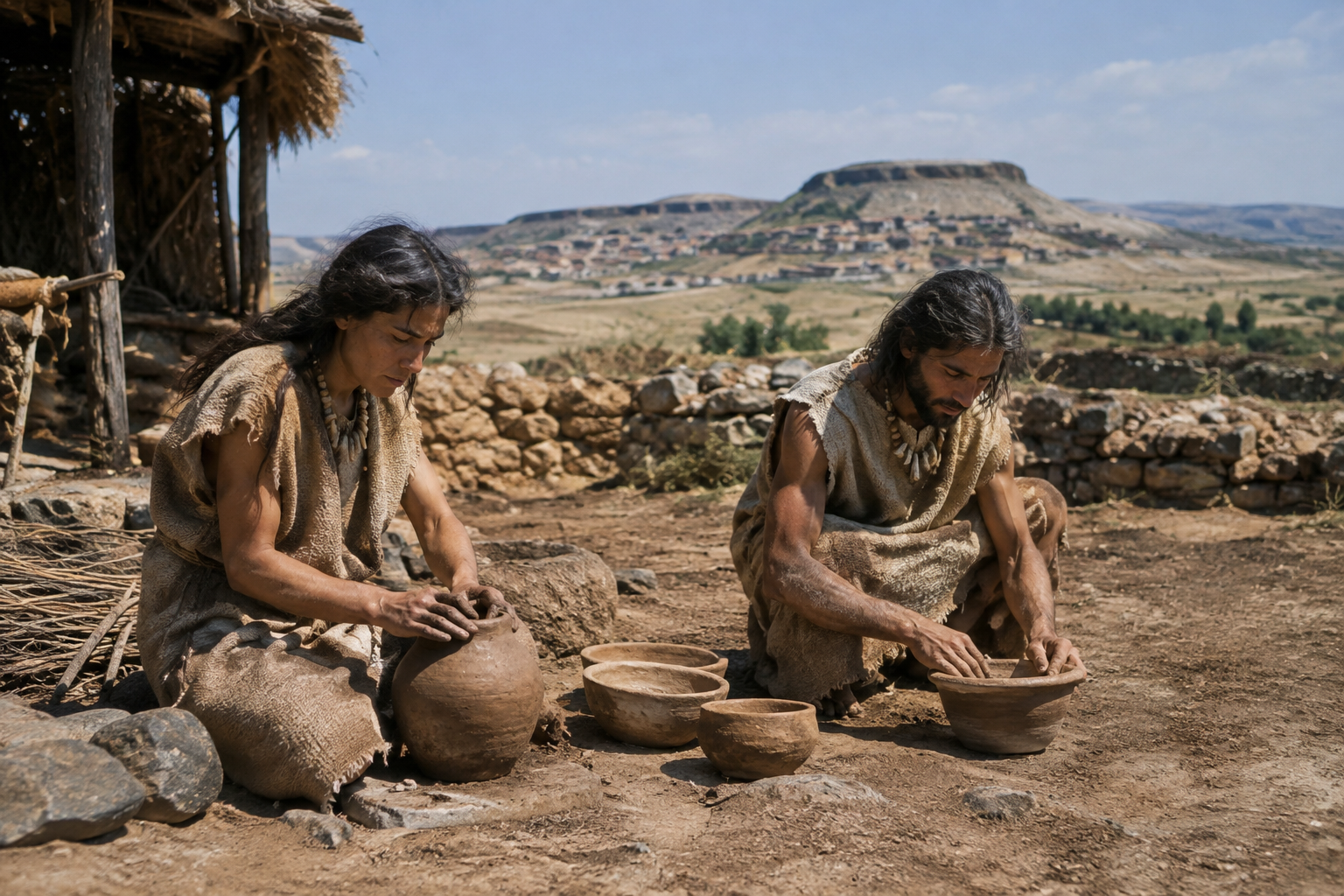
At Arslantepe in eastern Anatolia, two very early male samples associated with Y-DNA haplogroup H2b1 appear more than four centuries apart: ART042, dated around 5014 BC, and ART032, dated around 4568 BC. That is a modest little cluster on paper, but archaeologically it is rather striking. Arslantepe is one of those sites where the long transition from village farming to more complex social worlds can actually be watched layer by layer, and these two paternal lineages place H2b1 within that deep Neolithic setting.
For anyone exploring this branch today, the important point is that H2b1 is not being glimpsed here in a warrior grave, a medieval dynasty, or some dramatic migration-period burial. Instead, it turns up in early farming Anatolia, among communities living thousands of years before bronze weapons, kingship, or written archives dominated the historical stage. That makes this lineage valuable precisely because it belongs to the quieter but more consequential revolution of settled life.
Arslantepe, near modern Malatya, is best known for its later importance in the Chalcolithic and Early Bronze Age, when the mound became famous for evidence of administration, inequality, and some of the earliest state-like institutions in the region. But the H2b1 story here belongs to an earlier horizon. In the late 6th and early 5th millennium BC, the site was still part of the wider world of Neolithic and post-Neolithic farming communities of Anatolia.
That matters because Y-DNA traces only one direct paternal line, not a person's whole ancestry, yet paternal lines can still reveal something about continuity and local population structure. Two males from the same broad site, separated by centuries, suggest that this branch was not a one-off arrival preserved by luck. It was present at Arslantepe across time, embedded in the male ancestry of an early settled population.
An ancient DNA study of Anatolia and its neighboring regions, published in research on ancient West Asian populations, helped place sites like Arslantepe into a much bigger picture: the farming societies of Anatolia were not merely local curiosities, but central players in the demographic history of western Eurasia.
The sample IDs are worth keeping distinct. ART042, dated to around 5014 BC, is the earlier of the two. ART032, dated to around 4568 BC, shows the same reported H2b1 association several centuries later. With only these two individuals, caution is essential: they do not prove that every male at Arslantepe belonged to this lineage, nor do they map the full internal diversity of the settlement.
But they do tell us something concrete. H2b1 was present in Neolithic Anatolia in a place that would later become one of the most discussed archaeological mounds of Upper Mesopotamia's fringe. The repeated appearance of the branch at a single site gives it a firmer archaeological foothold than a single isolated burial would.
Just as importantly, the samples come from a period when farming, household continuity, and regional interaction mattered more than later ethnic labels. It would be quite wrong to project later kingdoms, language groups, or historical peoples backward onto these men. Their world was one of early agrarian communities in Anatolia, not the named states and empires of much later history.
H2b1 is a sub-branch of the broader haplogroup H2, a lineage repeatedly associated in ancient DNA research with early Neolithic contexts in western Eurasia. That broad pattern is useful background, but the narrower label matters here. One should not automatically assign to H2b1 every claim ever made about H2 as a whole. The safe statement is the simpler one: the supplied ancient evidence places H2b1, or individuals reported in association with it, in Neolithic Arslantepe.
This fits neatly with a larger archaeological truth. Some paternal lineages that appear rarely in later populations can nevertheless have been quite at home in the early farming world. Ancient DNA keeps reminding us that today's frequency maps are not straightforward guides to the Neolithic past. Many early farmer lineages were later reduced, absorbed, or displaced as the population history of Eurasia grew more complicated.
Arslantepe sits in a region that was never isolated. Eastern Anatolia linked the Anatolian plateau, the Upper Euphrates, the South Caucasus, and northern Mesopotamia. Even in prehistory, this was a zone of movement in crops, animals, technologies, and people. So when a paternal lineage like H2b1 appears here, the setting is significant: not because it proves a single migration event, but because it places the lineage in a region where local continuity and broader contact met.
The site's long occupation is especially useful for historical imagination. One can say, without embroidery, that men carrying this paternal line lived in a place that would later participate in much larger transformations of society. The H2b1 evidence belongs to the earlier chapters of that mound's history, when farming communities were laying down the demographic foundations on which later complexity would be built.
That is one of the pleasures of archaeology. A famous site often acquires its reputation from one spectacular period, yet its older layers may preserve the more important human story. Before Arslantepe became known for elite buildings and administrative power, it was already home to families whose paternal ancestry reached into the Neolithic world.
For many MyTrueAncestry users, the instinct is to look first for Iron Age tribes, medieval nobles, or historically named peoples. Perfectly understandable. But a haplogroup like H2b1 asks for a longer view. Its interest lies in the possibility that a paternal line can connect back to the first agricultural societies that reshaped western Eurasia.
That reshaping was enormous. The spread of farming altered settlement, diet, kinship, land use, and eventually population size on a continental scale. If a branch appears in Neolithic Anatolia, it belongs near the beginning of that process rather than at its flamboyant end. In that sense, H2b1 is historically modest but foundational.
Arslantepe also helps correct a common misconception: ancient ancestry is not always about sudden invasions or dramatic replacements. Sometimes the revealing pattern is persistence at one place over generations. ART042 and ART032 do not give us a dynasty, but they do give us temporal depth.
The strongest evidence here is clear and specific: H2b1 is represented by two ancient males from Neolithic Arslantepe, ART042 around 5014 BC and ART032 around 4568 BC. That places this paternal branch in early farming Anatolia, at a site of genuine archaeological importance and across a span of several centuries. It does not hand you a named tribe or a noble pedigree, but in some ways it offers something older and more substantial: a plausible link to the male lineages present in the settled agricultural communities that helped shape the later history of western Eurasia.






Comments