Haplogroup G2a2b1d

– 6 min read


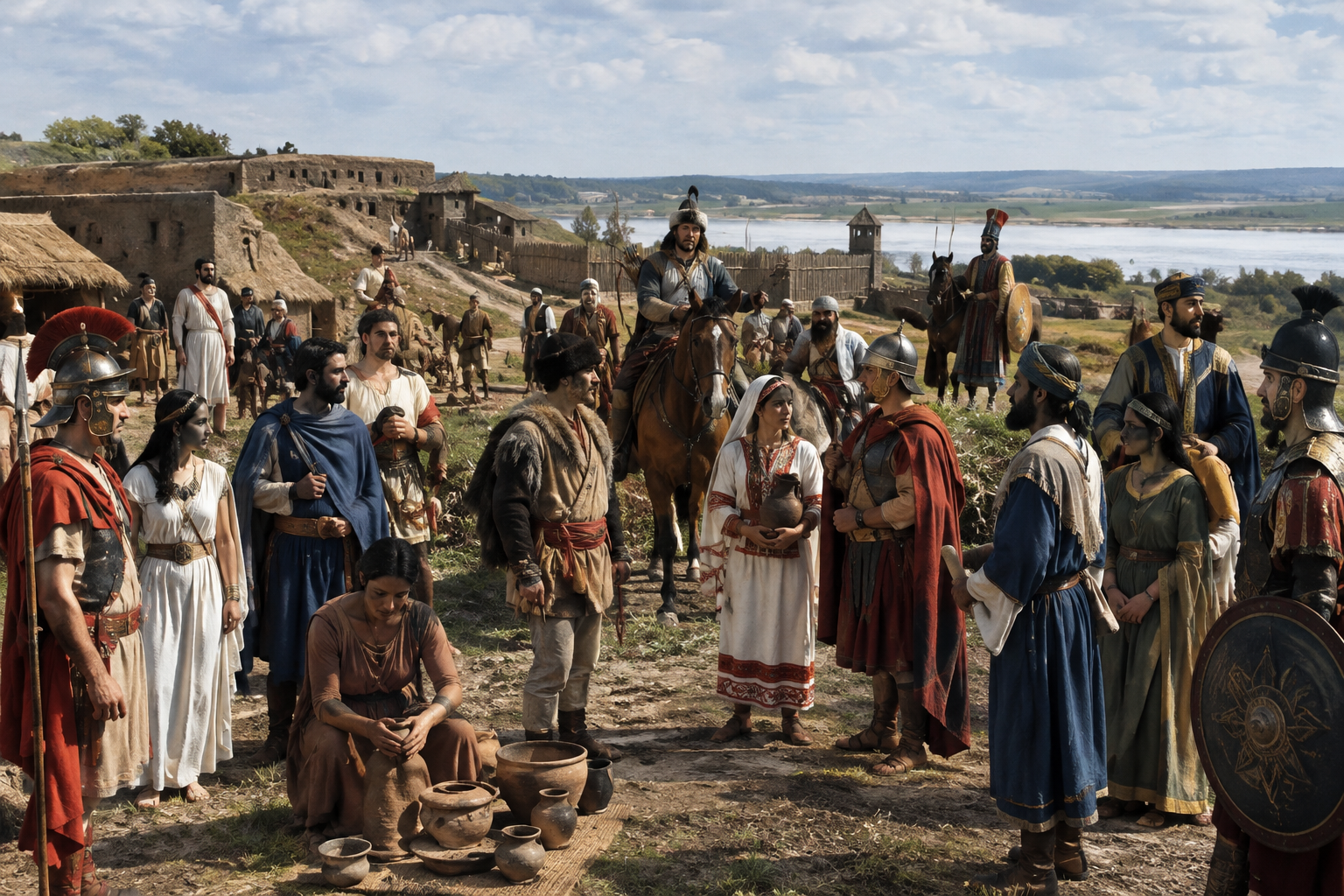
Some Y-DNA haplogroups announce themselves with the noise of famous empires or heavily studied royal houses. Haplogroup G2a2b1d is more interesting in a quieter way. It appears not as the badge of a single people, but as a recurring paternal line across an unexpectedly wide historical stage: Neolithic Anatolia, Bronze Age southeastern Europe, Iron Age and classical Mediterranean worlds, Roman frontier provinces, post-Roman Pannonia, and even later medieval Anatolia. That is precisely what makes it worth attention. It is the sort of lineage that reminds us that history is rarely tidy.
As always, a caution first. A Y-DNA haplogroup traces only one direct paternal line: father to father to father. It does not describe a person's whole ancestry, culture, language, or identity. Nor does sharing a haplogroup prove close kinship between people separated by centuries. But when a lineage keeps turning up in ancient graves from different periods, it gives us a valuable thread for following male-line continuity, movement, and survival across changing worlds.
G2 is widely known in ancient DNA research as one of the important Y-chromosome groups associated with early farming populations in western Eurasia. For the narrower branch G2a2b1d, the safest approach is not to force the whole story of broad G2 onto this specific subclade, but to notice that the supplied evidence fits a pattern stretching deep into the Neolithic and then continuing through later historical landscapes.
One early anchor is ART014, from Neolithic Anatolia Arslantepe, dated 4568 BC. Another comes from the Black Sea zone of Anatolia, IKI037 and IKI019 from Ikiztepe, both dated 3300 BC. These are important because they place this paternal branch, or a very close related line within the same genetic neighborhood, in Anatolia very early indeed. That does not prove an Anatolian "origin" for the exact subclade in some simplistic sense, but it does show that this lineage was present among populations living in regions crucial to the spread of farming, metallurgy, and long-distance exchange.
From there the trail moves west and north. HBS004, from Neolithic France dated 4300 BC, and YUN015 from Early Bronze Age Bulgaria Yunatsite dated 3120 BC, suggest that male lines of this type were not confined to Anatolia. By the Bronze Age and after, they were part of a much broader European and eastern Mediterranean story.
Explore the Neolithic Expansion
What makes this dataset especially striking is not one dramatic burial, but the geographical spread. In Greece, I13428 from Illyrian Mycenaean Phokis Delphi Greece dated 1310 BC places the lineage in the Aegean world of the later Bronze Age. In eastern Anatolia, I19612 from Bronze Age Eastern Anatolia Van dated 800 BC shows it remaining in circulation far to the east. Then there is I21987 from Phoenician Era Tharros Italy Sardinia dated 500 BC, a reminder that the Mediterranean was full of sailors, settlers, traders, and mixed communities long before Rome knitted the sea into an imperial system.
And then, wonderfully, the trail leaps even farther: I12293 from Greco-Bactrian Tajikistan dated 50 BC. One must be careful here. A single sample from Central Asia does not make G2a2b1d a "Greco-Bactrian haplogroup." But it does show that paternal lines from this wider network could appear in Hellenistic and post-Hellenistic worlds far beyond the Mediterranean core. Ancient empires did not just move ideas and pottery. They moved people.
Roman-era evidence continues that picture of mobility. DUX006 from Roman Era Cambridgeshire Duxford dated 112 AD places the lineage in Roman Britain. BBC022 from Imperial Roman Croatia Karlovac Pannonia Savia dated 275 AD and GYS037 from Late Roman Pannonia Arrabona Szechenyi Square Hungary dated 425 AD place it in the Danubian provinces, one of the great military and demographic crossroads of late antiquity.
If there is one region in the sample list that deserves special attention, it is Pannonia and the wider Carpathian Basin. The collapse of Roman administration did not empty the landscape. It changed who ruled, who arrived, who stayed, and who adapted. In that context, G2a2b1d appears again and again.
We see SZL056 from Post Roman Period Pannonia Savaria Szeleste Barbaricum Hungary dated 525 AD, MFC019 from Post Roman Period Pannonia Arrabona Menfocsanak Barbaricum Hungary dated 550 AD, and RKF255 from Migration Period Roman Hungary Rakoczifalva Szolnok dated 500 AD. Then RKF258 from Migration Period Hungary Rakoczifalva dated 650 AD carries the line further into the early medieval period. Even K2per33_GE, listed as Hungarian Conqueror Karos II Outlier dated 900 AD, hints at the way older local and incoming populations overlapped in the centuries around the Magyar conquest.
This is not proof of one uninterrupted father-to-son line across all these graves. It is something more historically useful: evidence that related paternal branches persisted in a region famous for migration, imperial retreat, frontier warfare, and cultural blending. One might say that Pannonia was not a corridor through which people simply passed. It was also a place where lineages settled in, survived shocks, and reappeared under new political labels.
The latest sample in the set, I14647 from Medieval Era Southeast Anatolia Gaziantep dated 1200 AD, is a useful corrective to the lazy habit of treating ancient DNA as though all the interesting action happened in prehistory. This paternal line was still present in the medieval Near East, in a region shaped by Byzantine, Armenian, Islamic, Crusader, and Turkic political worlds. That is the point: lineages survive regime changes remarkably well.
There is also NS3b, listed simply as a Byzantine Roman Warrior dated 605 AD. Even without a fuller site description, the label captures a wider truth. The late Roman and Byzantine worlds were not ethnically sealed containers. Soldiers, farmers, merchants, and settlers moved through them constantly. A haplogroup like G2a2b1d is interesting precisely because it turns up in settings where identities were historical and local, not reducible to modern categories.
Readers interested in how such evidence complicates neat ethnic storytelling may enjoy the broader discussion in Ancient DNA and the Rise of Archaeogenetics, which shows how genetics has changed the way we approach the past without making written history disappear.
What, then, do we do with a lineage like this when we arrive in Ireland and at Clan French in Frenchpark? The sensible answer is: we proceed with interest and restraint. The supplied historical material does not prove that every branch of the French family carried G2a2b1d, nor does it establish a direct genetic bridge from any ancient sample to the family. But Frenchpark offers a fine example of how paternal-line history, local power, and remembered landscape intersect.
Frenchpark, in north County Roscommon in Connacht, stands on land whose history began long before the French family lent it their name. This was part of the medieval kingdom of Moylurg, associated with the MacDermots, and later passed through Norman and Tudor upheavals into the age of landed estates. By the seventeenth century the French family had become major local landlords and built French Park House, making the district an estate center in a countryside already marked by older Gaelic authority.
That is worth lingering over. A place-name that sounds neat on a map is in fact a palimpsest: Gaelic kingship, conquest, landlordism, rents, administration, famine, emigration. The family seat does not prove a haplogroup, but it does preserve historical memory. Castles, manor houses, and baronies are not genetic documents; they are social ones. They show where power settled, not which SNP a dynasty carried.
The most responsible way to read G2a2b1d is as a paternal line with deep roots in the ancient Near East and southeastern Europe, and with later appearances across the Mediterranean, Roman provinces, and post-Roman frontier societies. The samples here show breadth rather than exclusivity. They suggest continuity in some places, mobility in others, and above all a refusal of simple labels.
So if you carry this haplogroup, what can you say? You can say that your direct paternal line belongs to a branch seen in ancient individuals from places as varied as Arslantepe, Yunatsite, Delphi, Sardinia, Roman Britain, Pannonia, and medieval Gaziantep. You cannot say, on that basis alone, that you are descended from Phoenicians, Mycenaeans, Byzantines, or the French family of Frenchpark. Ancient DNA gives context, not instant pedigree.
That, in the end, is the fascination. Genetics does not flatten history into slogans. It restores complication. A single paternal lineage can move from early farming societies to imperial garrisons, from frontier cemeteries to medieval estates remembered in later records. And that is a much more interesting story than any tidy myth of one people, one place, or one uninterrupted dynasty.
If you want to explore how your own DNA may connect with ancient individuals and historical populations, MyTrueAncestry can help you compare your results with archaeological samples across the ancient world. Those matches can offer remarkable clues about deep ancestry, even when they do not prove direct descent from a particular ancient person or noble family.






Comments